
[论文解读] Fast quantum algorithm for differential equations
该论文提出了一种快速量子算法,用于求解一大类非齐次偏微分方程(PDEs),其复杂度在系统规模 $N$ 上为多对数级,并且与条件数 $κ$ 无关。通过使用小波基作为坐标系,该方法实现了对角预条件器,能统一有界条件数,从而通过量子奇异值变换(QSVT)实现子线性缩放的高效量子线性系统求解。关键贡献在于,该量子算法对病态 PDE 实现了相对于经典方法的指数加速。
Partial differential equations (PDEs) are ubiquitous in science and engineering. Prior quantum algorithms for solving the system of linear algebraic equations obtained from discretizing a PDE have a computational complexity that scales at least linearly with the condition number $κ$ of the matrices involved in the computation. For many practical applications, $κ$ scales polynomially with the size $N$ of the matrices, rendering a polynomial complexity in $N$ for these algorithms. Here we present a quantum algorithm with a complexity that is polylogarithmic in $N$ but is independent of $κ$ for a large class of PDEs. Our algorithm generates a quantum state from which features of the solution can be extracted. Central to our methodology is using a wavelet basis as an auxiliary system of coordinates in which the condition number of associated matrices becomes independent of $N$ by a simple diagonal preconditioner. We present numerical simulations showing the effect of the wavelet preconditioner for several differential equations. Our work could provide a practical way to boost the performance of quantum simulation algorithms where standard methods are used for discretization.
研究动机与目标
- 为克服现有量子算法求解 PDE 时复杂度随条件数 $\kappa$ 线性增长的局限性,从而在病态系统中效率低下。
- 开发一种量子算法,实现在系统规模 $N$ 上为多对数复杂度且与 $\kappa$ 无关,从而为一大类 PDE 实现指数加速。
- 利用小波的数学特性,构建一个能统一有界离散化 PDE 矩阵条件数的预条件器,无论 $N$ 如何变化。
- 证明小波预条件化可实现高效量子矩阵求逆,即使对于非对称或变系数微分算子,也可通过量子奇异值变换(QSVT)实现。
提出的方法
- 该方法使用小波基作为离散化 PDE 的替代坐标系,将系统矩阵转换为条件数与 $N$ 无关的形式。
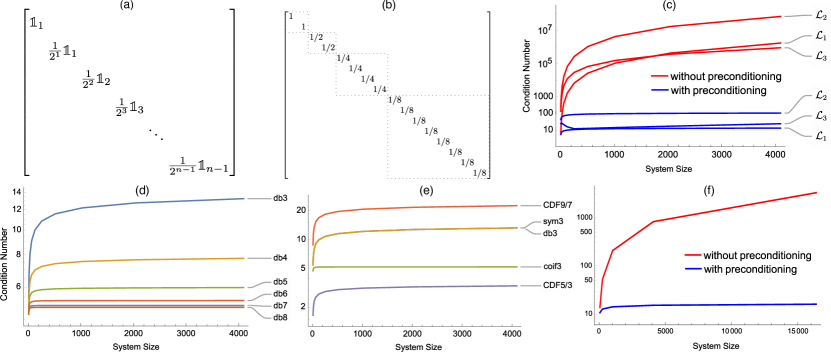
- 应用对角小波预条件器,该预条件器在不同矩阵规模下均保持条件数统一有界(例如,Haar 小波下为常数),从而有效稳定系统。
- 随后利用量子奇异值变换(QSVT)处理预条件化矩阵,通过矩阵求逆的多项式逼近实现高效的量子线性系统求解。
- 在远离零的区间上构造逆函数和阶跃函数的多项式逼近,确保在 $\varepsilon$ 误差范围内,同时保持有界算子范数。
- 使用复合多项式 $P_{\varepsilon/c,I_c}^{\textsc{mi}}(x)$ 近似 $1/(2cx)$,结合逆函数与阶跃函数逼近,实现 $\varepsilon/c$ 精度。
- 该方法适用于一大类 PDE,包括二阶和变系数微分算子,前提是小波预条件器能产生统一有界的条件数。
实验结果
研究问题
- RQ1是否存在一种量子算法,能够以在 $N$ 上为多对数复杂度且与 $\kappa$ 无关的方式求解一大类 PDE?
- RQ2小波预条件化是否能确保离散化 PDE 矩阵的条件数在系统规模 $N$ 变化时始终保持统一有界?
- RQ3是否可能通过 QSVT 与多项式逼近实现对病态 PDE 系统的高效量子矩阵求逆,即使 $\kappa$ 随 $N^2$ 增长?
- RQ4在小波坐标中使用结构化对角预条件器,是否能在保持与已知量子复杂度下限一致的前提下,实现 $\kappa$ 的次线性缩放?
主要发现
- 小波预条件器确保了离散化 PDE 矩阵的条件数保持统一有界(例如,Haar 小波下为常数),且与系统规模 $N$ 无关。
- 数值模拟证实,小波预条件器能有效降低算子 $\mathcal{L}_1 = d^2/dx^2$、$\mathcal{L}_2 = d^2/dx^2 - d/dx + 1$ 和 $\mathcal{L}_3 = -d/dx(\cosh(x/4)d/dx) + e^x$ 的条件数,且在 $N$ 增大时条件数仍保持有界。
- 该量子算法实现了在 $N$ 上为多对数复杂度且与 $\kappa$ 无关的计算复杂度,从而对病态 PDE 实现了相对于经典方法的指数加速。
- 该方法未违反已知的量子复杂度下限,因其仅适用于特定类别的 PDE——即‘可快速求解’的 PDE,类似于‘可快速前向’的哈密顿量。
- 通过使用 QSVT 与逆函数和阶跃函数的多项式逼近,可在量子计算机上实现准确且有界的矩阵求逆,误差控制在 $\varepsilon$ 范围内。
- 该算法适用于一大类非齐次 PDE,包括二阶和变系数微分算子,前提是小波预条件器能产生统一有界的条件数。

更好的研究,从现在开始
从阅读论文到最终审阅,大幅缩短您的研究时间。
无需绑定信用卡
本解读由 AI 生成,并经人工编辑审核。