
[论文解读] Features and Peculiarities of Gate-Voltage Modulation of Spin-Orbit Interaction in FeCoB Nanomagnets: Insights into the Physical Origins of the VCMA Effect
本研究揭示,在FeCoB/MgO/Ta纳米磁体中,栅压同时以相反极性的调控方式调节自旋-轨道相互作用强度与去磁化场,导致一种相互抵消效应,从而抑制了电压控制磁各向异性(VCMA)效应。研究结果表明,通过优化这两种相反贡献之间的平衡,可显著增强VCMA响应,为能效型自旋电子器件提供改进路径。
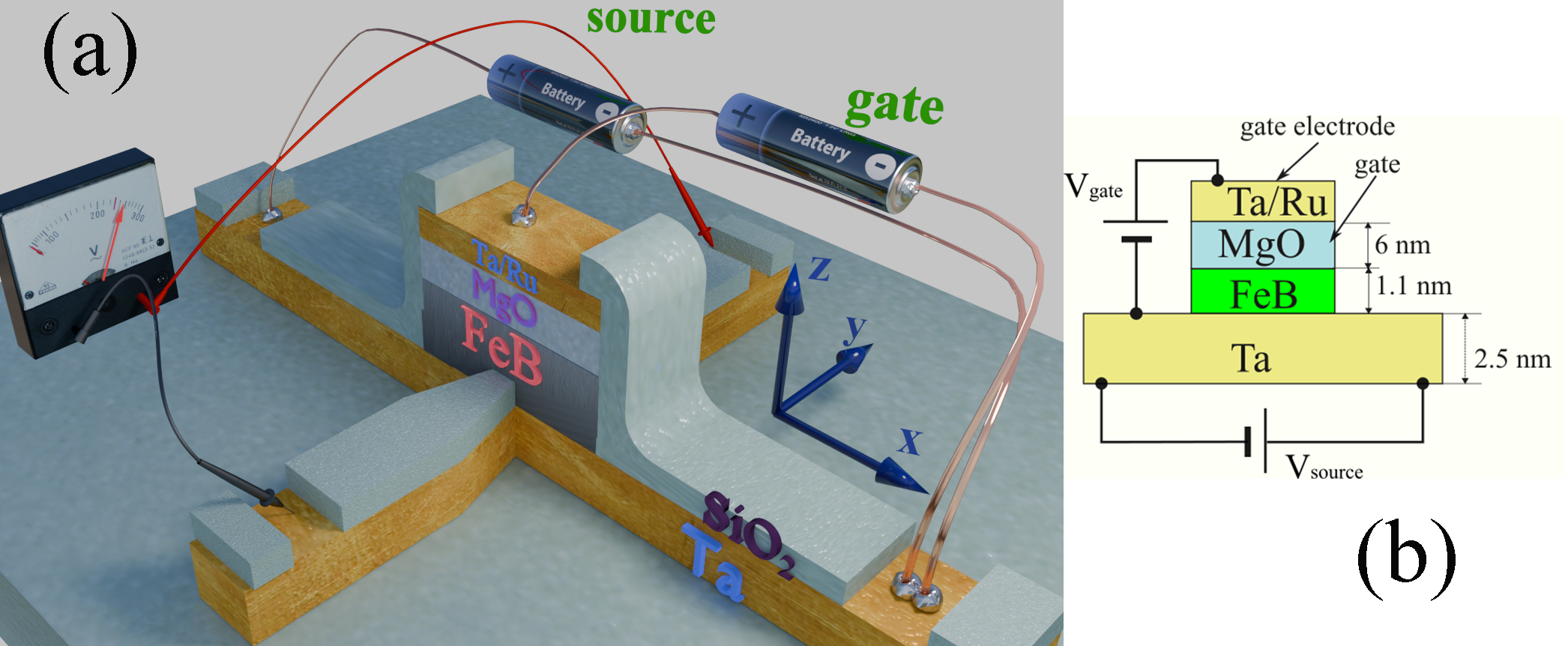
The paper investigates the systematic dependencies of the anisotropy field and the strength of spin-orbit (SO) interaction on gate voltage in Ta/FeB/MgO nanomagnets. Our findings reveal an intriguing opposite polarity in the gate-voltage dependencies of the anisotropy field and the coefficient of SO interaction across all studied nanomagnets. This opposite polarity indicates that the gate-voltage modulation of spin-orbit interaction is not the primary contributor to the voltage-controlled magnetic anisotropy (VCMA) effect. Instead, the gate-voltage modulation of magnetization emerges as the most probable candidate, given its polarity aligns with the observed modulation of anisotropy. The modulation of magnetic anisotropy is influenced by two major contributions of opposite polarities, which effectively counterbalance each other and reduce the overall VCMA effect. Optimizing the balance between these contributions could potentially lead to a substantial enhancement of the VCMA effect. Our measurements did not detect any modulation of the in-plane component of spin accumulation by the gate voltage.
研究动机与目标
- 系统研究栅压如何调控基于FeCoB的纳米磁体中的自旋-轨道相互作用与磁各向异性。
- 识别电压控制磁各向异性(VCMA)效应的物理起源,特别是界面自旋-轨道耦合与去磁化场的作用。
- 确定栅压是否影响自旋积累或其他界面电子性质,而不仅限于磁各向异性。
- 阐明自旋-轨道相互作用与去磁化场在塑造VCMA响应中的相互作用机制。
提出的方法
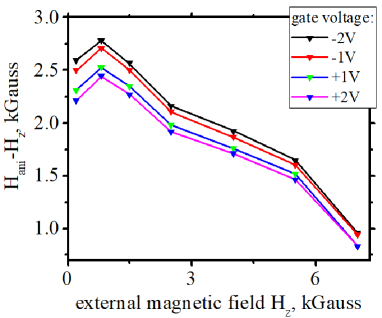
- 通过在$ H_{ani} - H_z $对$ H_z $的拟合中,利用$ H_{ani} $对平面内外磁场$ H_z $的线性依赖关系,提取系数$ k_{so} $来量化自旋-轨道相互作用的强度。
- 在Ta/FeB/MgO纳米磁体中,测量了栅电压变化下$ k_{so} $与本征各向异性场$ H^0_{ani} $的栅压依赖性。
- 通过测量电流方向平行与垂直于平面的磁化分量$ H_{||} $,探测自旋积累,重点检测栅压的调制效应。
- 实验装置实现了在不同栅压与电流偏置下,同时测量$ H_{ani} $、$ k_{so} $与$ H_{||} $。
- 理论分析将$ k_{so} $的变化与栅压引起的电场在FeB/MgO界面处轨道分布的改变联系起来。
- 由于$ H_{||} $未表现出栅压依赖性,因此排除了自旋积累或自旋霍尔效应贡献的显著调制。
实验结果
研究问题
- RQ1栅压如何影响FeB纳米磁体中自旋-轨道相互作用的强度,以$ k_{so} $量化?
- RQ2本征各向异性场$ H^0_{ani} $的栅压依赖性极性为何?其与$ k_{so} $的极性相比如何?
- RQ3去磁化场在VCMA效应中贡献多大程度?其是否受栅压调制?
- RQ4栅压是否影响通过$ H_{||} $检测到的自旋积累的平面分量?
- RQ5在栅压作用下,$ k_{so} $与$ H^0_{ani} $表现出相反极性的主导物理机制是什么?
主要发现
- 在所有研究的纳米磁体中,自旋-轨道相互作用系数$ k_{so} $与本征各向异性场$ H^0_{ani} $的栅压依赖性均表现出相反极性。
- 自旋-轨道相互作用强度与去磁化场均被栅压有效调制,且随栅压升高而增强。
- 这两种贡献的相反极性导致了相互抵消效应,从而降低了整体VCMA响应。
- 未观测到平面内磁化分量$ H_{||} $的显著栅压依赖性,表明栅压未显著调制自旋积累。
- 结果表明,栅压引起的界面轨道重分布是调控$ k_{so} $与去磁化场的关键机制。
- 通过优化这两种相反贡献之间的平衡,有望显著增强VCMA效应。
更好的研究,从现在开始
从阅读论文到最终审阅,大幅缩短您的研究时间。
无需绑定信用卡
本解读由 AI 生成,并经人工编辑审核。