
[论文解读] Fed-BioMed: Open, Transparent and Trusted Federated Learning for Real-world Healthcare Applications
Fed-BioMed 提供一个开放、透明且安全的联邦学习框架,专为现实世界的医疗研究而设计,强调治理、与生物医学数据标准的互操作性、研究者的互动性以及边缘节点的安全性。
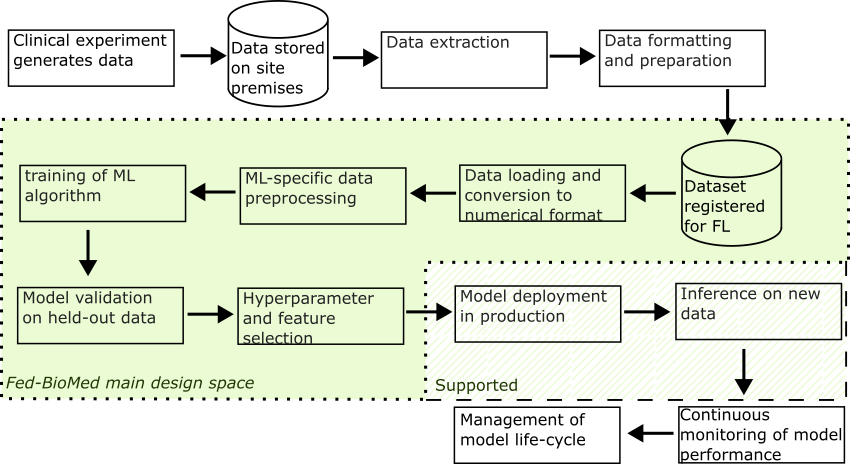
The real-world implementation of federated learning is complex and requires research and development actions at the crossroad between different domains ranging from data science, to software programming, networking, and security. While today several FL libraries are proposed to data scientists and users, most of these frameworks are not designed to find seamless application in medical use-cases, due to the specific challenges and requirements of working with medical data and hospital infrastructures. Moreover, governance, design principles, and security assumptions of these frameworks are generally not clearly illustrated, thus preventing the adoption in sensitive applications. Motivated by the current technological landscape of FL in healthcare, in this document we present Fed-BioMed: a research and development initiative aiming at translating federated learning (FL) into real-world medical research applications. We describe our design space, targeted users, domain constraints, and how these factors affect our current and future software architecture.
研究动机与目标
- Define a design space and guiding principles for applying FL to biomedical research and healthcare.
- Identify domain-specific requirements (data governance, interoperability, researcher interactivity, security) and map them to software architecture.
- Propose mechanisms (DataLoadingPlan, TrainingPlan, governance GUI) to simplify deployment across heterogeneous hospital infrastructures.
- Present a three-component architecture (network, researcher, nodes) and a governance-centric workflow for FL experiments in healthcare.
- Highlight how Fed-BioMed compares to existing FL frameworks in the biomedical domain and outline its production vs. research deployment considerations.
提出的方法
- Describe the design space, goals, and target user roles for Fed-BioMed in healthcare FL.
- Define primary, secondary, and minor requirements focusing on governance, interoperability, interactivity, and security.
- Propose architectural components (network, researcher, nodes) and data-driven TrainingPlan/Experiment constructs.
- Implement node-side governance features, including TrainingPlan approval and data loading customization via DataLoadingPlan.
- Provide researcher-facing Python SDK and Jupyter-friendly interfaces to configure experiments, with logging and checkpointing.
- Support data standard integration and heterogeneous edge infrastructures through containerization and dataset classes.
实验结果
研究问题
- RQ1What are the domain-specific requirements and design considerations for applying FL in healthcare and biomedicine?
- RQ2How can Fed-BioMed satisfy data governance, interoperability, researcher interactivity, and security needs in real-world hospital networks?
- RQ3What architectural choices and software mechanisms enable secure, interactive, and tamper-resistant federated training in biomedicine?
- RQ4How does Fed-BioMed compare with existing FL frameworks in terms of healthcare applicability and governance capabilities?
- RQ5What is the intended workflow for transitioning from research experiments to production deployment within Fed-BioMed?
主要发现
- Fed-BioMed articulates a four-tier requirement framework (primary, secondary, minor) to address governance, interoperability, interactivity, and security in biomedical FL.
- The architecture centers on three components—network, researcher, and nodes—to mediate secure and interactive federated training across heterogeneous hospital infrastructures.
- Introduces DataLoadingPlan and TrainingPlan concepts to harmonize data formats and model training while enabling node governance and security controls.
- Provides a Python SDK and Jupyter-friendly interfaces to support researchers and data providers, with features like plan approval and code hashing to mitigate substitution attacks.
- Compares Fed-BioMed’s design space with SubstraFL, OpenFL, Flare, and Flower, highlighting domain-focused capabilities such as governance, biomedical data integration, and interactive experimentation.
- Describes production versus research deployment considerations and emphasizes human-in-the-loop governance and secure, auditable workflows.

更好的研究,从现在开始
从论文设计到论文写作,大幅缩短您的研究时间。
无需绑定信用卡
本解读由 AI 生成,并经人工编辑审核。