
[论文解读] Federated Continual Learning via Knowledge Fusion: A Survey
本综述通过知识融合提出联邦持续学习(FCL),以解决去中心化、流式数据环境中的时空灾难性遗忘问题。它提出了两种通用框架——同步FCL与异步FCL,并根据知识融合机制对现有方法进行分类,为在异构客户端上持续学习的同时保留历史知识提供了统一视角。
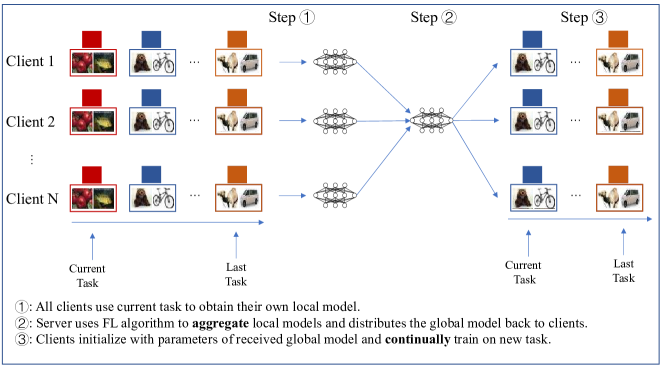
Data privacy and silos are nontrivial and greatly challenging in many real-world applications. Federated learning is a decentralized approach to training models across multiple local clients without the exchange of raw data from client devices to global servers. However, existing works focus on a static data environment and ignore continual learning from streaming data with incremental tasks. Federated Continual Learning (FCL) is an emerging paradigm to address model learning in both federated and continual learning environments. The key objective of FCL is to fuse heterogeneous knowledge from different clients and retain knowledge of previous tasks while learning on new ones. In this work, we delineate federated learning and continual learning first and then discuss their integration, i.e., FCL, and particular FCL via knowledge fusion. In summary, our motivations are four-fold: we (1) raise a fundamental problem called ''spatial-temporal catastrophic forgetting'' and evaluate its impact on the performance using a well-known method called federated averaging (FedAvg), (2) integrate most of the existing FCL methods into two generic frameworks, namely synchronous FCL and asynchronous FCL, (3) categorize a large number of methods according to the mechanism involved in knowledge fusion, and finally (4) showcase an outlook on the future work of FCL.
研究动机与目标
- 识别并形式化联邦持续学习(FCL)中时空灾难性遗忘的根本挑战,结合客户端的时间遗忘与全局聚合过程中的空间遗忘。
- 将现有FCL方法整合进两种通用系统框架中:同步FCL与异步FCL,以实现结构化分析与比较。
- 基于其知识融合机制对FCL方法进行分类,如参数蒸馏、回放机制与模型剪枝,以阐明设计原则。
- 对FCL中的开放挑战与未来研究方向提供全面展望,尤其关注合理协作、收敛效率以及与大模型的集成。
提出的方法
- 提出双重遗忘框架:客户端上的时间灾难性遗忘(在顺序任务学习过程中)与全局模型聚合期间的空间灾难性遗忘(在异构客户端之间)。
- 引入两种通用的FCL系统架构:同步FCL(集中式协调)与异步FCL(去中心化、事件驱动更新),以模拟不同的通信模式。
- 根据知识融合机制对FCL方法进行分类,包括知识蒸馏、经验回放、参数正则化与模型压缩,以突出设计多样性。
- 采用联邦平均(FedAvg)作为基线,通过实证评估时空遗忘对模型性能的影响。
- 分析FCL中的隐私与效率权衡,强调客户端参与中的通信效率与数据质量。
- 综述FCL在推荐系统、大语言模型(LLMs)及基于区块链的系统中的新兴应用,以证明其在现实世界中的可行性。

实验结果
研究问题
- RQ1在联邦持续学习中,时空灾难性遗忘如何产生,其对模型性能有何影响?
- RQ2同步与异步FCL框架在架构与操作上的关键差异是什么,它们如何影响知识融合?
- RQ3现有FCL方法如何通过知识融合机制减轻时间与空间遗忘?
- RQ4FCL中合理协作、收敛速度与数据质量方面的关键挑战是什么,它们如何影响模型效率与隐私?
- RQ5如何有效将FCL与大语言模型及其他新兴AI系统集成,以支持持续、隐私保护的学习?
主要发现
- 时空灾难性遗忘显著降低FCL中的模型性能,联邦平均(FedAvg)在聚合过程中因参数覆盖而对先前任务表现出显著遗忘。
- 将FCL方法整合进同步与异步框架中揭示了收敛速度、通信开销与遗忘缓解效果之间的显著权衡。
- 知识融合机制如知识蒸馏与经验回放能有效减少遗忘,但其性能在非独立同分布(non-IID)数据与动态客户端参与下表现不一。
- 数据异质性与不可靠的客户端贡献导致空间灾难性遗忘,即全局模型聚合无法保留各客户端的特定任务知识。
- FCL中的收敛时间仍是主要瓶颈,尤其在使用回放或生成式回放时,因多轮重复通信与计算而加剧。
- 在大语言模型、推荐系统与区块链中的新兴应用显示出潜力,但FCL与大模型的集成在当前研究中仍探索不足且受限。
更好的研究,从现在开始
从阅读论文到最终审阅,大幅缩短您的研究时间。
无需绑定信用卡
本解读由 AI 生成,并经人工编辑审核。