
[论文解读] Federated Learning for Connected and Automated Vehicles: A Survey of Existing Approaches and Challenges
本综述对车联网(CAV)中的联邦学习(FL)进行了全面分析,探讨了集中式与去中心化FL框架、数据模态、安全技术及应用场景。研究识别出通信开销、隐私保护、系统异构性以及模型收敛等关键挑战,同时强调了FL在提升CAV中隐私保护型协作模型训练方面的潜力。
Machine learning (ML) is widely used for key tasks in Connected and Automated Vehicles (CAV), including perception, planning, and control. However, its reliance on vehicular data for model training presents significant challenges related to in-vehicle user privacy and communication overhead generated by massive data volumes. Federated learning (FL) is a decentralized ML approach that enables multiple vehicles to collaboratively develop models, broadening learning from various driving environments, enhancing overall performance, and simultaneously securing local vehicle data privacy and security. This survey paper presents a review of the advancements made in the application of FL for CAV (FL4CAV). First, centralized and decentralized frameworks of FL are analyzed, highlighting their key characteristics and methodologies. Second, diverse data sources, models, and data security techniques relevant to FL in CAVs are reviewed, emphasizing their significance in ensuring privacy and confidentiality. Third, specific applications of FL are explored, providing insight into the base models and datasets employed for each application. Finally, existing challenges for FL4CAV are listed and potential directions for future investigation to further enhance the effectiveness and efficiency of FL in the context of CAV are discussed.
研究动机与目标
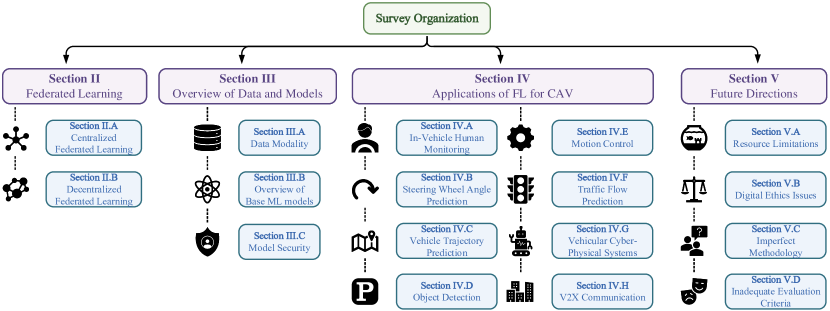
- 分析车联网(CAV)中集中式与去中心化联邦学习(FL)框架。
- 回顾与CAV中FL相关的多样化数据源、机器学习模型及数据安全技术。
- 探索CAV中FL的具体应用,包括基础模型、数据集与应用场景。
- 识别CAV中FL的关键挑战,如通信效率、隐私保护与系统异构性。
- 提出未来研究方向,以提升FL在CAV环境中的有效性与效率。
提出的方法
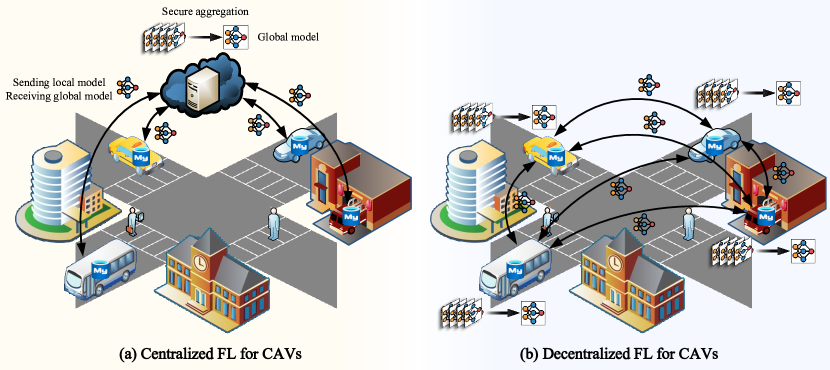
- 将FL框架分类为集中式与去中心化架构,评估其在通信与隐私之间的权衡。
- 回顾来自CAV的数据模态,包括传感器数据(激光雷达、摄像头)、V2X通信数据及ECU数据,用于模型训练。
- 分析FL中用于隐私保护的技术,如安全聚合、差分隐私与同态加密。
- 评估FL在CAV中的应用,包括感知、规划、控制、驾驶员行为建模、异常检测与预测性维护。
- 提出协作式FL与基于强化学习的客户端选择机制,以优化资源利用并降低通信负载。
- 引入可信感知的深度强化学习用于客户端选择,并缓解异构CAV网络中的慢速客户端问题。
实验结果
研究问题
- RQ1如何有效适应联邦学习以满足车联网在数据、通信与隐私方面的独特约束?
- RQ2在CAV环境中,集中式与去中心化FL框架之间存在哪些关键差异与权衡?
- RQ3在FL用于CAV时,如何缓解系统异构性问题,包括设备能力差异与网络条件波动?
- RQ4当参与车辆具有不同的隐私需求时,应采用何种机制确保数据完整性与公平性?
- RQ5如何对FL框架进行评估与优化,以应对新车辆加入网络的情况,并具备对故障或恶意更新的鲁棒诊断能力?
主要发现
- 联邦学习通过仅传输模型参数(梯度或权重)而非原始数据,显著降低了通信开销,提升了CAV中的网络效率。
- FL通过确保原始车辆数据始终保留在本地,实现了对本地数据隐私的保护,符合GDPR等隐私法规要求。
- 去中心化FL架构减少了对中心服务器的依赖,提升了系统韧性,尤其适用于高延迟或断连的V2X环境。
- 由于连接性差或处理能力低,慢速客户端可能延迟训练过程,但自适应策略与客户端选择模型可有效缓解此问题。
- 可信感知的深度强化学习通过优先选择可靠且高质量的数据贡献者,提升了客户端选择效率与模型收敛性能。
- 诸如灾难性遗忘与资源利用效率低下等挑战仍为开放性问题,需在动态、异构的CAV网络中开展进一步研究。
更好的研究,从现在开始
从阅读论文到最终审阅,大幅缩短您的研究时间。
无需绑定信用卡
本解读由 AI 生成,并经人工编辑审核。