
[论文解读] FeedRec: News Feed Recommendation with Various User Feedbacks
FeedRec 提出了一种统一的新闻推荐框架,通过整合多样化的用户反馈(如点击、跳过、分享、不喜欢、完成操作和快速关闭)来增强用户兴趣建模与感知参与度的训练。通过使用强到弱注意力蒸馏和多反馈训练,该方法在真实数据上提升了点击率预测与用户参与度指标。
Accurate user interest modeling is important for news recommendation. Most existing methods for news recommendation rely on implicit feedbacks like click for inferring user interests and model training. However, click behaviors usually contain heavy noise, and cannot help infer complicated user interest such as dislike. Besides, the feed recommendation models trained solely on click behaviors cannot optimize other objectives such as user engagement. In this paper, we present a news feed recommendation method that can exploit various kinds of user feedbacks to enhance both user interest modeling and model training. We propose a unified user modeling framework to incorporate various explicit and implicit user feedbacks to infer both positive and negative user interests. In addition, we propose a strong-to-weak attention network that uses the representations of stronger feedbacks to distill positive and negative user interests from implicit weak feedbacks for accurate user interest modeling. Besides, we propose a multi-feedback model training framework to learn an engagement-aware feed recommendation model. Extensive experiments on a real-world dataset show that our approach can effectively improve the model performance in terms of both news clicks and user engagement.
研究动机与目标
- 解决仅依赖点击反馈在建模复杂用户兴趣(如点赞与不喜欢)方面的局限性。
- 通过整合不同类型反馈(包括显式与隐式信号,强度各异),改进用户兴趣建模。
- 开发一种训练框架,超越点击率优化,实现用户参与度感知的优化。
- 建模不同反馈类型之间的相关性,并从嘈杂的隐式反馈中蒸馏出准确的正负向兴趣。
提出的方法
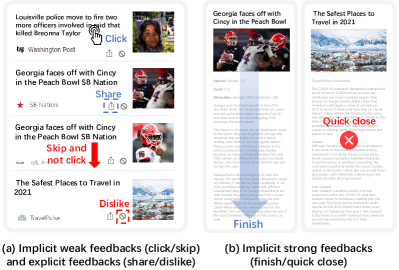
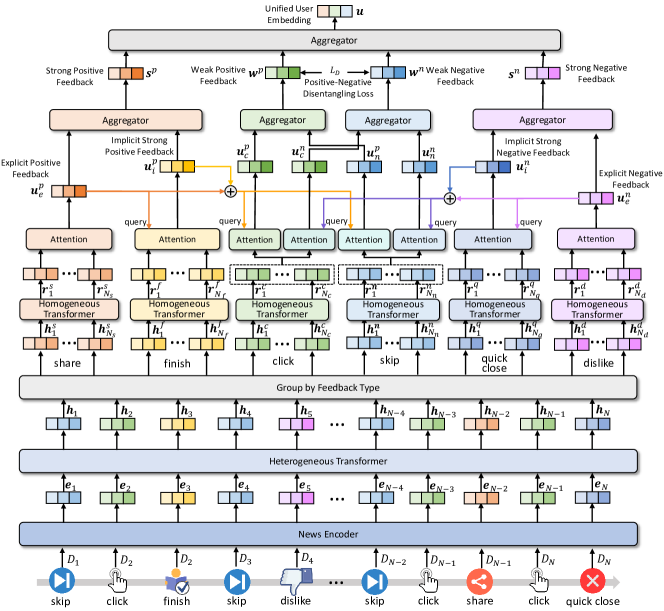
- 统一的用户建模框架将多种反馈类型——点击、跳过、分享、不喜欢、完成和快速关闭——整合为单一表征。
- 强到弱注意力网络利用来自更强反馈(如不喜欢、完成)的表征,从较弱反馈(如点击、跳过)中蒸馏出准确的正负兴趣。
- 异构与同构 Transformer 分别用于建模跨反馈与反馈内关系。
- 多反馈训练框架联合优化点击率预测、完成率预测与停留时间预测,以学习感知参与度的表征。
- 使用反馈嵌入、停留时间嵌入、位置嵌入与时间间隔嵌入,丰富新闻编码器的表征。
- 损失函数通过可学习系数(α, β, γ)进行加权,以平衡点击、完成与正负兴趣解耦的目标。
实验结果
研究问题
- RQ1如何有效整合强度各异的多样化用户反馈,构建统一的用户建模框架?
- RQ2是否可利用强反馈(如不喜欢、完成)提升从弱反馈(如点击)中推断正负兴趣的准确性?
- RQ3多反馈训练在多大程度上可提升参与度,超越仅基于点击的优化?
- RQ4哪些反馈类型与嵌入对模型性能贡献最大?
主要发现
- 所提出的强到弱注意力机制显著提升了模型性能,实现了从嘈杂隐式反馈中更准确地蒸馏用户兴趣。
- 联合训练点击率、完成率与停留时间预测任务,性能优于仅训练点击率,表明模型具备更强的参与度感知能力。
- 反馈嵌入是最重要的特征,其次为停留时间嵌入,二者均提供了用户满意度与兴趣推断的关键信号。
- 识别快速关闭的最优停留时间阈值为10秒,可在捕捉负面信号的同时避免误判正向行为。
- 最佳性能对应损失系数为 α=0.2(完成率)、β=0.15(停留时间)、γ=0.2(正负兴趣解耦),表明各项任务间实现了均衡优化。
更好的研究,从现在开始
从阅读论文到最终审阅,大幅缩短您的研究时间。
无需绑定信用卡
本解读由 AI 生成,并经人工编辑审核。