
[论文解读] First Scan Search for Dark Photon Dark Matter with a Tunable Superconducting Radio-Frequency Cavity
本研究首次利用可调谐超导射频(SRF)谐振腔对暗光子暗物质展开扫描搜索,借助其超高的品质因数(~10^10)实现了前所未有的探测灵敏度。通过机械调节谐振腔的谐振频率,在1.3 GHz中心频率处覆盖1.37 MHz带宽,实验在广阔质量范围内设定了迄今为止最严格的动能混合系数约束,即 ε < 2.2 × 10^−16。
Dark photons have emerged as promising candidates for dark matter, and their search is a top priority in particle physics, astrophysics, and cosmology. We report the first use of a tunable niobium superconducting radio-frequency cavity for a scan search of dark photon dark matter with innovative data analysis techniques. We mechanically adjusted the resonant frequency of a cavity submerged in liquid helium at a temperature of $2$ K, and scanned the dark photon mass over a frequency range of $1.37$ MHz centered at $1.3$ GHz. Our study leveraged the superconducting radio-frequency cavity's remarkably high quality factors of approximately $10^{10}$, resulting in the most stringent constraints to date on a substantial portion of the exclusion parameter space on the kinetic mixing coefficient $ε$ between dark photons and electromagnetic photons, yielding a value of $ε< 2.2 imes 10^{-16}$.
研究动机与目标
- 开发并实现一种基于扫描的新型暗光子暗物质(DPDM)探测方法,利用可调谐超导射频(SRF)腔。
- 利用SRF腔的超高品质因数(Q ~ 10^10)提升对弱耦合暗光子的探测灵敏度。
- 首次通过机械可调谐腔实现对DPDM质量窗口的实验扫描,实现1.37 MHz的频率覆盖范围。
- 对暗光子与标准模型光子之间的动能混合系数ε设定严格的上限。
- 证明SRF腔作为超轻暗物质探测新平台的可行性与高灵敏度。
提出的方法
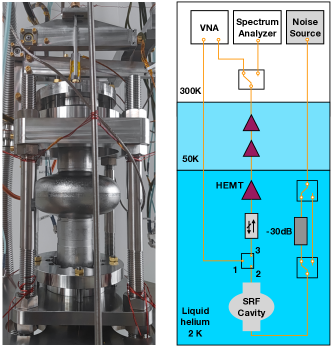
- 通过低温作动器对单细胞、1.3 GHz椭圆SRF腔进行机械调谐,实现以1.3 GHz为中心、带宽为1.37 MHz的谐振频率扫描。
- 在液氦温度2 K下运行腔体,维持约10^10的品质因数,从而实现高信噪比与增强的探测灵敏度。
- 基于ε = 1时的预期信号,结合有效电压、耦合度与总增益等系统参数,定义参考信号功率 $ P_{\text{ref}}^{i} $。
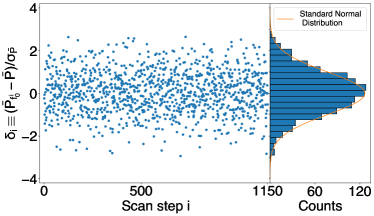
- 采用似然函数 $ \text{Pr}(p_i|\epsilon, m_{A'}) $ 进行统计分析,将相邻频率通道的数据合并,计算ε的90%置信度上限。
- 通过Fisher矩阵方法将系统参数(如 $ V_{\text{eff}}, \beta, G_{\text{net}} $)的不确定性传播至参考功率,详见补充材料。
- 通过将实测信号功率与参考信号进行比较,验证最终灵敏度,采用逐通道似然函数的乘积推导排除极限。
实验结果
研究问题
- RQ1是否可利用机械可调谐SRF腔实现对暗光子暗物质质量窗口的连续扫描?
- RQ2在基于扫描的探测中,利用高Q因子SRF腔可实现的动能混合系数ε的灵敏度极限是多少?
- RQ3SRF腔的超高品质因数如何增强对弱耦合暗光子的探测灵敏度?
- RQ4未来实验中,通过改进调谐机制,扫描范围可扩展至何种程度?
- RQ5基于似然比与参考信号归一化的数据分析框架,能否有效抑制系统误差并获得稳健的排除极限?
主要发现
- 实验在迄今为止最严格的范围内设定了暗光子暗物质动能混合系数ε的上限,ε < 2.2 × 10^−16,覆盖了扫描质量窗口的显著部分。
- 灵敏度主要受限于腔体的品质因数与系统噪声,实测Q ~ 10^10使信号积累增强且噪声水平降低。
- 扫描覆盖了以1.3 GHz为中心、1.37 MHz带宽的频率范围,对应约1.37 MHz宽度的暗光子质量范围。
- 基于相邻频率通道合并的似然函数分析策略,成功抑制了统计涨落,实现了稳健的90%置信度上限。
- 结果验证了SRF腔作为未来暗物质探测的有前途平台,未来可通过压缩、多模耦合或网络化探测器进一步提升灵敏度。
- 本研究展示了利用可调谐SRF腔实现连续扫描的可行性,目前正计划通过改进调谐机制扩展扫描窗口。
更好的研究,从现在开始
从阅读论文到最终审阅,大幅缩短您的研究时间。
无需绑定信用卡
本解读由 AI 生成,并经人工编辑审核。