
[论文解读] Fitting the light curves of Sagittarius A* with a hot-spot model
本研究在贝叶斯框架下,使用半解析的热点模型拟合银河系中心人马座A*的偏振毫米波光曲线,结合了磁化等离子体团块绕黑洞运行所产生的同步辐射。最佳拟合模型揭示了约90分钟的偏好轨道周期、150–160°的倾角、10.7–13.0倍引力半径的轨道半径,以及0.8–0.9倍开普勒速度的非开普勒运动,自旋参数较低(a* < 0.6)。
Sagittarius A* exhibits frequent flaring activity across the electromagnetic spectrum. Signatures of an orbiting hot spot have been identified in the polarized millimeter wavelength light curves observed with ALMA in 2017 immediately after an X-ray flare. The nature of these hot spots remains uncertain. We expanded existing theoretical hot-spot models created to describe the Sgr A* polarized emission at millimeter wavelengths. We sampled the posterior space, identifying best-fitting parameters and characterizing uncertainties. Using the numerical radiative transfer code ipole, we defined a semi-analytical model describing a ball of plasma orbiting Sgr A*, threaded with a magnetic field and emitting synchrotron radiation. We then explored the posterior space in the Bayesian framework of dynesty. We fit the static background emission separately, using a radiatively inefficient accretion flow model. We considered eight models with a varying level of complexity, distinguished by choices regarding dynamically important cooling, non-Keplerian motion, and magnetic field polarity. All models converge to realizations that fit the data, but one model without cooling, non-Keplerian motion, and magnetic field pointing toward us improved the fit significantly and also matched the observed circular polarization. Our models represent observational data well and allow testing various effects in a systematic manner. From our analysis, we have inferred an inclination of $155-160$ deg, which corroborates previous estimates, a preferred period of 90 minutes, and an orbital radius of $9-12$ gravitational radii. Our non-Keplerian models indicate a preference for an orbital velocity of $0.6-0.9$ times the Keplerian value. Last, all our models agree on a high dimensionless spin value ($a_{*}>0.8$), but the impact of spin on the corresponding light curves is subdominant with respect to other parameters.
研究动机与目标
- 使用包含磁化等离子体团块同步辐射的半解析热点模型,对Sgr A*的偏振毫米波辐射进行建模。
- 通过贝叶斯推断约束热点的物理参数,如大小、磁场强度和轨道速度。
- 检验动力学效应(如非开普勒运动和同步辐射冷却)对拟合质量及与观测一致性的影响。
- 利用辐射效率低的吸积流(RIAF)模型,将热点信号与背景吸积流分离。
- 评估黑洞自旋和磁场构型对观测光曲线和偏振特征的影响。
提出的方法
- 使用数值辐射转移代码ipole,模拟绕Sgr A*运行的局域等离子体团块在磁场作用下的同步辐射。
- 采用dynesty实现的贝叶斯推断框架,探索模型参数(包括热点位置、磁场和轨道运动)的后验分布。
- 单独使用RIAF模型拟合背景辐射,以分离出热点对观测斯托克斯参数(I, Q, U, V)的贡献。
- 考虑八种模型变体,分别基于冷却、非开普勒运动和磁场极性等假设,以评估模型的稳健性。
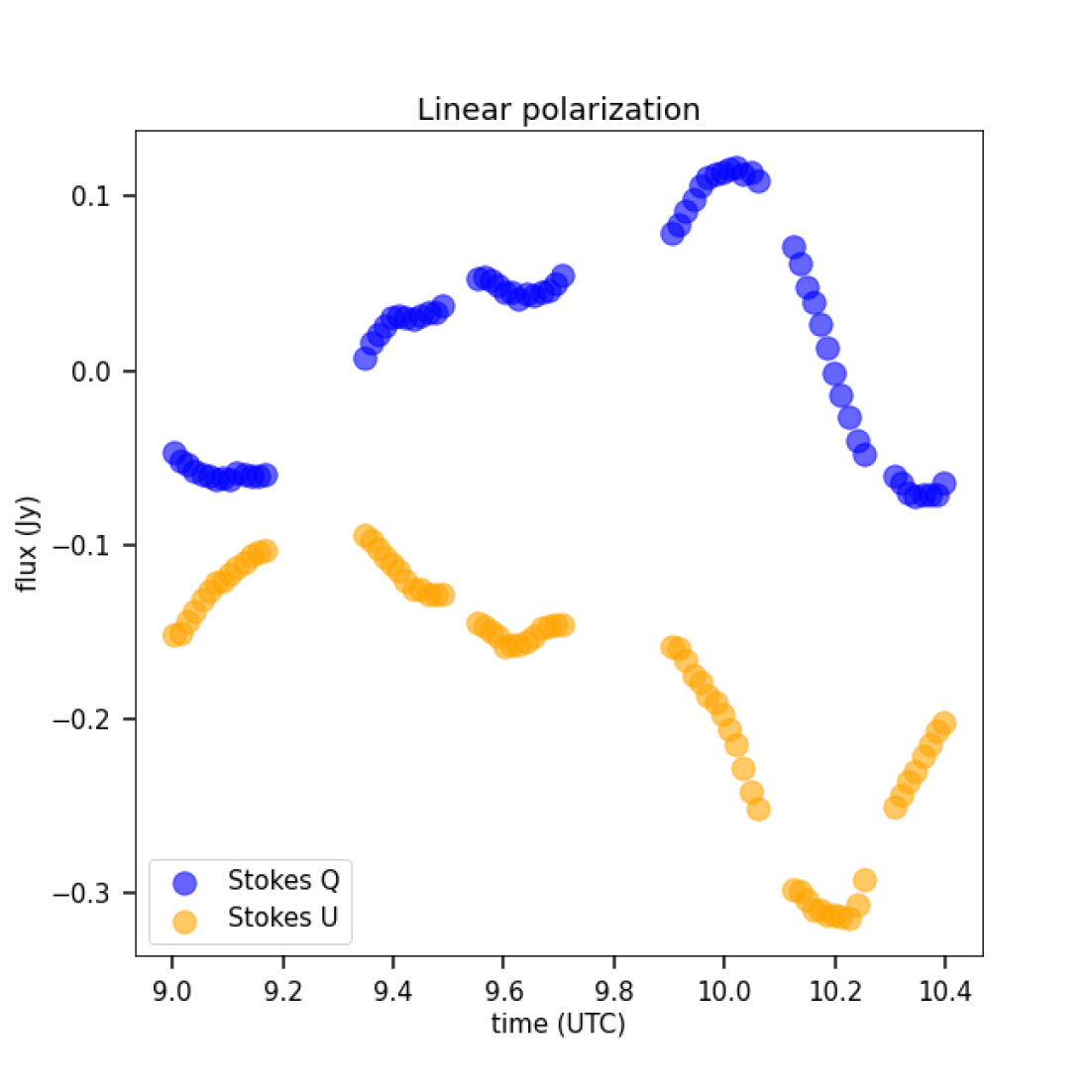
- 将模型预测与ALMA在1.3毫米波段对Sgr A*的2017年观测数据进行比较,重点关注Q–U环和圆偏振特性。
- 通过检查背景模型是否能重现从热点拟合过程中推断出的类阴影斯托克斯参数,验证模型的一致性。
实验结果
研究问题
- RQ1产生Sgr A*观测到的Q–U环的热点,其最佳拟合轨道和磁场参数为何?
- RQ2与标准模型相比,包含同步辐射冷却或非开普勒轨道运动是否能显著改善对ALMA光曲线的拟合?
- RQ3观测对黑洞自旋和倾角施加了何种约束?
- RQ4不同磁场构型(如指向内或指向外)如何影响偏振特征和模型似然度?
- RQ5背景RIAF辐射在多大程度上影响对热点参数的推断?组合的盘-热点模型是否能更好地重现所有斯托克斯参数?
主要发现
- 最佳拟合模型收敛于约90分钟的轨道周期,与观测到的Q–U环 timescale 一致。
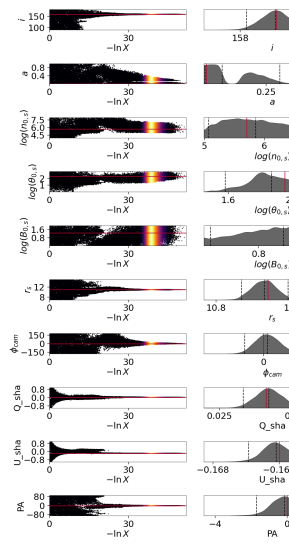
- 倾角被约束在150–160度之间,与EHT及其他研究的先前估计一致。
- 热点轨道半径估计为10.7–13.0倍引力半径,位于最内层稳定圆轨道附近。
- 包含非开普勒运动的模型(速度为开普勒速度的0.8–0.9倍)显著改善了拟合效果,并与预期的同步辐射冷却 timescale 相符。
- 引入同步辐射冷却也改善了拟合效果,并能重现观测到的圆偏振,尤其当磁场方向朝向观测者时。
- 黑洞自旋被约束为较低值(a* < 0.6),尽管其对光曲线的影响次于倾角和轨道半径等其他参数。
更好的研究,从现在开始
从阅读论文到最终审阅,大幅缩短您的研究时间。
无需绑定信用卡
本解读由 AI 生成,并经人工编辑审核。