
[论文解读] Fourier Neural Operator Surrogate Model to Predict 3D Seismic Waves Propagation
该论文提出了一种基于U型架构(UNO)的3D傅里叶神经算子(FNO)代理模型,用于从3D地质结构预测地震地面运动,将地下非均质性映射为时间序列速度输出。该模型在30,000次高保真SEM3D模拟数据上进行训练,实现了波前到达时间和相位预测的高精度,相位拟合优度(GOF)得分超过8的比例达92%,尽管峰值振幅存在低估现象。
With the recent rise of neural operators, scientific machine learning offers new solutions to quantify uncertainties associated with high-fidelity numerical simulations. Traditional neural networks, such as Convolutional Neural Networks (CNN) or Physics-Informed Neural Networks (PINN), are restricted to the prediction of solutions in a predefined configuration. With neural operators, one can learn the general solution of Partial Differential Equations, such as the elastic wave equation, with varying parameters. There have been very few applications of neural operators in seismology. All of them were limited to two-dimensional settings, although the importance of three-dimensional (3D) effects is well known. In this work, we apply the Fourier Neural Operator (FNO) to predict ground motion time series from a 3D geological description. We used a high-fidelity simulation code, SEM3D, to build an extensive database of ground motions generated by 30,000 different geologies. With this database, we show that the FNO can produce accurate ground motion even when the underlying geology exhibits large heterogeneities. Intensity measures at moderate and large periods are especially well reproduced. We present the first seismological application of Fourier Neural Operators in 3D. Thanks to the generalizability of our database, we believe that our model can be used to assess the influence of geological features such as sedimentary basins on ground motion, which is paramount to evaluating site effects.
研究动机与目标
- 开发一种适用于异质地质中3D弹性波传播的可泛化深度学习代理模型。
- 克服传统神经网络在不同地质参数下无法泛化的局限性。
- 通过替换计算成本高昂的模拟,实现在地震危险性评估中的高效不确定性量化。
- 验证傅里叶神经算子在3D地震学问题中的可行性与精度,特别是针对复杂地质非均质性。
- 证明同时预测三个速度分量可提升模型的泛化能力与性能。
提出的方法
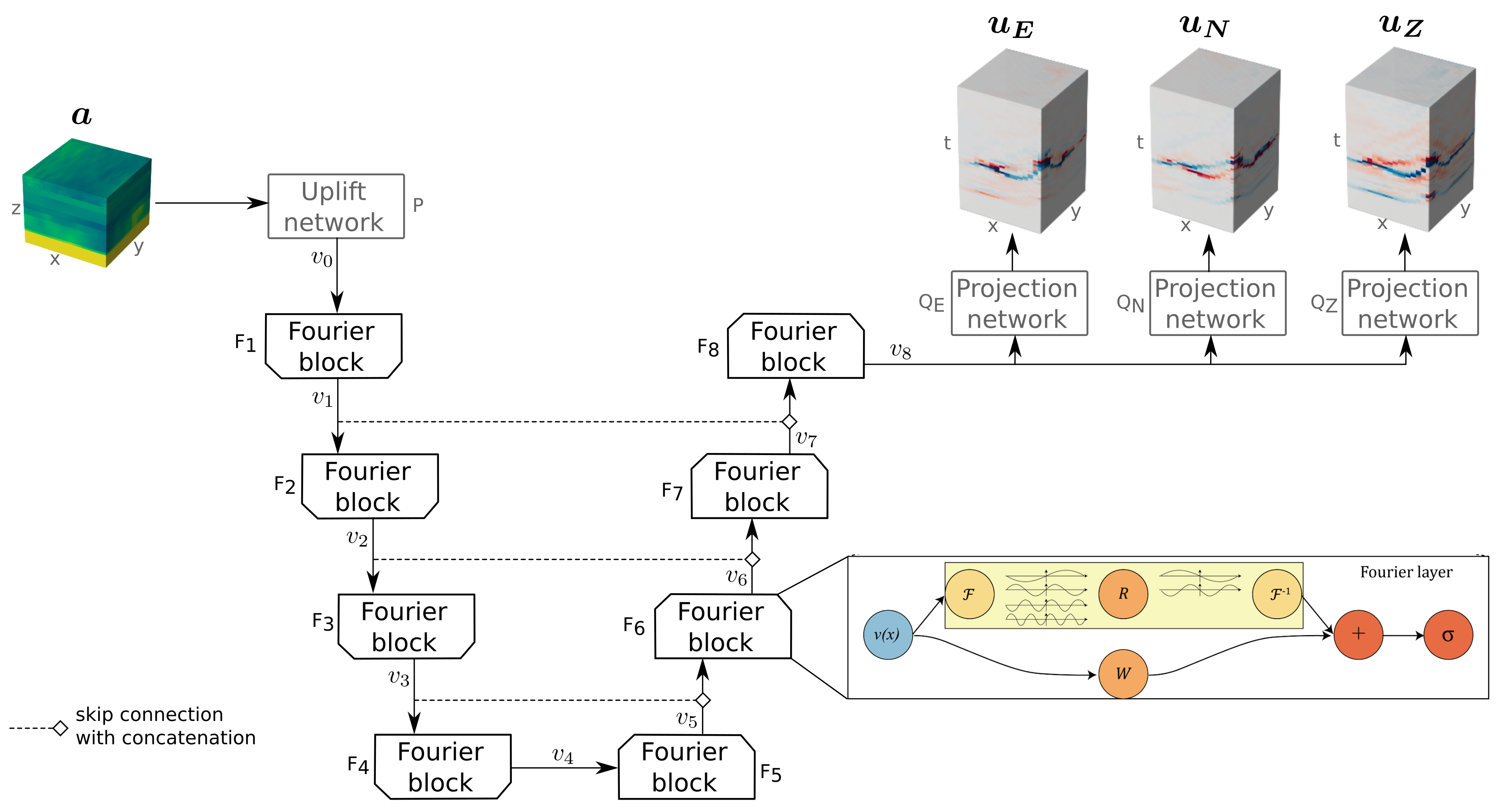
- 该模型采用具有十层的U型神经算子(UNO)架构,用于学习3D弹性波方程的解算子。
- 输入为表示地质非均质性的3D S波速度场,输出为多个传感器处的三方向地面速度时间序列。
- 该方法将地质输入的深度维度映射到输出的时间维度,从而将一个4D问题(3D空间+时间)转化为可处理的3D输入-输出映射。
- 模型在由随机场生成的30,000个独特3D地质模型数据集上进行训练,模拟采用高保真SEM3D谱元法代码完成。
- 损失函数通过时域与频域正则化的组合进行最小化,重点关注相位与包络保真度。
- 模型引入傅里叶特征嵌入,并通过频域中的学习型谱卷积来捕捉空间与时间依赖性。
实验结果
研究问题
- RQ1傅里叶神经算子能否在多样化3D地质结构上泛化,以预测完整的3D地面运动时间序列?
- RQ2在强地质非均质性条件下,FNO对波前到达时间和相位的预测精度如何?
- RQ3同时预测三个速度分量是否相比单一分量预测能提升模型泛化能力?
- RQ4该模型在保留高频分量方面表现如何,其在振幅表征上的失败点在哪里?
- RQ5该代理模型能否在保持足够精度的前提下显著降低计算成本,以支持地震危险性分析中的不确定性量化?
主要发现
- UNO模型在92%的测点位置实现了相位预测的拟合优度(GOF)得分高于8,表明波前到达时间预测具有高精度。
- 包络GOF得分在95%的时间序列中超过6,证实了整体信号能量与波形形状的可靠再现。
- 尽管相位预测准确,但峰值振幅系统性地被低估,尤其在1 Hz以上频段,表明高频振幅建模存在局限。
- 傅里叶域中的振幅衰减斜率与参考信号高度一致,表明未引入人工滤波,但高频分辨率有所降低。
- 同时训练三个速度分量显著提升了泛化能力,可能归因于有效训练数据增加而模型参数增长不显著。
- 该模型在具有强非均质性(如沉积盆地)的未见地质结构上表现出良好泛化能力,显示出在场地效应评估中的潜力。
更好的研究,从现在开始
从阅读论文到最终审阅,大幅缩短您的研究时间。
无需绑定信用卡
本解读由 AI 生成,并经人工编辑审核。