
[论文解读] Fractal scaling and the aesthetics of trees
本文基於達文西的樹木規則與現代維管生物學,提出一種樹木審美之分形尺度理論,透過藝術作品中枝條直徑的冪律擬合來量化尺度指數(α)。研究發現,16世紀伊斯蘭藝術、江戶時代日本藝術與20世紀歐洲藝術的α值介於1.5至2.5之間,皮埃特·蒙德里安的抽象樹木更預示了現代尺度指數α=3,顯示藝術表現與生物尺度原則之間存在深刻的一致性。
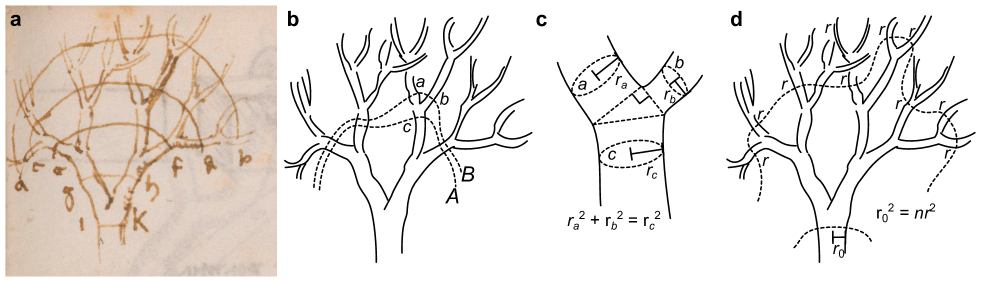
Trees in works of art have stirred emotions in viewers for millennia. Leonardo da Vinci described geometric proportions in trees to provide both guidelines for painting and insights into tree form and function. Da Vinci's Rule of trees further implies fractal branching with a particular scaling exponent $α= 2$ governing both proportions between the diameters of adjoining boughs and the number of boughs of a given diameter. Contemporary biology increasingly supports an analogous rule with $α= 3$ known as Murray's Law. Here we relate trees in art to a theory of proportion inspired by both da Vinci and modern tree physiology. We measure $α$ in 16th century Islamic architecture, Edo period Japanese painting and 20th century European art, finding $α$ in the range 1.5 to 2.5. We find that both conformity and deviations from ideal branching create stylistic effect and accommodate constraints on design and implementation. Finally, we analyze an abstract tree by Piet Mondrian which forgoes explicit branching but accurately captures the modern scaling exponent $α= 3$, anticipating Murray's Law by 15 years. This perspective extends classical mathematical, biological and artistic ways to understand, recreate and appreciate the beauty of trees.
研究动机与目标
- 探討藝術作品中的樹木表現是否反映真實樹木生理中所見的潛在分形尺度原理。
- 測試假設:不同文化與時期的藝術家,其創作無意識地遵循或預見了樹木形態的尺度法則,如達文西規則(α=2)或莫雷定律(α=3)。
- 發展一種可量化的藝術作品中分形尺度測量方法,利用枝條直徑分佈與冪律擬合技術。
- 評估與理想尺度偏差在藝術表現與設計限制中的角色。
- 探討抽象藝術(如蒙德里安的樹木)即使缺乏明確分枝,仍可能仍包含生物上正確的尺度指數。
提出的方法
- 使用Inkscape中的SVG向量圖形手動標註16世紀伊斯蘭、江戶時代日本與20世紀歐洲藝術作品中的枝條直徑。
- 透過在分枝點下游繪製垂直線來測量枝條直徑,以避免彎曲或葉子造成的扭曲。
- 使用Firefox開發者控制台中的JavaScript從SVG路徑元素中提取枝條長度與直徑資料。
- 應用最大概似冪律擬合方法(λ=2)以估計尺度指數α,並使用閾值(xm)排除雜訊或不可靠的小尺度測量。
- 透過視覺與統計檢驗來驗證閾值選擇,確保冪律模型能適配最大且最可靠可測量的枝條。
- 由三位觀察者獨立重複評分,包括對蒙德里安畫作的盲評第三名評估者,以評估評分者間的一致性與主觀性。
实验结果
研究问题
- RQ1不同文化與歷史時期的藝術作品中,樹木表現是否展現與生物原則一致的分形尺度?
- RQ2與理想尺度(如α=2或α=3)的偏差,在多大程度上反映藝術限制或風格選擇?
- RQ3抽象或風格化樹木表現(如蒙德里安作品)是否仍能編碼生物上正確的尺度指數?
- RQ4閾值(xm)的選擇如何影響藝術作品中枝條直徑資料的尺度指數估計?
- RQ5視覺與測量主觀性在多大程度上影響藝術作品中分形尺度的估計?
主要发现
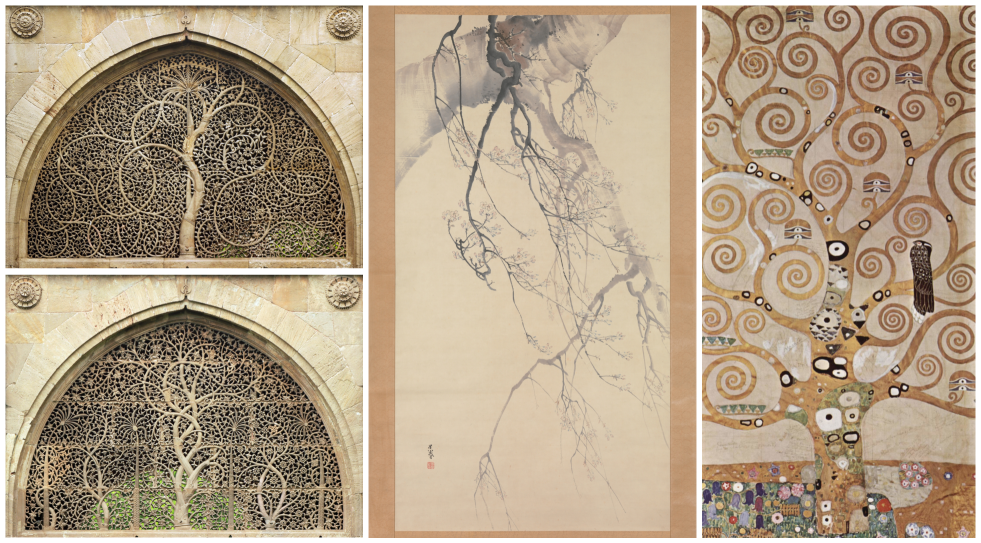
- 16世紀伊斯蘭建築(西迪·賽義德清真寺)中,尺度指數α介於1.5至2.5之間,顯示與生物原則一致的分形尺度。
- 江戶時代日本繪畫(如松村觀山的櫻花)的α值落在相同範圍,顯示藝術家對分形尺度的遵循。
- 古斯塔夫·克里姆特的《生命之樹》展現與分形分枝一致的α值,反映美學與生理尺度的結合。
- 皮埃特·蒙德里安的抽象樹木雖無明確分枝,卻精確捕捉了現代生物學的尺度指數α=3,比莫雷定律早15年預見。
- 本研究的冪律擬合方法(λ=2,並以經驗選擇的閾值xm)成功建模了多種藝術風格的枝條直徑分佈。
- 視覺與統計驗證確認,所選閾值成功排除非自相似、雜訊資料(如樹皮、葉子、陰影),提升模型可靠性。
更好的研究,从现在开始
从阅读论文到最终审阅,大幅缩短您的研究时间。
无需绑定信用卡
本解读由 AI 生成,并经人工编辑审核。