
[论文解读] Fractional quantum anomalous Hall effects in rhombohedral multilayer graphene in the moiréless limit and in Coulomb imprinted superlattice
该论文提出,菱面体堆叠多层石墨烯中的分数化量子反常霍尔(FQAH)态并非源于外部莫尔势垒,而是源于具有连续平移对称性的体系中,由电子关联驱动形成的拓扑性维格纳晶体。通过哈特里-福克(Hartree-Fock)和精确对角化(exact diagonalization)方法,作者表明在ν=1处形成了一个窄的C=1陈数能带,即使在无外部莫尔超晶格的情况下,该能带仍能稳定存在并支持鲁棒的FQAH态,此时莫尔势仅作为弱钉扎场。关键结果是提出了一种基于电子关联诱导拓扑性的新型FQAH平台,而非依赖人工周期性结构。
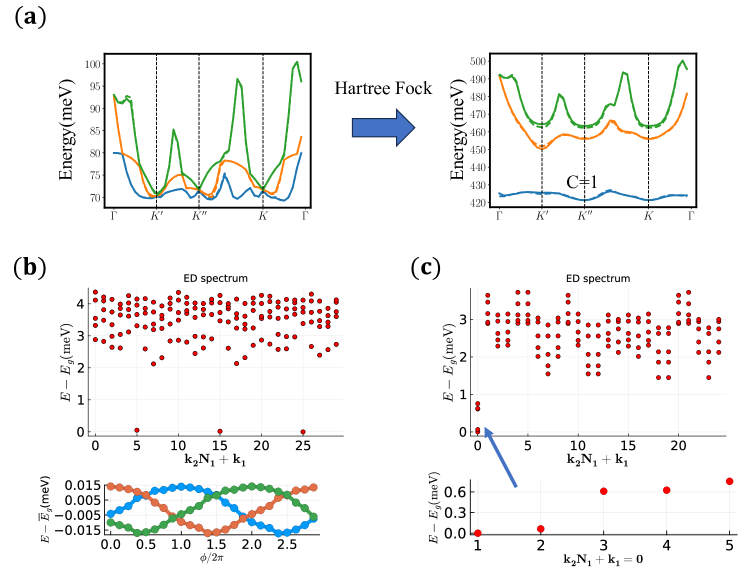
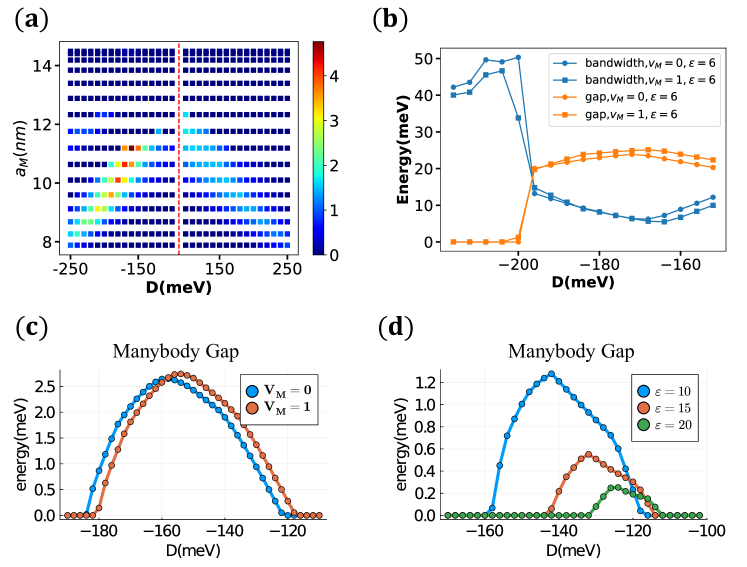
The standard theoretical framework for fractional quantum anomalous Hall effect (FQAH) assumes an isolated flat Chern band in the single particle level. In this paper we challenges this paradigm for the FQAH recently observed in the pentalayer rhombohedral stacked graphene aligned with hexagon boron nitride (hBN). We show that the external moiré superlattice potential is simply a perturbation in a model with continuous translation symmetry. Through Hartree Fock calculation, we find that interaction opens a sizable remote band gap, resulting an isolated narrow $C=1$ Chern band at filling $ν=1$. From exact diagonalization (ED) we identify FQAH phases at various fillings. But they exist also in the calculations without any external moiré potential. We suggest that the QAH insulator at $ν=1$ should be viewed as an interaction driven topological Wigner crystal with QAH effect, which is then pinned by a small moiré potential. The $C=1$ QAH crystal is robust with a crystal period around $10\mathrm{nm}$ in 4-layer, 5-layer, 6-layer and 7-layer graphene systems. Our work suggests a new direction to exploring the interplay of topology and FQAH with spontaneous crystal formation in the vanishing moiré potential limit. We also propose a new system to generate and control both honeycomb and triangular moiré superlattice potential through Coulomb interaction from another control layer, which can stabilize or suppress the QAH crystal depending on the density of the control layer.
研究动机与目标
- 解决在外部莫尔势极弱(约0.05 meV)的五层菱面体堆叠石墨烯中,FQAH态为何仍能稳定存在的悖论。
- 挑战标准范式,即FQAH必须依赖外部莫尔超晶格所形成的工程化平坦陈数能带。
- 提出一种新平台,其中莫尔势通过与扭转双层石墨烯层的库仑耦合而生成。
- 证明在无莫尔势极限下,QAH-维格纳晶体和FQAH相依然稳定,并可延伸至零外部势情况。
- 探索通过hBN厚度和扭转角调控库仑印迹结构中超晶格势和周期的可行性。
提出的方法
- 执行哈特里-福克计算,研究n层菱面体堆叠石墨烯在自旋-谷极化条件下ν=1处C=1陈数能带的形成。
- 利用精确对角化(ED)识别哈特里-福克修正能带在分数填充时的FQAH态。
- 对比分析存在与不存在外部莫尔势的情况,以分离莫尔晶格的作用。
- 提出通过在n层石墨烯上方放置一层由薄hBN隔开的扭转双层石墨烯(TBG)层,实现库仑印迹超晶格。
- 推导n层石墨烯中有效莫尔势的形式为V_l(G_M) ∝ e^(-G_M (d + l d_layer)) / (G_M a_M),其中a_M由TBG扭转角决定。
- 通过调节hBN厚度d,独立调控诱导莫尔势的强度,而不改变晶格周期。
实验结果
研究问题
- RQ1为何在外部莫尔势仅为约0.05 meV(在能带结构中可忽略)的五层菱面体堆叠石墨烯中,FQAH态仍能稳定存在?
- RQ2ν=1处的QAH绝缘体是否可理解为一种自发形成的拓扑维格纳晶体,而非由莫尔势诱导的陈数能带?
- RQ3当完全移除外部莫尔势时,FQAH相是否仍能维持,表明电子关联可产生本征拓扑序?
- RQ4能否仅通过与扭转双层石墨烯层的库仑耦合,实现完全由库仑作用诱导的莫尔超晶格,并稳定FQAH态?
- RQ5通过调节hBN厚度和TBG扭转角,如何实现对n层石墨烯中莫尔势强度和周期的独立控制?
主要发现
- 在4、5、6和7层菱面体堆叠石墨烯中,即使无外部莫尔势,电子关联也能导致在ν=1处形成一个窄的C=1陈数能带,并具有可观测的能隙。
- ν=1态被识别为一种自发破缺连续平移对称性的QAH-维格纳晶体,其晶格周期约为10 nm。
- FQAH态在哈特里-福克修正能带的分数填充下被稳定,且即使关闭外部莫尔势后仍能持续存在。
- 外部莫尔势仅起弱钉扎作用,对拓扑能带或FQAH相的形成并非必要。
- 在库仑印迹结构中,可通过调节hBN厚度d来调控莫尔势,且在d→∞极限下,QAH-维格纳晶体和FQAH相依然保持鲁棒性。
- 当d=1 nm且ε=6时,若以石墨烯单层为源,n层石墨烯中诱导的莫尔势为0.84 meV,证实了弱且可调超晶格的可行性。
更好的研究,从现在开始
从阅读论文到最终审阅,大幅缩短您的研究时间。
无需绑定信用卡
本解读由 AI 生成,并经人工编辑审核。