
[论文解读] From existing and new nuclear and astrophysical constraints to stringent limits on the equation of state of neutron-rich dense matter
本文在一个与物理无关的贝叶斯框架中整合多种核理论与天体物理约束,以推导对中子星状态方程的严格限制,获得对典型中子星半径和最大质量的显著界限。
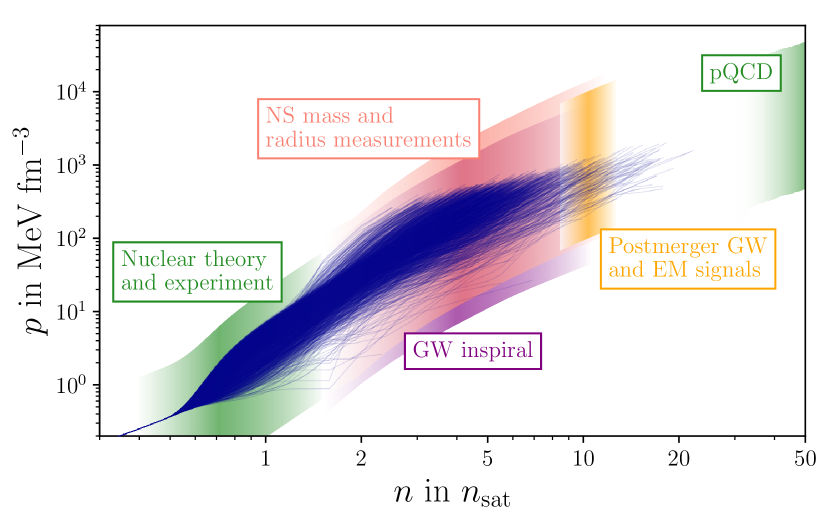
Through continuous progress in nuclear theory and experiment and an increasing number of neutron-star observations, a multitude of information about the equation of state (EOS) for matter at extreme densities is available. To constrain the EOS across its entire density range, this information needs to be combined consistently. However, the impact and model-dependency of individual observations vary. We present a broad compendium of different constraints and apply them individually to a large set of EOS candidates within a Bayesian framework. Specifically, we explore different ways how chiral effective field theory and perturbative quantum chromodynamics can be used to place a likelihood on EOS candidates. We also investigate the impact of nuclear experimental constraints, as well as different radio and X-ray observations of neutron star (NS) masses and radii. This is augmented by reanalyses of the existing data from BNS coalescences, in particular of GW170817, with improved models for the tidal waveform and kilonova light curves, which we also utilize to construct a tight upper limit of 2.39$\,$M$_\odot$ on the TOV mass based on GW170817's remnant. Our diverse set of constraints is eventually combined to obtain stringent limits on NS properties. We organize the combination in a way to distinguish between constraints where the systematic uncertainties are deemed small and those that rely on less conservative assumptions. For the former, we find the radius of the canonical 1.4$\,$M$_\odot$ neutron star to be $R_{1.4}= 12.26_{-0.91}^{+0.80}\,$km and the TOV mass at $M_{ m TOV}= 2.25_{-0.22}^{+0.42}\,$M$_\odot$ (95% credibility). Including all the presented constraints yields $R_{1.4}= 12.20_{-0.48}^{+0.50}\,$km and $M_{ m TOV}= 2.30_{-0.20}^{+0.07}\,$M$_\odot$.
研究动机与目标
- 评估不同核物理与天体物理输入如何约束紧密的致密物质EoS。
- 构建一个覆盖从核子到非核子高密度区域的大型、物理无关先验的EOS候选集合。
- 量化各约束(χEFT、pQCD、中子皮厚、重离子碰撞、NS质量-半径数据、GW、伽马暴/ kilonova)对EOS参数的影响。
- 将约束结合起来以推断典型NS半径和TOV最大质量,并给出量化的不确定性。
- 评估不同约束组合如何影响推断出的EOS及相关可观测量(R1.4、M_TOV、p3n_sat、n_TOV)。
提出的方法
- 使用一个核子物质到n_break的元模型来构建10万个EOS先验集合,低密度处固定外壳模型。
- 通过速度传播(speed-of-sound)方法在高密度外推上附加一个与模型无关的网格点,直到25 n_sat,插值得到c_s^2(n)。
- 通过基于AFDMC带宽的分数函数f(p,n)应用χEFT约束,并通过对p(n)曲线的乘积/积分来计算似然。
- 通过测试低密度EOS与高密度pQCD区间之间插值的力学稳定性与因果性来纳入pQCD约束,包含保守的n_L=n_TOV匹配以及更严格的pQCD*方法。
- 通过中子皮厚与重离子数据约束对称能量参数E_sym与L_sym,通过与中子皮厚的相关性来实现约束。
- 使用EOS候选的贝叶斯后验加权来推导R1.4、M_TOV及相关量的分布。
实验结果
研究问题
- RQ1χEFT、pQCD、中子皮厚、重离子以及NS观测各自及组合对中子星EOS的影响如何?
- RQ2约束如何映射到EOS的密度区间,哪些可观测量(R1.4、M_TOV)受影响最大?
- RQ3在应用所有约束且可控强度变化时,偏好哪些典型NS半径R1.4和TOV质量M_TOV?
- RQ4pQCD匹配的选择(保守与pQCD*)如何影响后验EOS?
主要发现
- 在包括受限系统误差的情况下,分析结果为R1.4 = 12.27_{-0.94}^{+0.83} km,M_TOV = 2.26_{-0.22}^{+0.45} M_sun,在95%置信区间内。
- 较不保守约束组合给出R1.4 = 12.20_{-0.50}^{+0.53} km,M_TOV = 2.31_{-0.20}^{+0.08} M_sun。
- χEFT约束在低密度处偏好较软的EOS,但由于高密度外推的灵活性,尚未完全排除高质量质量配置。
- pQCD约束不利于非常僵硬或非常柔软的EOS,pQCD*方法提供更强的约束,将后验偏向于更具信息量的M_TOV与p3n_sat区间。
- 中子皮厚测量(PREX-II、CREX)影响对称能量参数E_sym与L_sym,从而影响与NS相关的富中子区域的EOS。
![Figure 2: Score function $f(p,n)$ from Eq. ( 4 ) used in Eq. ( 6 ) to calculate the likelihood of an EOS given $\chi$ EFT constraints. The black dashed lines show the band obtained by $\chi$ EFT calculations in Ref. [ 46 ] .](https://ar5iv.labs.arxiv.org/html/2402.04172/assets/x2.png)
更好的研究,从现在开始
从阅读论文到最终审阅,大幅缩短您的研究时间。
无需绑定信用卡
本解读由 AI 生成,并经人工编辑审核。