
[论文解读] Fundamental charges for dual-unitary circuits
本文建立了1+1维对偶幺正量子电路中宽度为$w$的守恒荷与宽度为$w$的孤立子之间的一一对应关系,表明此类荷必须以有效光速作为右行或左行孤立子传播。关键结果是,这些电路中的所有守恒密度本质上都与孤立子激发紧密关联,通过乘积态和费米子Jordan-Wigner变换提供了显式构造,尤其在比特系统(d=2)中。
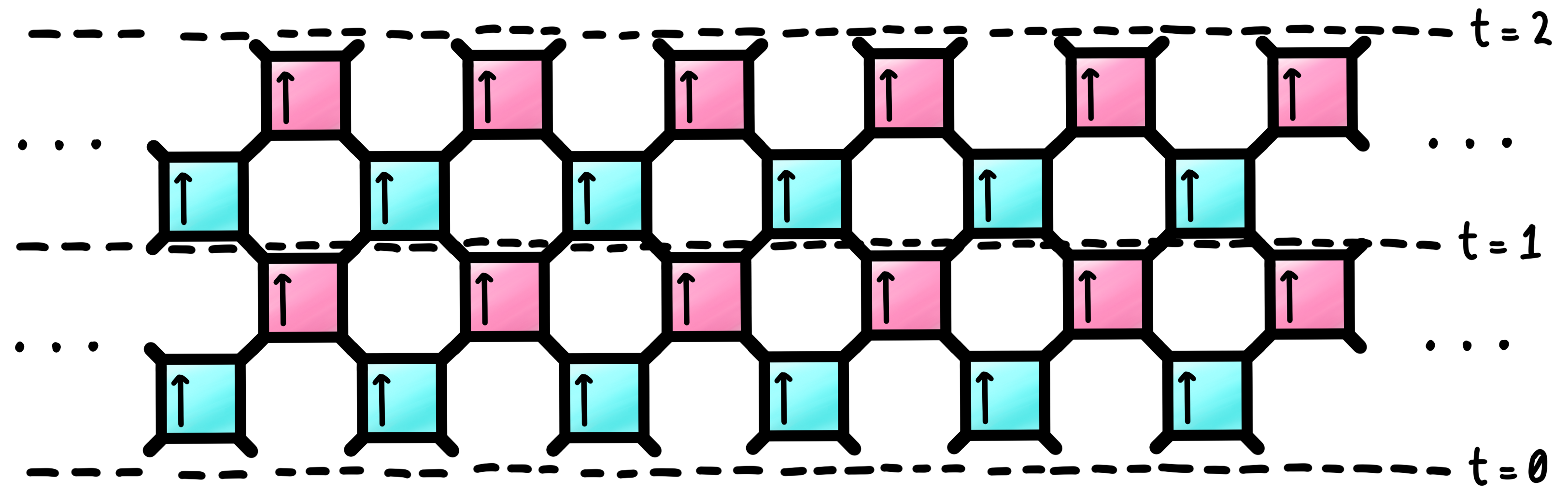
Dual-unitary quantum circuits have recently attracted attention as an analytically tractable model of many-body quantum dynamics. Consisting of a 1+1D lattice of 2-qudit gates arranged in a 'brickwork' pattern, these models are defined by the constraint that each gate must remain unitary under swapping the roles of space and time. This dual-unitarity restricts the dynamics of local operators in these circuits: the support of any such operator must grow at the effective speed of light of the system, along one or both of the edges of a causal light cone set by the geometry of the circuit. Using this property, it is shown here that for 1+1D dual-unitary circuits the set of width-$w$ conserved densities (constructed from operators supported over $w$ consecutive sites) is in one-to-one correspondence with the set of width-$w$ solitons - operators which, up to a multiplicative phase, are simply spatially translated at the effective speed of light by the dual-unitary dynamics. A number of ways to construct these many-body solitons (explicitly in the case where the local Hilbert space dimension $d=2$) are then demonstrated: firstly, via a simple construction involving products of smaller, constituent solitons; and secondly, via a construction which cannot be understood as simply in terms of products of smaller solitons, but which does have a neat interpretation in terms of products of fermions under a Jordan-Wigner transformation. This provides partial progress towards a characterisation of the microscopic structure of complex many-body solitons (in dual-unitary circuits on qubits), whilst also establishing a link between fermionic models and dual-unitary circuits, advancing our understanding of what kinds of physics can be explored in this framework.
研究动机与目标
- 表征对偶幺正电路中多体守恒荷的微观结构。
- 确定对偶幺正电路中的守恒荷是否可以超越简单的孤立子激发而存在。
- 通过Jordan-Wigner变换探索费米子模型与对偶幺正电路之间的联系。
- 研究在比特系统(d=2)中的对偶幺正电路孤立子是否可由特定乘积或费米子构造完全分类。
- 理解这种荷-孤立子对应关系对非遍历动力学及其在CFT和拓扑序中潜在应用的影响。
提出的方法
- 利用对偶幺正性约束,确保门在空间和时间方向上均为幺正,以强制实现光锥动力学和弹道算符增长。
- 利用砖墙电路的因果结构,表明宽度$w$的守恒荷必须对应于以有效光速空间平移的算符。
- 通过更小孤立子的乘积,显式构造比特系统(d=2)中的孤立子,证明其作为守恒密度的作用。
- 提出第二种基于Jordan-Wigner变换的构造方法,揭示非乘积孤立子的费米子解释。
- 应用算符动力学和光锥传播的定理,证明对偶幺正电路中所有守恒荷必然为孤立子形式。
- 分析这些构造对非遍历动力学存在性及有限系统中守恒量结构的影响。
实验结果
研究问题
- RQ11+1维对偶幺正电路中的所有守恒荷是否必然与以有效光速传播的孤立子激发相关?
- RQ2在比特系统(d=2)的对偶幺正电路中,所有宽度-$w$孤立子是否均可通过更小孤立子的乘积或费米子Jordan-Wigner映射构造?
- RQ3非乘积孤立子在生成守恒荷中起什么作用,它们与基于乘积的构造有何不同?
- RQ4这些基于孤立子的守恒荷在多大程度上导致非遍历动力学,如持久关联或泊松水平统计?
- RQ5该孤立子-荷对应关系能否推广至高维量子电路,或用于建模共形场理论中的手性输运?
主要发现
- 在1+1维对偶幺正电路中,宽度-$w$守恒密度与宽度-$w$孤立子之间存在一一对应关系,其中孤立子为以有效光速空间平移的算符。
- 对偶幺正电路中所有守恒荷本质上均被限制为右行或左行孤立子,意味着局部荷密度的动力学为平凡的。
- 在比特系统(d=2)中,孤立子可显式构造为更小孤立子的乘积,从而提供一种系统生成守恒量的方法。
- 存在第二类孤立子,无法分解为更小孤立子的乘积,但可通过Jordan-Wigner变换自然地表示为费米子算符的乘积。
- 结果表明,在d=2对偶幺正电路中,所有孤立子及因此所有守恒荷可能均可由这两种构造方法完全分类。
- 孤立子与守恒荷之间的对应关系为对偶幺正电路与共形场理论之间提供了新联系,尤其通过手性输运和边界模式体现。

更好的研究,从现在开始
从阅读论文到最终审阅,大幅缩短您的研究时间。
无需绑定信用卡
本解读由 AI 生成,并经人工编辑审核。