
[论文解读] FuXi: A cascade machine learning forecasting system for 15-day global weather forecast
FuXi 是一个级联的、预训练的机器学习气象预测系统,能够以 0.25° 分辨率提供 15 天全球预报,达到类似 ECMWF 集合预报的性能,并延长 Z500 和 T2M 的有技能预报领先时间。
Over the past few years, due to the rapid development of machine learning (ML) models for weather forecasting, state-of-the-art ML models have shown superior performance compared to the European Centre for Medium-Range Weather Forecasts (ECMWF)'s high-resolution forecast (HRES) in 10-day forecasts at a spatial resolution of 0.25 degree. However, the challenge remains to perform comparably to the ECMWF ensemble mean (EM) in 15-day forecasts. Previous studies have demonstrated the importance of mitigating the accumulation of forecast errors for effective long-term forecasts. Despite numerous efforts to reduce accumulation errors, including autoregressive multi-time step loss, using a single model is found to be insufficient to achieve optimal performance in both short and long lead times. Therefore, we present FuXi, a cascaded ML weather forecasting system that provides 15-day global forecasts with a temporal resolution of 6 hours and a spatial resolution of 0.25 degree. FuXi is developed using 39 years of the ECMWF ERA5 reanalysis dataset. The performance evaluation, based on latitude-weighted root mean square error (RMSE) and anomaly correlation coefficient (ACC), demonstrates that FuXi has comparable forecast performance to ECMWF EM in 15-day forecasts, making FuXi the first ML-based weather forecasting system to accomplish this achievement.
研究动机与目标
- 推动使用级联机器学习模型以降低长程天气预报中的累积误差。
- 开发 FuXi,一种使用 ERA5 数据、以 0.25° 分辨率产生 15 天预报的级联机器学习预测系统。
- 展示 FuXi 能够达到与 ECMWF 集合预测相匹配的性能,并延长关键变量的有技能领先时间。
- 展示 FuXi 集合预报提供的 不确定性估计 可与 ECMWF 集合相当。
提出的方法
- 使用 0.25° 分辨率和 6 小时时序的 ERA5 再分析数据训练 FuXi。
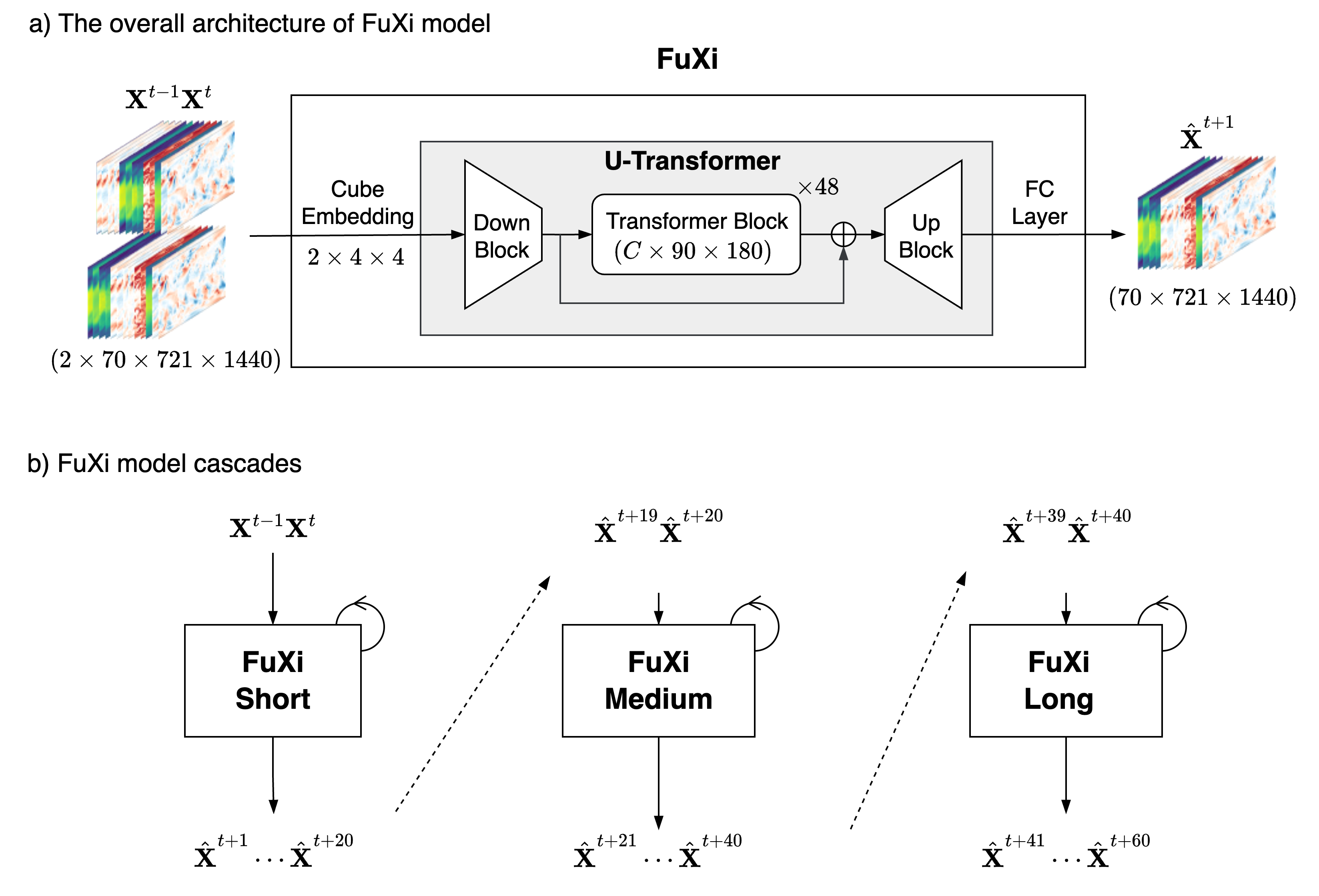
- 将 FuXi 构建为三个专业模型的级联:FuXi-Short (0–5 天)、FuXi-Medium (5–10 天)、FuXi-Long (10–15 天)。
- FuXi 的基础架构结合了立方嵌入、带有 48 个 Swin Transformer V2 块的 U-Transformer,以及一个最终的全连接层。
- 通过两阶段过程训练:一阶段预训练(预测单个 6 小时步)和带自回归课程的级联模型微调。
- 在训练过程中使用自回归多步损失来提高稳定性并减少累积误差。
- 通过用 Perlin 噪声扰动初始条件并应用蒙特卡洛 dropout,创建一个包含 50 个成员的 FuXi 集合。
实验结果
研究问题
- RQ1级联式机器学习架构是否能够降低长时程预报的累积误差并在 15 天预报中达到与 ECMWF 集合相匹配的性能?
- RQ2相对于 ECMWF HRES,Z500 和 T2M 可达到的预报领先时间扩展是多少?
- RQ3FuXi 集合是否在预测不确定性方面相对于 ECMWF 集合具有竞争力?
- RQ4在多变量和不同领先时间下,FuXi 相对于确定性基准(HRES、EM)的表现如何?
主要发现
- FuXi 的级联架构在 0.25° 下提供的 15 天预报与 ECMWF 集合平均值(EM)相当。
- FuXi 将 Z500 的有技能相关系数 ACC(ACC > 0.6)的领先时间扩展到 10.5 天,T2M 为 14.5 天。
- FuXi 在 15 天预报中多变量上优于 ECMWF HRES,随着领先时间的增加,ACC 和 RMSE 的优势也在增强。
- FuXi 集合预报在若干场场在 9 天内达到与 ECMWF 集合相当的 CRPS 性能,表明不确定性估计有用。

更好的研究,从现在开始
从阅读论文到最终审阅,大幅缩短您的研究时间。
无需绑定信用卡
本解读由 AI 生成,并经人工编辑审核。