
[论文解读] GA-NIFS: Early-stage feedback in a heavily obscured AGN at $z=4.76$
利用詹姆斯·韦布空间望远镜/NIRSpec积分场光谱,本研究在红移 z=4.76 的高度遮蔽活动星系核 ALESS073.1 中探测到一条宽 Hα 线,证实其中存在一个超大质量黑洞(log M_BH/M☉ > 8.7),其吸积率低于爱丁顿极限的 15%。尽管存在高程度的尘埃消光(N_H ~ 10^24 cm⁻²),由于存在宽线区,该源被归类为 Type 1 活动星系核。同时探测到一条边缘分辨的电离喷流,其质量加载因子约为 0.01,导致中心区域湍流增强,但并未抑制恒星形成。
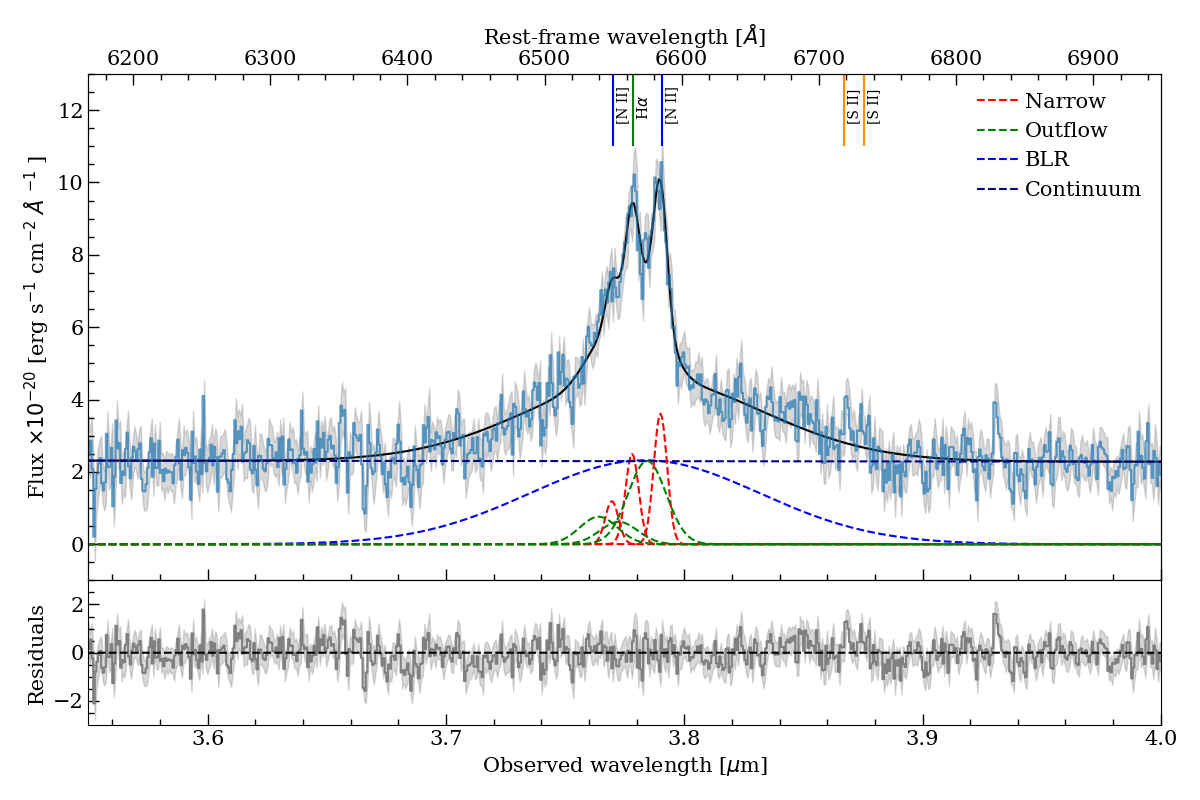
Dust-obscured galaxies are thought to represent an early evolutionary phase of massive galaxies in which the active galactic nucleus (AGN) is still deeply buried in significant amounts of dusty material and its emission is strongly suppressed. The unprecedented sensitivity of the James Webb Space Telescope enables us for the first time to detect the rest-frame optical emission of heavily obscured AGN and unveil the properties of the hidden accreting super-massive black holes (BHs). In this work, we present the JWST/NIRSpec IFS data of ALESS073.1, a massive, dusty, star-forming galaxy at $z = 4.76$ hosting an AGN at its center. The detection of a very broad $H_α$ emission associated with the Broad Line Region (BLR) confirms the presence of a BH ($\log(M_{BH}/M_\odot)>8.7$) accreting at less than 15\% of its Eddington limit and classifies the target as a Type 1 AGN. The rest-frame optical emission lines also reveal a fast ionized gas outflow marginally resolved in the galaxy center. The high sensitivity of NIRSpec allows us to perform the kinematic analysis of the narrow H$α$ component which indicates that the warm ionized gas velocity field is consistent with disk rotation. We also find that, in the innermost nuclear regions ($< 1.5$ kpc), the intrinsic velocity dispersion of the disk reaches $\sim 150$ km/s, $\sim 2-3$ times higher than the velocity dispersion inferred from the [CII] 158$μ$m line tracing mostly cold gas. Since, at large radii, the velocity dispersion of the warm and cold gas are comparable, we conclude that the outflows are injecting turbulence in the warm ionized gas in the central region, but they are not sufficiently powerful to disrupt the dense gas and quench star formation. These findings support the scenario that dust-obscured galaxies represent the evolutionary stage preceding the unobscured quasar when all gas and dust are removed from the host.
研究动机与目标
- 研究在高红移(z=4.76)的严重遮蔽活动星系核中,活动星系核反馈机制的早期阶段,此时活动星系核反馈预计尚处于初始阶段。
- 利用静止系光学发射线,确定 ALESS073.1 中活动星系核的吸积状态及其黑洞质量。
- 评估活动星系核驱动的喷流对宿主星系星际介质的影响,特别是对恒星形成和气体动力学的影响。
- 将观测到的 M_BH/M_star 比值与本地及高红移宁静系统进行比较,以评估黑洞与宿主星系的共同演化。
- 通过分析不同空间尺度上的 [N ii]/Hα 线比值,确定星际介质的电离源。
提出的方法
- 利用詹姆斯·韦布空间望远镜获取 ALESS073.1 的高灵敏度、空间分辨 NIRSpec 积分场光谱(IFS),以探测静止系光学发射线。
- 对 Hα 发射线进行动力学分解,分离宽(BLR)与窄成分,测量速度宽度及喷流特性。
- 测量星系内不同区域的 [N ii] λ6585/Hα 比值,以区分电离源:活动星系核 vs. 年轻恒星。
- 利用喷流质量流量与恒星形成率计算电离喷流的质量加载因子(ξ)。
- 将 Hα 的速度弥散度与 [C ii] 158 μm 线的动力学特性进行比较,评估能量在不同气体相中的沉积情况。
- 利用恒星质量(log M_*/M☉ = 10.7)和黑洞质量估计值(log M_BH/M☉ > 8.7)评估 M_BH/M_star 比值相对于本地及高红移基准值的情况。
实验结果
研究问题
- RQ1ALESS073.1 中活动星系核的吸积状态如何?是否证实了超大质量黑洞的存在?
- RQ2电离气体动力学如何揭示在严重遮蔽系统中活动星系核驱动喷流的存在及其特性?
- RQ3活动星系核在电离宿主星系星际介质中扮演何种角色?与年轻恒星的电离相比如何?
- RQ4喷流在在多大程度上向星际介质注入能量?是否具备抑制恒星形成的能力?
- RQ5该高红移遮蔽活动星系核的 M_BH/M_star 比值与本地及高红移宁静系统相比如何?
主要发现
- 检测到 FWHM > 9000 km s⁻¹ 的宽 Hα 成分,证实存在宽线区,表明存在一个 log M_BH/M☉ > 8.7 的超大质量黑洞,尽管存在高程度的尘埃消光(N_H ~ 10^24 cm⁻²)。
- 由于存在宽线区,该活动星系核被归类为 Type 1,即使其高度遮蔽,这表明 JWST 的灵敏度足以探测到静止系光学发射。
- 探测到一条边缘分辨的电离喷流,其质量加载因子约为 0.01,表明气体从星系中被移除的效率较低。
- 中心区域的 Hα 速度弥散度比星系其余部分高 2–3 倍,表明喷流导致湍流增强。
- [N ii]/Hα 比值显示,活动星系核主导了中心区域和喷流成分的电离,而年轻恒星在更大半径区域占主导地位。
- M_BH/M_star 比值比具有相似恒星质量的本地活动星系核高出一个以上数量级,表明黑洞相对于宿主星系处于早期增长阶段。
![Figure 2: Spectrum of the central region from the G235H/F170LP cube. In the upper panel, we report in blue the spectrum around the [O iii ] $\lambda$ 5007Å emission, extracted from a circular aperture with a radius of 0.15″ in the central region with the associated error (gray-shaded region). In bla](https://ar5iv.labs.arxiv.org/html/2309.05713/assets/OIIIspectrum.png)
更好的研究,从现在开始
从阅读论文到最终审阅,大幅缩短您的研究时间。
无需绑定信用卡
本解读由 AI 生成,并经人工编辑审核。