
[论文解读] Gaia Data Release 3. Astrometric binary star processing
本文针对盖亚数据释放3中的410万颗双星候选体进行了天体测量处理,采用加速度、轨道及变光诱导运动(VIM)模型检测并表征未分辨双星。共识别出338,215个加速度解、165,500个轨道解和869个VIM解,显著扩展了以往的天体测量双星星表,为大规模双星系统统计研究提供了支持。
Context.The Gaia Early Data Release 3 contained the positions, parallaxes and proper motions of 1.5 billion sources, among which some did not fit well the "single star" model. Binarity is one of the causes of this. Aims. Four million of these stars were selected and various models were tested to detect binary stars and to derive their parameters. Methods. A preliminary treatment was used to discard the partially resolved double stars and to correct the transits for perspective acceleration. It was then investigated whether the measurements fit well with an acceleration model with or without jerk. The orbital model was tried when the fit of any acceleration model was beyond our acceptance criteria. A Variability-Induced Mover (VIM) model was also tried when the star was photometrically variable. A final selection has been made in order to keep only solutions that probably correspond to the real nature of the stars. Results. At the end, 338,215 acceleration solutions, about 165,500 orbital solutions and 869 VIM solutions were retained. In addition, formulae for calculating the uncertainties of the Campbell orbital elements from orbital solutions expressed in Thiele-Innes elements are given in an appendix.
研究动机与目标
- 通过多模型拟合检测并表征盖亚DR3中未分辨的天体测量双星。
- 通过光度和天体测量筛选标准,减少部分分辨双星带来的污染。
- 开发稳健的筛选流程,以区分加速度、轨道和变光诱导运动模型。
- 为双星星族的统计研究提供可靠的天体测量解。
- 提供从索列-英尼斯元素推导出的坎贝尔轨道元素的不确定性公式。
提出的方法
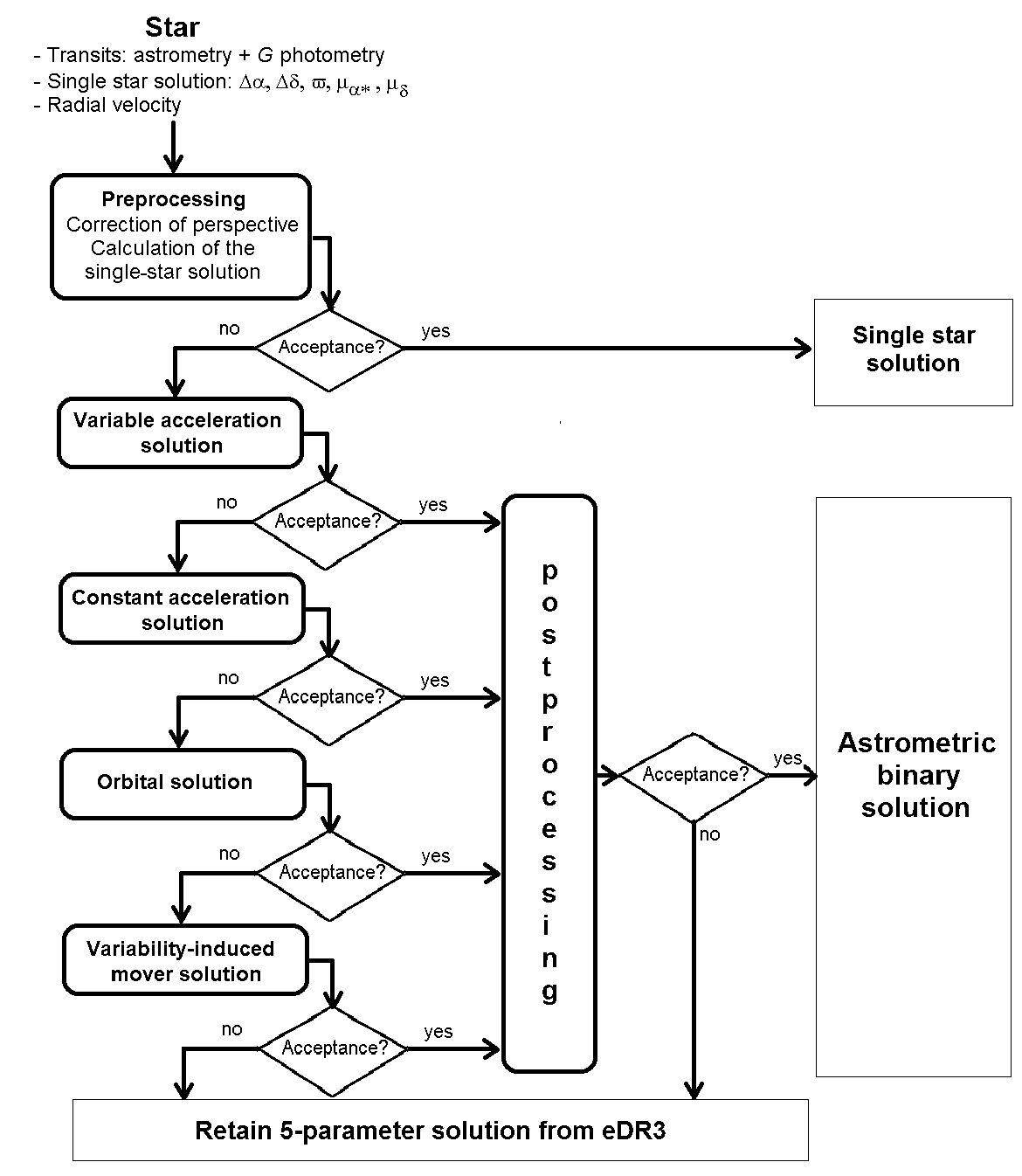
- 采用多阶段处理级联,首先利用IPD指标($ipd\_frac\_multi\_peak \leq 2$,$ipd\_gof\_harmonic\_amplitude < 0.1$)剔除部分分辨双星。
- 使用光度通量过剩因子 $C^{*}$ 拒绝 $G$ 波段 magnitude 行为异常的恒星,采用 $|C^{*}| < 1.645\sigma_{C^{*}}$ 以获得90%置信度。
- 优先测试加速度模型,当加速度拟合结果超过接受阈值时再尝试轨道模型。
- 仅对具有单一主导成分的光度变星应用变光诱导运动(VIM)模型。
- 通过质心与变星组分之间的中位距离验证解的可靠性,采用高 $F_2$ 阈值以限制误报。
- 通过附录中提供的解析公式,从索列-英尼斯元素推导坎贝尔轨道元素的不确定性。
实验结果
研究问题
- RQ1在盖亚DR3中,具有高RUWE值和长观测基线的恒星中,有多少比例最能用天体测量加速度而非单星运动来解释?
- RQ2光度和基于IPD的筛选标准在双星建模前有效剔除部分分辨双星的效率如何?
- RQ3加速度、轨道和VIM模型在检测未分辨双星方面的相对性能与可靠性如何?
- RQ4VIM模型在识别具有一个光度变星组分的系统方面成功程度如何?
- RQ5筛选阈值与模型接受标准如何影响最终双星星表的完整性和纯净度?
主要发现
- 最终星表包含338,215个加速度解、165,500个轨道解和869个VIM解,显著扩展了以往的天体测量双星星表。
- 通过应用IPD和 $C^{*}$ 筛选标准,初始的3650万候选体被减少至4,115,743颗恒星。
- VIM解稀少(869个),仅限于固定组分模型,且由于处理级联中后期应用,可能被系统性低估。
- 采用高 $F_2$ 阈值及接受测试中的 $c$-系数,有效抑制了具有两个变星组分的VIMF解,降低了污染。
- 统计检验表明污染可忽略:加速度解在自行中未表现出轨道运动特征,VIM解未产生倾角为90°的轨道解。
- 附录提供了从索列-英尼斯元素计算坎贝尔轨道元素不确定性的解析公式,实现了误差传播的一致性。
更好的研究,从现在开始
从阅读论文到最终审阅,大幅缩短您的研究时间。
无需绑定信用卡
本解读由 AI 生成,并经人工编辑审核。