
[论文解读] GALACTICNUCLEUS: A high-angular-resolution JHKs imaging survey of the Galactic centre III. Evidence for wavelength dependence of the extinction curve in the near-infrared
本研究利用来自 GALACTICNUCLEUS 巡天的超过 165,000 颗红巨星分支星的高角分辨率 JHKs 光度测量,分析了银河系中心的近红外消光曲线。研究提供了强有力的证据,表明消光指数具有波长依赖性,其中 α_JH = 2.44 ± 0.05 且 α_HKs = 2.23 ± 0.05,表明在较短波长处消光更陡峭,同时发现消光指数在视线方向或总消光上无显著变化。
The characterisation of the extinction curve in the near infrared (NIR) is fundamental to analyse the structure and stellar population of the Galactic centre (GC), whose analysis is hampered by the extreme interstellar extinction ($A_V\sim 30$ mag) that varies on arc-second scales. Recent studies indicate that the behaviour of the extinction curve might be more complex than previously assumed, pointing towards a variation of the extinction curve as a function of wavelength. We aim at analysing the variations of the extinction index, $α$, with wavelength, line-of-sight, and absolute extinction, extending previous analysis to a larger area of the innermost regions of the Galaxy. We analysed the whole GALACTICNUCLEUS survey, a high-angular resolution ($\sim 0.2''$) $JHK_s$ NIR survey specially designed to observe the GC in unprecedented detail. It covers a region of $\sim 6000$\,pc$^2$, comprising fields in the nuclear stellar disc, the inner bulge, and the transition region between them. We applied two independent methods based on red clump (RC) stars to constrain the extinction curve and analysed its variation superseding previous studies. We used more than 165,000 RC stars and increased significantly the size of the regions analysed to confirm that the extinction curve varies with the wavelength. We estimated a difference $Δα= 0.21\pm0.07$ between the obtained extinction indices, $α_{JH}=2.44\pm0.05$ and $α_{HK_s} = 2.23\pm0.05$. We also concluded that there is no significant variation of the extinction curve with wavelength, with the line-of-sight or the absolute extinction. Finally, we computed the ratios between extinctions, $A_J/A_H = 1.87\pm0.03$ and $A_{H}/A_{K_s} = 1.84\pm0.03$, consistent with all the regions of the GALACTICNUCLEUS catalogue.
研究动机与目标
- 表征银河系中心的近红外消光曲线,该区域极端消光(AV ~ 30 mag)使恒星族和结构分析复杂化。
- 调查消光指数 α 是否随波长、视线方向或总消光变化,以挑战单一幂律消光曲线的假设。
- 通过将红巨星分支星用作具有明确定义的固有颜色的标准烛光,克服宽带光度测量中的退化问题。
- 通过量化波长依赖性消光效应,提高对银河系最内区恒星距离和消光测量的准确性。
提出的方法
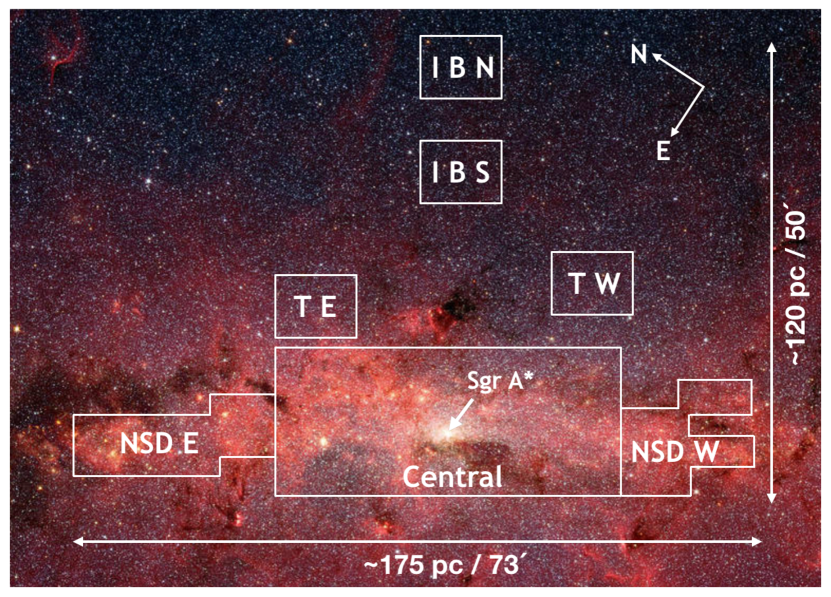
- 利用覆盖核球盘、内球状星团及过渡区域的约 6000 pc² 区域的高角分辨率(≈0.2")JHKs 成像数据,数据来自 GALACTICNUCLEUS 巡天。
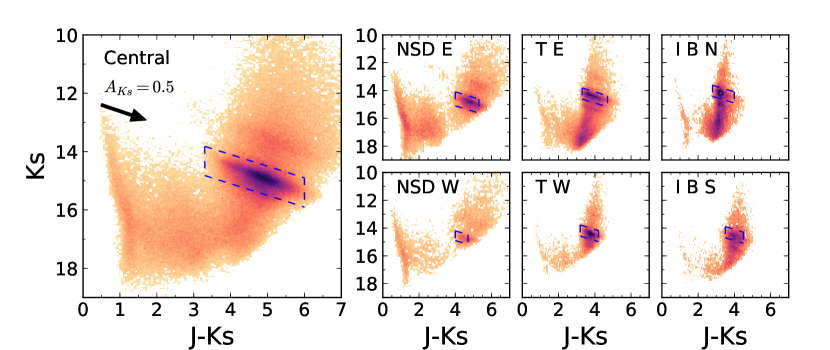
- 通过颜色-星等图识别出超过 165,000 颗红巨星分支星,作为具有已知固有 J−H 和 H−Ks 颜色的标准烛光。
- 采用两种独立方法,通过拟合 Aλ ∝ λ^−α 到观测的 JHKs 星等,推导出消光指数 α,同时校正差异消光。
- 为每个区域和星类计算有效中心波长(λ_eff),以最小化光度退化,使用每片场的平均绝对消光。
- 通过平方根传播不确定度,并利用外部消光模型(如 Schlafly & Finkbeiner 2016,Nishiyama et al. 2009)交叉验证结果。
- 通过比较不同场和消光水平下的 α 值,评估视线方向和消光水平的依赖性,排除低质量的 NSD W 场。
实验结果
研究问题
- RQ1在银河系中心,近红外消光指数 α 是否随波长变化,从而挑战标准幂律假设?
- RQ2在银河系最内区,消光曲线是否依赖于视线方向或总消光水平?
- RQ3红巨星分支星能否提供一种稳健、系统的方法来测量波长依赖性消光,而不会受到恒星类型退化的影响?
- RQ4所推导的消光比值 A_J/A_H 和 A_H/A_Ks 与标准模型相比如何,它们对消光曲线形状有何启示?
- RQ5在宽带滤光片中,非线性光度效应在多大程度上会偏差消光曲线测量结果?是否可通过使用大规模、同质的红巨星分支星样本减轻此问题?
主要发现
- 消光指数 α 显示出显著的波长依赖性,其中 α_JH = 2.44 ± 0.05 且 α_HKs = 2.23 ± 0.05,导致 Δα = 0.21 ± 0.07 的差异。
- 所有区域的消光比值一致:A_J/A_H = 1.87 ± 0.03 和 A_H/A_Ks = 1.84 ± 0.03,支持消光曲线形状非均匀。
- 在视线方向或总消光水平上未发现 α 的显著变化,表明在所调查的区域中消光曲线在空间上是不变的。
- 观测到的 α 的波长依赖性是稳健的,非系统误差或退化所致,经外部模型和替代方法交叉验证确认。
- 结果反驳了早期关于 α 依赖于总消光的主张,这些主张被证明源于方法学偏差和 NSD 中恒星距离的混合。
- 研究结果表明,假设单一幂律消光曲线可能导致显著偏差(例如,消光上约 0.3 mag),在距离和恒星族分析中需引入波长依赖性校正。
更好的研究,从现在开始
从阅读论文到最终审阅,大幅缩短您的研究时间。
无需绑定信用卡
本解读由 AI 生成,并经人工编辑审核。