
[论文解读] GenCast: Diffusion-based ensemble forecasting for medium-range weather
GenCast 是一种基于 ML 的扩散模型,以 1°×1° 分辨率生成 15 天全球天气集合,在多项概率指标上优于 ENS,同时具有较高的计算效率。它为 84 个变量提供物理一致、时空连贯的预报。
Weather forecasts are fundamentally uncertain, so predicting the range of probable weather scenarios is crucial for important decisions, from warning the public about hazardous weather, to planning renewable energy use. Here, we introduce GenCast, a probabilistic weather model with greater skill and speed than the top operational medium-range weather forecast in the world, the European Centre for Medium-Range Forecasts (ECMWF)'s ensemble forecast, ENS. Unlike traditional approaches, which are based on numerical weather prediction (NWP), GenCast is a machine learning weather prediction (MLWP) method, trained on decades of reanalysis data. GenCast generates an ensemble of stochastic 15-day global forecasts, at 12-hour steps and 0.25 degree latitude-longitude resolution, for over 80 surface and atmospheric variables, in 8 minutes. It has greater skill than ENS on 97.4% of 1320 targets we evaluated, and better predicts extreme weather, tropical cyclones, and wind power production. This work helps open the next chapter in operational weather forecasting, where critical weather-dependent decisions are made with greater accuracy and efficiency.
研究动机与目标
- 在高影响力领域的不确定性决策中,推动进行概率预测。
- 通过建模联合时空分布与物理一致性,解决以 RMSE 为中心的 ML 模型的局限性。
- 开发基于扩散的生成模型,以生成天气轨迹集合。
- 在再分析数据上训练,以在 1°1° 分辨率下生成覆盖 15 天、涉及 84 个变量的全球预报。
提出的方法
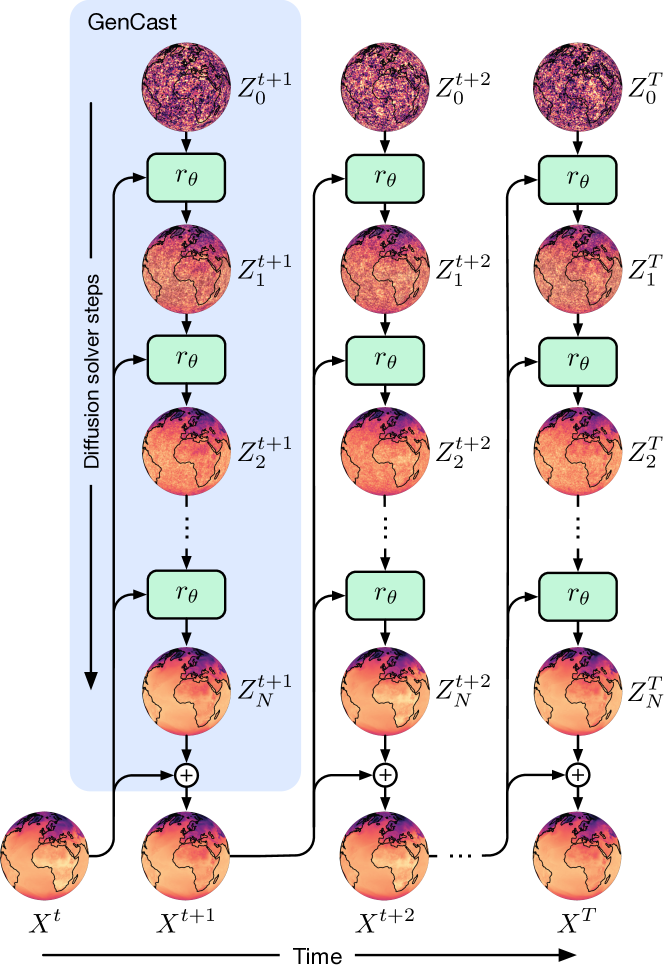
- 对 p(X^t|X^{t-2:t-1}) 建模,使用一个扩散去噪器预测相对于 X^{t-1} 的残差 Z^t。
- 使用残差采样 X^t = X^{t-1} + S Z^t(降水:X^t = S Z^t)。
- 在经过改进的二十面体网格上采用稀疏 Transformer 处理器,以处理时空条件。
- 用对变量、层次和面积加权网格单元的加权均方误差目标来训练 D_theta。
- 使用基于 ODE 的求解器(DPMSolver++)在每个预测时间步进行 20 步采样,以产生 15 天轨迹。
- 从 ERA5 再分析(以及 ERA5-EDA 扰动)初始化集合,以进行概率采样。
实验结果
研究问题
- RQ1基于扩散的 ML 模型是否能够在 1°1° 分辨率下生成高达 15 天的概率性、物理上一致的天气集合?
- RQ2GenCast 在 CRPS、集合均值 RMSE 和极端事件指标上,是否比运营中的 ENS 集合具有更高的技能和可靠性?
- RQ3与传统 NWP 集合相比,基于 ML 的集合是否保持了物理上合理的谱特性?
- RQ4在生成长范围预报时,GenCast 相对于传统 NWP 集合的计算效率是多少?
- RQ5在多变量和不同长时间步的极端事件预测(Brier 分数)中,GenCast 集合的表现如何?
主要发现
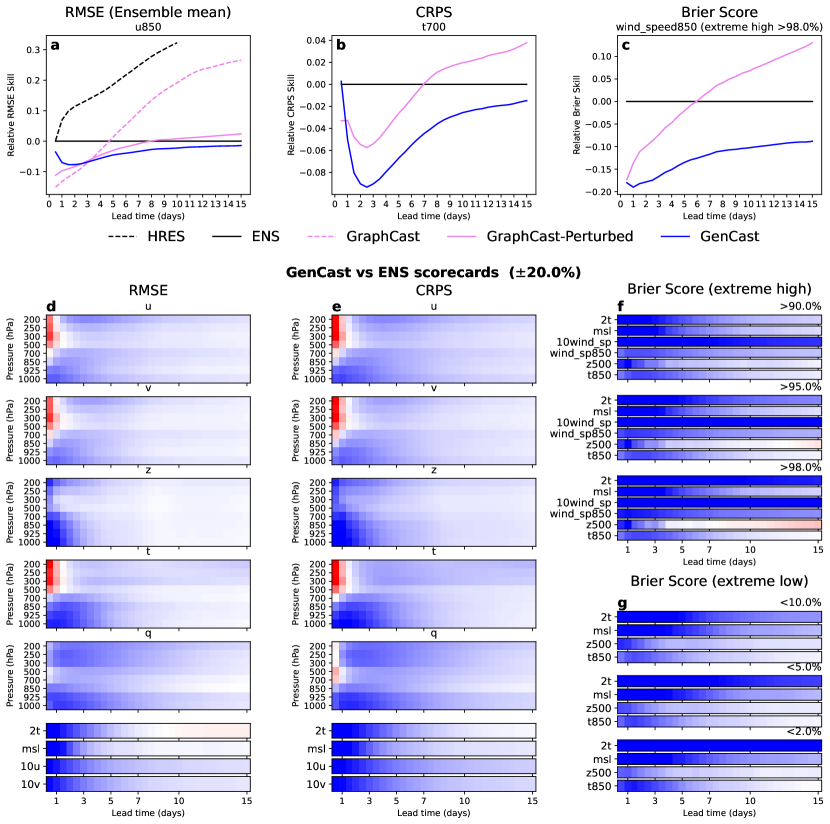
- 在持续时间至多 15 天的情形中,GenCast 在 CRPS 的表现超越 ENS 的比例为 97.3%,在 Ensemble-Mean RMSE 的表现超越比例为 96.4%。
- GenCast 在大气变量上平均 CRPS 提升 4.8%,在地表变量上提升 7.9%;RMSE 提升为大气 3.5%,地表 5.4%。
- GenCast 保持可靠性和物理一致的功率谱,保留的高频内容比 GraphCast-Perturbed 更接近真值。
- GenCast 展现出清晰、具有时空相干性的多样化集合成员,避免了 RMSE 训练模型常见的模糊化。
- 极端事件预测(Brier 分数)显示 GenCast 在 97.6% 的案例中优于 ENS,测试事件的平均提升为 12.6%。
更好的研究,从现在开始
从论文设计到论文写作,大幅缩短您的研究时间。
无需绑定信用卡
本解读由 AI 生成,并经人工编辑审核。