
[论文解读] General SIS diffusion process with indirect spreading pathways on a hypergraph
本文提出了一种在有向超图上推广的SIS扩散模型,通过多项式及一般相互作用函数捕捉直接成对互动与间接高阶互动。研究证明,即使基本再生数R₀ < 1,高阶互动仍可引发双稳态现象,并表明在双病毒系统中,共存均衡通常不稳定,解会收敛至健康状态或主导地方性流行状态。
While conventional graphs only characterize pairwise interactions, higher-order networks (hypergraph, simplicial complex) capture multi-body interactions, which is a potentially more suitable modeling framework for a complex real system. However, the introduction of higher-order interactions brings new challenges for the rigorous analysis of such systems on a higher-order network. In this paper, we study a series of SIS-type diffusion processes with both indirect and direct pathways on a directed hypergraph. In a concrete case, the model we propose is based on a specific choice (polynomial) of interaction function (how several agents influence each other when they are in a hyperedge). Then, by the same choice of interaction function, we further extend the system and propose a bi-virus competing model on a directed hypergraph by coupling two single-virus models together. Finally, the most general model in this paper considers an abstract interaction function under single-virus and bi-virus settings. For the single-virus model, we provide the results regarding healthy state and endemic equilibrium. For the bi-virus setting, we further give an analysis of the existence and stability of the healthy state, dominant endemic equilibria, and coexisting equilibria. All theoretical results are finally supported by some numerical examples.
研究动机与目标
- 在超图上建立包含直接成对互动与间接高阶互动的SIS型扩散过程模型。
- 分析单病毒与双病毒系统在一般相互作用函数下的健康状态与地方性流行均衡的存在性与稳定性。
- 研究超越成对连接的高阶互动如何影响系统动力学,特别是双稳态与共存行为的出现。
- 通过引入非线性、非多项式相互作用函数,扩展先前的超图流行病模型研究,并在不可约性与单调性假设下证明系统收敛至均衡。
- 为这类系统的全局行为提供理论与数值支持,包括均衡稳定性与不稳定性条件。
提出的方法
- 使用多项式相互作用函数在有向超图上形式化广义SIS模型,以描述超边上的多智能体影响。
- 通过耦合两个单病毒系统,引入双病毒竞争模型,包含独立的感染率与高阶互动项。
- 利用单调动力系统理论工具分析系统,证明所有系统均为不可约且单调。
- 通过特征值分析与李雅普诺夫函数,推导健康状态、地方性流行均衡与共存均衡的存在性与稳定性条件。
- 通过不同初始条件与系统参数的数值模拟验证分析结果,尤其关注双稳态与共存均衡的不稳定性。
- 将模型推广至抽象的非多项式相互作用函数,表明在温和假设下,核心动力学行为(如收敛至均衡)依然成立。
实验结果
研究问题
- RQ1在什么条件下,超图上的单病毒SIS模型即使在基本再生数R₀ < 1时仍表现出双稳态?
- RQ2通过超边实现的高阶互动如何影响单病毒与双病毒模型中地方性流行均衡的稳定性与存在性?
- RQ3在双病毒系统中,超图上共存均衡存在的条件是什么?其是否稳定?
- RQ4当相互作用函数被推广至多项式形式之外时,系统行为如何变化?收敛至均衡的现象是否仍然成立?
- RQ5在不可约性与单调性假设下,系统的全局动力学能否被完整刻画?这对控制策略有何启示?
主要发现
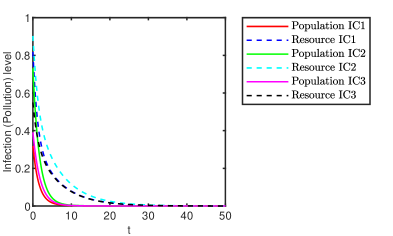
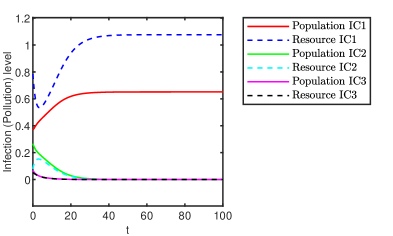
- 即使基本再生数R₀ < 1,单病毒SIS模型在超图上仍可能因高阶互动的影响而出现双稳态。
- 当R₀ > 1且高阶互动项足够小时,唯一的地方性流行均衡是全局稳定的。
- 在双病毒模型中,共存均衡仅在特定参数条件下存在,但数值模拟一致表明其不稳定。
- 无论采用多项式还是抽象相互作用函数,广义SIS模型在超图上的解,只要系统不可约且单调,总会收敛至一个均衡点。
- 数值模拟验证了分析结果:在单病毒与双病毒系统中,解均收敛至健康状态或主导地方性流行状态,未观察到收敛至共存均衡的现象。
- 系统作为不可约单调动力系统,确保长期收敛至均衡,从而为基于超图的流行病动力学提供了统一的理论框架。
更好的研究,从现在开始
从阅读论文到最终审阅,大幅缩短您的研究时间。
无需绑定信用卡
本解读由 AI 生成,并经人工编辑审核。