
[论文解读] Generalized cluster states from Hopf algebras: non-invertible symmetry and Hopf tensor network representation
本文提出了一种使用霍普夫代数的聚类态广义构造方法,其中任意维度的自由度被替换为霍普夫代数取值的任意维度。通过利用正则作用和表示作用定义广义泡利算符,该框架实现了非可逆对称性,并为一维霍普夫聚类态构造了一个能隙哈密顿量,该哈密顿量被证明等价于准一维霍普夫量子双模型,从而确立了一类具有非可逆全局对称性的对称保护拓扑相。
Cluster states are crucial resources for measurement-based quantum computation (MBQC). It exhibits symmetry-protected topological (SPT) order, thus also playing a crucial role in studying topological phases. We present the construction of cluster states based on Hopf algebras. By generalizing the finite group valued qudit to a Hopf algebra valued qudit and introducing the generalized Pauli-X operator based on the regular action of the Hopf algebra, as well as the generalized Pauli-Z operator based on the irreducible representation action on the Hopf algebra, we develop a comprehensive theory of Hopf qudits. We demonstrate that non-invertible symmetry naturally emerges for Hopf qudits. Subsequently, for a bipartite graph termed the cluster graph, we assign the identity state and trivial representation state to even and odd vertices, respectively. Introducing the edge entangler as controlled regular action, we provide a general construction of Hopf cluster states. To ensure the commutativity of the edge entangler, we propose a method to construct a cluster lattice for any triangulable manifold. We use the 1d cluster state as an example to illustrate our construction. As this serves as a promising candidate for SPT phases, we construct the gapped Hamiltonian for this scenario and provide a detailed discussion of its non-invertible symmetries. We demonstrate that the 1d cluster state model is equivalent to the quasi-1d Hopf quantum double model with one rough boundary and one smooth boundary. We also discuss the generalization of the Hopf cluster state model to the Hopf ladder model through symmetry topological field theory. Furthermore, we introduce the Hopf tensor network representation of Hopf cluster states by integrating the tensor representation of structure constants with the string diagrams of the Hopf algebra, which can be used to solve the Hopf cluster state model.
研究动机与目标
- 通过使用霍普夫代数作为任意维度假设自由度的底层代数结构,将聚类态的构造推广至有限群之外。
- 通过正则作用和不可约表示作用,发展一套一致的霍普夫任意维度假设自由度理论,以定义广义泡利算符。
- 展示所构造的霍普夫聚类态中非可逆对称性的出现。
- 为一维霍普夫聚类态构造一个能隙哈密顿量,并建立其与准一维霍普夫量子双模型的等价性。
- 通过将结构常数的张量表示与霍普夫代数的弦图形式结合,引入霍普夫张量网络表示。
提出的方法
- 通过将有限群取值的任意维度假设自由度替换为霍普夫代数取值的任意维度假设自由度来定义霍普夫任意维度假设自由度,使用正则作用定义广义泡利-X算符,使用不可约表示作用定义广义泡利-Z算符。
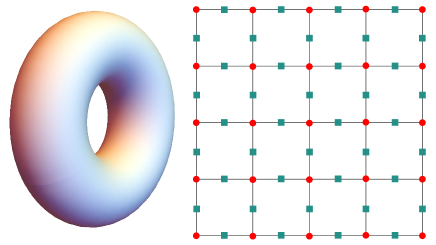
- 在二分图聚类晶格上,通过在边上施加正则作用的受控操作来构建边纠缠操作,将偶数顶点分配为单位态,奇数顶点分配为平凡表示态。
- 通过在可三角剖分流形上构建一致的边排序和顶点分配方案,确保边纠缠操作的可交换性,从而在任意流形上构造聚类晶格。
- 通过识别稳定子项为作用在相邻位点上的广义泡利算符的乘积,推导出一维霍普夫聚类态的能隙哈密顿量。
- 通过哈密顿量映射和对称性分析,建立一维霍普夫聚类态模型与准一维霍普夫量子双模型之间的等价性。
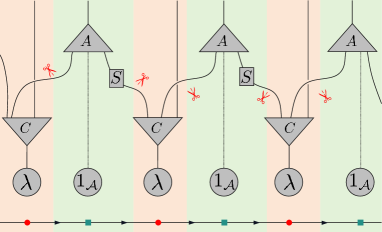
- 通过将霍普夫代数的结构常数编码为张量网络,并与弦图形式语言结合,引入霍普夫张量网络表示,以保证拓扑不变性。
实验结果
研究问题
- RQ1如何通过使用霍普夫代数作为底层代数结构,将聚类态的构造推广至有限群之外?
- RQ2非可逆对称性在霍普夫聚类态中扮演什么角色?它们如何从霍普夫代数的代数结构中涌现?
- RQ3能否为一维霍普夫聚类态构造一个能隙哈密顿量,使其实现具有非可逆全局对称性的对称保护拓扑相?
- RQ4在一维霍普夫聚类态与准一维霍普夫量子双模型之间,其哈密顿量结构和拓扑序的关系是什么?
- RQ5如何系统地构造霍普夫张量网络表示,以编码霍普夫聚类态的代数与拓扑特征?
主要发现
- 通过在霍普夫代数上使用正则作用和表示作用构造霍普夫任意维度假设自由度,系统中自然涌现出非可逆对称性。
- 通过在可三角剖分流形上构建晶格,使聚类态构造中的边纠缠操作保持可交换性,从而实现一致的态制备。
- 一维霍普夫聚类态哈密顿量被证明等价于准一维霍普夫量子双模型,将其与已知的拓扑量子场论联系起来。
- 一维霍普夫聚类态实现了一个具有非可逆全局对称性的对称保护拓扑相,其对称性由表示范畴 Rep(D₈) 描述,与近期关于非可逆对称性的研究结果一致。
- 通过将结构常数的张量表示与弦图形式结合,建立了霍普夫张量网络表示,为该态提供了一个图解化且代数一致的框架。
- 该模型将基于有限群的聚类态推广,并通过霍普夫代数将框架扩展至非可逆对称性,提供了比以往更广泛的SPT相类别。
更好的研究,从现在开始
从阅读论文到最终审阅,大幅缩短您的研究时间。
无需绑定信用卡
本解读由 AI 生成,并经人工编辑审核。