
[论文解读] Generative agent-based modeling with actions grounded in physical, social, or digital space using Concordia
本文介绍 Concordia,一个用于构建生成性主体模型(GABMs)的库,其中主体通过自然语言行动,游戏大师模拟环境,从而实现对物理、社会或数字空间的 grounding,并可与外部 API 集成。
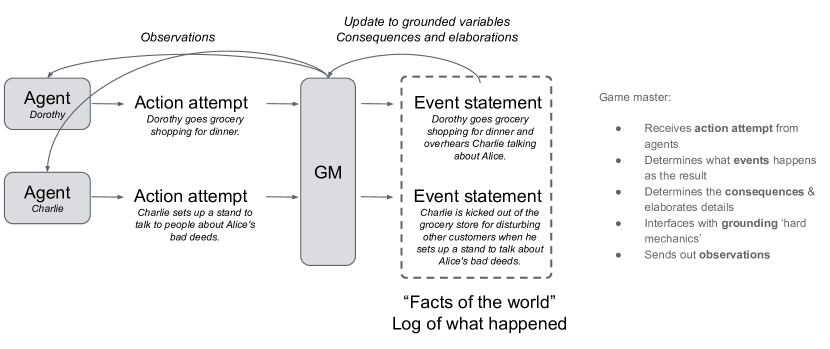
Agent-based modeling has been around for decades, and applied widely across the social and natural sciences. The scope of this research method is now poised to grow dramatically as it absorbs the new affordances provided by Large Language Models (LLM)s. Generative Agent-Based Models (GABM) are not just classic Agent-Based Models (ABM)s where the agents talk to one another. Rather, GABMs are constructed using an LLM to apply common sense to situations, act "reasonably", recall common semantic knowledge, produce API calls to control digital technologies like apps, and communicate both within the simulation and to researchers viewing it from the outside. Here we present Concordia, a library to facilitate constructing and working with GABMs. Concordia makes it easy to construct language-mediated simulations of physically- or digitally-grounded environments. Concordia agents produce their behavior using a flexible component system which mediates between two fundamental operations: LLM calls and associative memory retrieval. A special agent called the Game Master (GM), which was inspired by tabletop role-playing games, is responsible for simulating the environment where the agents interact. Agents take actions by describing what they want to do in natural language. The GM then translates their actions into appropriate implementations. In a simulated physical world, the GM checks the physical plausibility of agent actions and describes their effects. In digital environments simulating technologies such as apps and services, the GM may handle API calls to integrate with external tools such as general AI assistants (e.g., Bard, ChatGPT), and digital apps (e.g., Calendar, Email, Search, etc.). Concordia was designed to support a wide array of applications both in scientific research and for evaluating performance of real digital services by simulating users and/or generating synthetic data.
研究动机与目标
- 将 Concordia 作为一个灵活的库用于构建生成性主体模型(GABMs)。
- 描述在基于 LLM 的行动生成与环境 grounding 之间调解的模块化体系结构。
- 展示环境(Game Master)与主体通过自然语言行动和基于事件的变量交互。
- 讨论用于科学与数字服务评估的验证、解释及广泛应用。
- 概述评估 GABMs 泛化与有效性的最佳实践与未来方向。
提出的方法
- 主体以自然语言生成行动,由 Game Master(GM)进行 grounding。
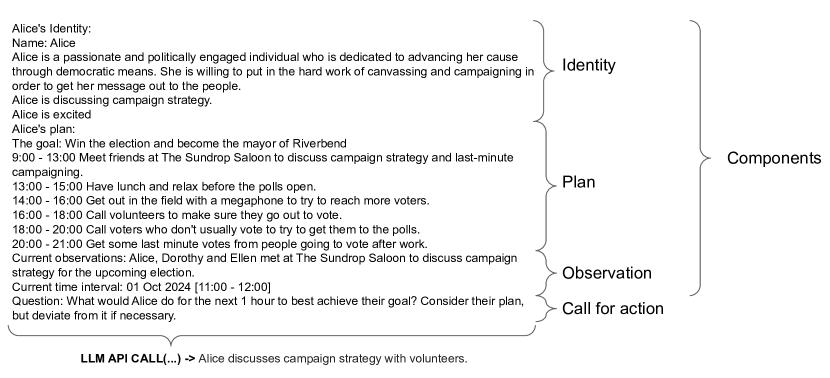
- 行动通过两步过程产生:(1) 由工作记忆/组件形成上下文,(2) 在长期记忆和当前状态约束下采样行动。
- GM 将行动转化为环境事件并发出观测,同时维持 grounding 变量与世界状态。
- 环境和主体都是生成式的,允许通过组件(ODE、FSM 等)将物理、数字或金融过程模型整合进来。
- 数字环境可以通过 API 调用或模拟表示与外部应用和服务接口。
- 记忆架构使用联想记忆和基于组件的上下文,类似“心智社会”,以条件化 LLM 提示。
实验结果
研究问题
- RQ1一个生成性主体模型如何使用自然语言和LLMs 在物理、社会或数字空间中对行动进行现实 grounding?
- RQ2哪些架构组件(记忆、计划、感知、 grounding 变量)能够实现连贯的主体行为和稳健的环境交互?
- RQ3游戏大师如何有效地模拟环境并跨主体与行动管理 grounding 变量?
- RQ4哪些最佳实践和验证策略支持 GABMs 对真实世界情境的泛化?
主要发现
- Concordia 使以自然语言行动和环境 grounding 结果为基础的 GABMs 的灵活构建成为可能。
- 主体使用模块化组件和联想记忆来条件化 LLM 提示,产生连贯行为。
- GM 管理世界状态、 grounding 变量、事件和观测,能够从选举到数字应用交互等多样化仿真。
- 数字环境通过 API 与真实应用和服务集成,支持合成数据生成和服务评估。
- 该框架讨论了验证策略,包括泛化、算法保真、模型比较、鲁棒性以及 GABMs 的认知伦理规范。
更好的研究,从现在开始
从论文设计到论文写作,大幅缩短您的研究时间。
无需绑定信用卡
本解读由 AI 生成,并经人工编辑审核。