
[论文解读] GenPhys: From Physical Processes to Generative Models
本文提出了GenPhys,一个统一框架,可将物理过程中产生的平滑生成型偏微分方程(PDE)转化为新型生成模型。通过识别‘s-生成型’PDE——即随时间平滑且描述密度流的PDE——该框架推广了扩散模型与泊松流模型,并发现了新家族,如杨-米尔斯生成模型,从而拓展了物理启发式生成建模的设计空间。
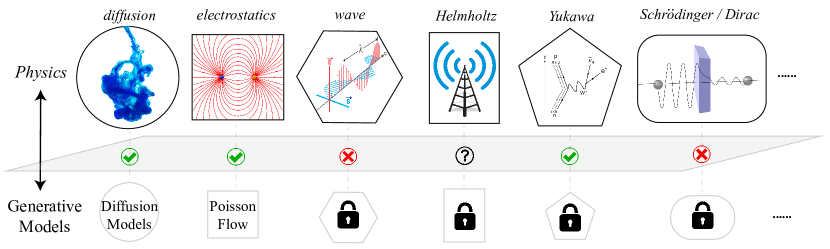
Since diffusion models (DM) and the more recent Poisson flow generative models (PFGM) are inspired by physical processes, it is reasonable to ask: Can physical processes offer additional new generative models? We show that the answer is yes. We introduce a general family, Generative Models from Physical Processes (GenPhys), where we translate partial differential equations (PDEs) describing physical processes to generative models. We show that generative models can be constructed from s-generative PDEs (s for smooth). GenPhys subsume the two existing generative models (DM and PFGM) and even give rise to new families of generative models, e.g., "Yukawa Generative Models" inspired from weak interactions. On the other hand, some physical processes by default do not belong to the GenPhys family, e.g., the wave equation and the Schrödinger equation, but could be made into the GenPhys family with some modifications. Our goal with GenPhys is to explore and expand the design space of generative models.
研究动机与目标
- 建立一个系统性框架,用于从由PDE描述的物理过程中推导生成模型。
- 识别一类广泛的PDE——指定为‘s-生成型’——其可通过平滑与密度流动力学生成有效的生成模型。
- 在单一理论框架下统一现有的生成模型,如扩散模型与泊松流模型。
- 发现新的生成模型家族,如杨-米尔斯生成模型,其灵感源自弱核力等物理相互作用。
- 探索非平滑与非线性PDE在当前s-生成型约束之外的理论与实际潜力。
提出的方法
- 将's-生成型'PDE定义为满足两个条件的PDE:(C1) 描述密度流,(C2) 其解通过高频模态更快衰减而随时间变得平滑。
- 利用色散关系严格评估PDE是否满足平滑条件(C2),从而实现PDE按s-生成型、条件性s-生成型或非s-生成型进行分类。
- 通过GenPhys框架将物理PDE(如扩散方程、泊松方程、杨-米尔斯方程)映射到相应的生成模型,确保PDE满足s-生成型标准。
- 将生成过程表述为从简单初始分布(如高斯分布)到数据分布的连续时间演化,由PDE的流引导。
- 将该框架应用于已知模型:扩散模型对应热方程,泊松流模型对应泊松方程,新模型则对应如杨-米尔斯方程等方程。
- 提出对非线性、时变及非对称PDE的扩展作为未来方向,尽管核心分析聚焦于线性、时不变、对称PDE。
实验结果
研究问题
- RQ1能否系统性地将由PDE描述的物理过程转化为生成模型?
- RQ2PDE需满足何种数学条件,才能通过平滑与密度流动力学生成有效的生成模型?
- RQ3现有的生成模型如扩散与泊松流模型是否可作为更广泛物理过程驱动生成建模框架下的特例?
- RQ4能否从已知扩散与泊松类型之外的物理PDE中推导出新的生成模型家族?
- RQ5当前框架的局限性是什么,特别是针对非平滑、非线性或时变PDE?
主要发现
- 该框架成功将扩散模型与泊松流生成模型作为GenPhys的特例纳入其中,其中扩散方程与泊松方程均为s-生成型PDE。
- 本文引入了‘杨-米尔斯生成模型’作为一类新生成模型家族,其源自杨-米尔斯(屏蔽泊松)方程,灵感来自弱核力相互作用。
- 通过色散关系正式定义了‘s-生成型’PDE,提供了一套严格的判据,用于判断PDE是否能产生适合生成建模的平滑流。
- 如波动方程与薛定谔方程等PDE默认并非s-生成型,但可通过修改使其成为s-生成型,暗示未来扩展的潜力。
- 该框架揭示了物理与生成建模之间的对偶性并非偶然,而是数学上根植于描述平滑密度流的PDE结构。
- 本文识别出大量尚未探索的机遇,包括非线性PDE(如纳维-斯托克斯方程)、时变PDE与非对称PDE,这些可能产生超越当前s-生成型范畴的新生成模型家族。
更好的研究,从现在开始
从阅读论文到最终审阅,大幅缩短您的研究时间。
无需绑定信用卡
本解读由 AI 生成,并经人工编辑审核。