
[论文解读] Geodesic Optimization for Predictive Shift Adaptation on EEG data
GOPSA 在 SPD 流形上学习域特定的测地传输,以联合作用对齐基于协方差的 EEG 特征和预测性变化,从而提升来自静息态 EEG 的跨站点年龄预测。
Electroencephalography (EEG) data is often collected from diverse contexts involving different populations and EEG devices. This variability can induce distribution shifts in the data $X$ and in the biomedical variables of interest $y$, thus limiting the application of supervised machine learning (ML) algorithms. While domain adaptation (DA) methods have been developed to mitigate the impact of these shifts, such methods struggle when distribution shifts occur simultaneously in $X$ and $y$. As state-of-the-art ML models for EEG represent the data by spatial covariance matrices, which lie on the Riemannian manifold of Symmetric Positive Definite (SPD) matrices, it is appealing to study DA techniques operating on the SPD manifold. This paper proposes a novel method termed Geodesic Optimization for Predictive Shift Adaptation (GOPSA) to address test-time multi-source DA for situations in which source domains have distinct $y$ distributions. GOPSA exploits the geodesic structure of the Riemannian manifold to jointly learn a domain-specific re-centering operator representing site-specific intercepts and the regression model. We performed empirical benchmarks on the cross-site generalization of age-prediction models with resting-state EEG data from a large multi-national dataset (HarMNqEEG), which included $14$ recording sites and more than $1500$ human participants. Compared to state-of-the-art methods, our results showed that GOPSA achieved significantly higher performance on three regression metrics ($R^2$, MAE, and Spearman's $ρ$) for several source-target site combinations, highlighting its effectiveness in tackling multi-source DA with predictive shifts in EEG data analysis. Our method has the potential to combine the advantages of mixed-effects modeling with machine learning for biomedical applications of EEG, such as multicenter clinical trials.
研究动机与目标
- 在基于 EEG 的预测建模中同时处理输入数据 X(协方差矩阵)和目标变量 y 的分布漂移。
- 开发一种多源测试时域自适应方法,无需在目标域重新训练。
- 利用 SPD 矩阵的黎曼几何,在共享全局回归模型的同时学习域特定的测地截距。
- 展示基于 EEG 协方差数据的跨站点年龄预测泛化能力的提升。
- 提供一个将混合效应模型与机器学习相结合的多中心 EEG 分析框架。
提出的方法
- 将 EEG 协方差矩阵表示为 SPD 流形 S_d^{++} 的点,并使用仿射不变黎曼度量来计算测地距离。
- 定义一个黎曼混合效应模型,通过从每个域的均值沿着到单位矩阵的测地线进行平行传输来学习域特定的测地截距。
- 在黎曼对数映射后的切空间中学习一个共享的线性回归,并在训练时对域权重 α_k 进行优化以控制传输程度。
- 在训练时,联合优化所有 K 个源域的域传输和岭回归系数(算法 1)。
- 在测试时,通过优化传输参数 γ_T 将目标均值 y_T 与预测对齐,以适应新的目标域(算法 2)。
- 关键方程包括传输 φ(Σ_i, Σ_k̄, α) = uvec(log_I(PT(Σ_i, Σ_k̄, α))) 以及在岭正则回归下对 γ_S 和 γ_T 的优化。
![Figure 1: Joint shift in $X$ and $y$ distributions on the HarMNqEEG dataset [ 31 ] . Subset of mean PSDs ( A ) and age distributions ( B ) from three recording sites used for the empirical benchmarks.](https://ar5iv.labs.arxiv.org/html/2407.03878/assets/x1.png)
实验结果
研究问题
- RQ1当 EEG 数据中输入协方差矩阵的漂移和结果变量 y 的漂移同时存在时,如何进行域自适应?
- RQ2在 SPD 流形上应用的基于测地线的多源、测试时自适应方法是否能够优于现有的重新居中和域自适应基线在 EEG 回归任务中的表现?
- RQ3在共享全局回归模型的同时学习域特定的测地截距(平行传输)对跨站点 EEG 年龄预测有什么好处?
主要发现
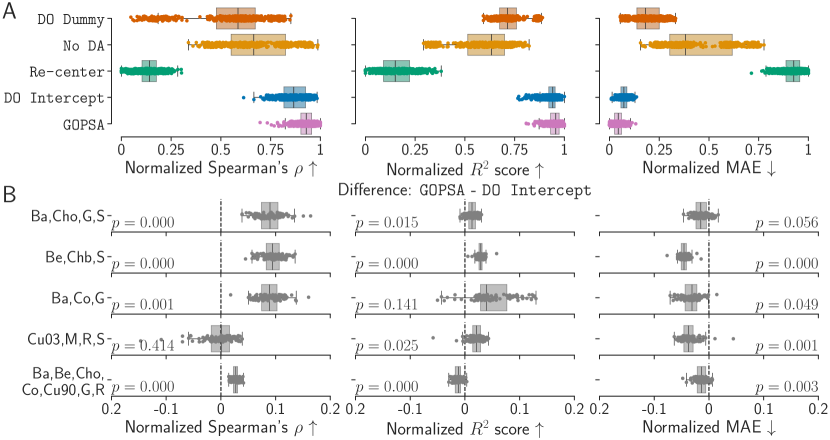
- GOPSA 在 HarMNqEEG 站点组合的回归指标上,相比若干基线(Dummy DO、No DA、Re-center、DO Intercept)取得更高的性能。
- 在 Spearman 相关系数 ρ 的平均值上,GOPSA 达到 0.78 ± 0.01,超过包括 DO Intercept 在内的替代方案(0.75 ± 0.02)。
- 在 R^2 的平均值上,GOPSA 达到 0.61 ± 0.02,高于 Do Intercept(0.58 ± 0.02)。
- 在 MAE 的平均值上,GOPSA 产生 8.25 ± 0.19,优于 Re-center(8.55 ± 0.18)。
- 在具体站点对上,GOPSA 相较基线方法持续提升,证明了在多站点 EEG 数据中处理预测性漂移的有效性。
更好的研究,从现在开始
从阅读论文到最终审阅,大幅缩短您的研究时间。
无需绑定信用卡
本解读由 AI 生成,并经人工编辑审核。