
[论文解读] Giant effective magnetic moments of chiral phonons from orbit-lattice coupling
本文通过轨道-晶格耦合,提出了一种关于手性声子中巨大有效磁矩的微观理论,其中圆极化晶格振动诱导轨道态之间的跃迁,产生约一个玻尔磁子量级的磁矩——比以往预测大几个数量级。该机制源于光学声子与电子轨道跃迁的混合,定量解释了4f稀士卤化物中大的声子Zeeman能级分裂,并预测在3d过渡金属氧化物中,当轨道能级与声子能量共振时,也会出现类似效应。
Circularly polarized lattice vibrations carry angular momentum and lead to magnetic responses in applied magnetic fields or when resonantly driven with ultrashort laser pulses. Recent measurements have found responses that are orders of magnitude larger than those calculated in prior theoretical studies. Here, we present a microscopic model for the effective magnetic moments of chiral phonons in magnetic materials that is able to reproduce the experimentally measured magnitudes and that allows us to make quantitative predictions for materials with giant magnetic responses using microscopic parameters. Our model is based on orbit-lattice couplings that hybridize optical phonons with orbital electronic transitions. We apply our model to two types of materials: $4f$ rare-earth halide paramagnets and $3d$ transition-metal oxide magnets. In both cases, we find that chiral phonons can carry giant effective magnetic moments of the order of a Bohr magneton, orders of magnitude larger than previous predictions.
研究动机与目标
- 解决实验观测到的巨大声子磁矩(高达玻尔磁子量级)与以往理论预测(通常为核磁子量级)之间长期存在的矛盾。
- 建立一个微观模型,以定量解释顺磁性和磁性材料中手性声子所观测到的巨大有效磁矩。
- 阐明轨道-晶格耦合在强电子关联和自旋-轨道耦合体系中生成这些巨大磁矩的作用。
- 预测新材料和新条件——尤其是3d过渡金属氧化物——中可实现此类巨大磁响应。
提出的方法
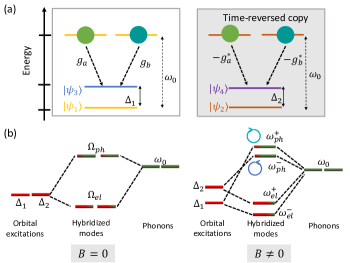
- 基于轨道-晶格耦合构建微观模型,其中手性声子诱导不同轨道态之间的跃迁,类似于拉曼过程。
- 进行全面的群论分析,以识别手性声子模与电子轨道跃迁之间允许的耦合。
- 将该模型应用于4f稀士卤化物,其中强自旋-轨道耦合与小的晶体场分裂使声子与CEF激发态之间产生强混合。
- 将模型扩展至3d过渡金属氧化物,其中声子与由自旋-轨道耦合或晶格畸变引起的轨道分裂多重态发生混合。
- 利用第一性原理计算提取微观参数(如有效电荷、轨道矩阵元),并将其输入自旋-轨道耦合哈密顿量框架。
- 从声子耦合态之间轨道电流算符的矩阵元推导有效磁矩,将其与可观测的声子Zeeman分裂联系起来。
实验结果
研究问题
- RQ1何种微观机制可解释实验观测到的手性声子巨大有效磁矩(比传统模型预测大几个数量级)?
- RQ2轨道-晶格耦合如何介导角动量从手性晶格振动传递至电子轨道自由度,从而产生巨大的有效磁矩?
- RQ3为何4f稀士卤化物中的声子Zeeman分裂远大于仅由离子回磁比预期的值?
- RQ4该机制是否也能在3d过渡金属氧化物中产生巨大磁响应,尽管自旋-轨道耦合较弱但轨道分裂较大?
- RQ5在何种条件下——特别是声子与电子跃迁能量共振时——有效磁矩可达到玻尔磁子量级?
主要发现
- 该模型仅使用第一性原理参数,定量再现了五十年前在4f稀士卤化物中观测到的巨大声子Zeeman分裂。
- 在4f体系中,由于与晶体场激发态的混合,手性声子获得约一个玻尔磁子量级的有效磁矩,这得益于强自旋-轨道耦合。
- 在3d过渡金属氧化物中,当声子模式能量与轨道跃迁能量共振时,相同的轨道-晶格耦合机制可产生相当大的有效磁矩。
- 有效磁矩与耦合态之间轨道电流算符的矩阵元成正比,该矩阵元受强自旋-轨道耦合和轨道杂化增强。
- 该理论预测,具有近简并轨道多重态和手性声子的材料可表现出显著的声子Zeeman效应和反常法拉第效应,从而实现通过超快声子激发控制磁化。
- 该模型为具有巨大声子响应的顺磁性和磁性材料提供了统一解释,解决了以往理论方法中的不一致性。
更好的研究,从现在开始
从阅读论文到最终审阅,大幅缩短您的研究时间。
无需绑定信用卡
本解读由 AI 生成,并经人工编辑审核。