
[论文解读] Global transformer overheating from geomagnetic storms
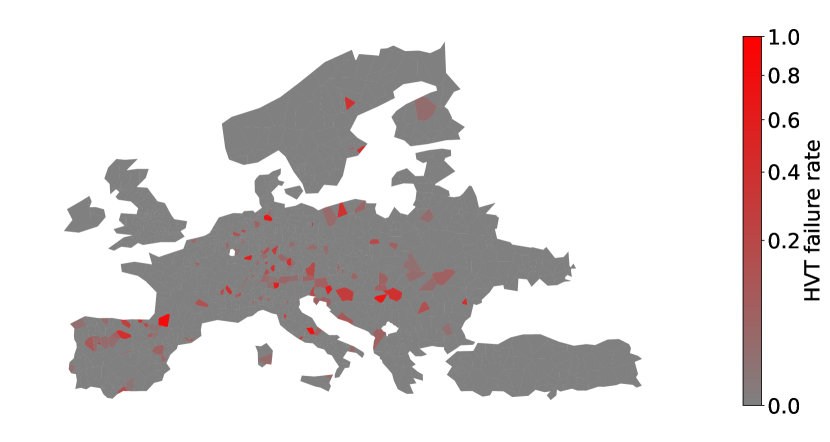
本文提出了一套全球尺度的框架,用于评估地磁风暴引起的变压器过热风险,采用地电场、全球电导率模型以及高压变压器的热力模拟。估算表明,千年一遇的地磁风暴可能导致欧洲0.99%的人口(超过740万人)和北美0.86%的人口(超过410万人)长期停电。
Geomagnetic storms occurring due to sustained, high-speed solar winds are known to induce currents in power distribution networks. These geomagnetically induced currents (GICs) can cause high voltage transformers (HVT) to overheat, thus resulting in a catastrophic electricity loss event (CELE). Since significant portions of infrastructures around the world rely heavily on access to electric power, it is essential to estimate the risks associated with GICs on a global scale. We assemble multiple methodologies across various scientific disciplines to develop a framework assessing the probability of a severe geomagnetic storm causing a long-term, widespread power outage. Our model incorporates thermal models of HVT tie bar hot spots, historical geoelectric field estimates, and a global conductivity model to estimate the risk of long-term power outage for regions between -70 degrees and 80 degrees geomagnetic latitude due to transformer overheating failure. Assuming a uniform 33% HVT spare capacity, our analysis indicates that a 1 in 10,000 year storm would result in approximately 1% of the population in Europe and North America experiencing a long-term (months to years) electricity loss.
研究动机与目标
- 为解决电力网络中地磁感应电流(GIC)全球尺度风险评估的缺失问题。
- 量化严重地磁风暴导致的变压器过热引发灾难性电力损失(CEL)的概率及其对人口的影响。
- 开发一个开源、可扩展的建模框架,适用于具备足够电网和地球物理数据的任何地区。
- 向政策制定者和基础设施规划者提供关于空间天气引发全球灾难性风险的信息。
提出的方法
- 整合地面站点的历史地磁场数据和大地电磁(MT)传递函数,以估算地电场。
- 应用全球电导率模型,将地电场估算值外推至数据有限的区域。
- 利用高压变压器(HVT)连接杆热点的热力模型,预测在GIC作用下的过热故障。
- 结合OpenStreetMap和NERC/EPRI数据的电网拓扑结构,以及变压器故障概率,估算区域电力损失。
- 对调整后的地电场水平采用对数正态分布拟合,以估算参考位置的风暴重现期和强度。
- 使用开源Python代码执行模型,可在标准硬件上运行,无需超级计算资源。
![Figure 2: Peak $60$ -second geoelectric field magnitude for a $1$ -in- $100$ year storm in Europe (top) and North America (bottom). The colour indicates the field level [V/km].](https://ar5iv.labs.arxiv.org/html/2403.18070/assets/x1.png)
实验结果
研究问题
- RQ1地磁风暴导致的变压器过热在全球范围内的风险如何,特别是在极端事件中?
- RQ2在千年一遇的风暴下,欧洲和北美的人口受长期停电影响的程度如何随停电概率变化?
- RQ3在磁大地电磁数据有限的情况下,地电场估算在全球范围内的外推程度如何?
- RQ4变压器备用容量和电网拓扑结构的变化如何影响大范围停电的可能性?
- RQ5能否开发一个统一的、开源的建模框架,以实现对GIC引发的变压器故障进行大规模评估?
主要发现
- 千年一遇的地磁风暴将导致欧洲约0.99%的人口(超过740万人)经历长期电力中断。
- 在北美,相同风暴将影响0.86%的人口(超过410万人)导致长期停电。
- 在极端事件下,模型估算的总预期电力损失为欧洲49.71 GW,北美56.12 GW。
- 该框架为开源,可在标准个人计算机上运行,具备广泛可及性与区域适应性。
- 研究识别出数据限制——尤其是电网和磁大地电磁数据的不足——为主要制约因素,而非模型结构。
- 该模型为GIC引发的变压器故障全球风险评估提供了基础性、可扩展的方法,未来可拓展至GDP和工业影响指标。
更好的研究,从现在开始
从阅读论文到最终审阅,大幅缩短您的研究时间。
无需绑定信用卡
本解读由 AI 生成,并经人工编辑审核。