
[论文解读] Graph Decision Transformer
本文提出图决策变压器(GDT),一种新型离线强化学习方法,通过将状态-动作-奖励序列建模为因果图,以更好地捕捉时间依赖性和因果依赖性。通过使用关系增强注意力的图变压器,并结合可选的序列变压器处理视觉输入,GDT在Atari和OpenAI Gym基准测试中实现了最先进性能,尤其在长序列和高信息密度环境中优于现有方法。
Offline reinforcement learning (RL) is a challenging task, whose objective is to learn policies from static trajectory data without interacting with the environment. Recently, offline RL has been viewed as a sequence modeling problem, where an agent generates a sequence of subsequent actions based on a set of static transition experiences. However, existing approaches that use transformers to attend to all tokens naively can overlook the dependencies between different tokens and limit long-term dependency learning. In this paper, we propose the Graph Decision Transformer (GDT), a novel offline RL approach that models the input sequence into a causal graph to capture potential dependencies between fundamentally different concepts and facilitate temporal and causal relationship learning. GDT uses a graph transformer to process the graph inputs with relation-enhanced mechanisms, and an optional sequence transformer to handle fine-grained spatial information in visual tasks. Our experiments show that GDT matches or surpasses the performance of state-of-the-art offline RL methods on image-based Atari and OpenAI Gym.
研究动机与目标
- 为解决标准Transformer在离线强化学习中对状态、动作与奖励之间依赖关系建模不足的问题,通过更有效地建模其依赖关系。
- 通过在输入序列中显式编码因果关系,提升非马尔可夫环境中长序列依赖学习能力。
- 通过整合针对补丁的序列变压器,保留视觉输入中的细粒度空间信息。
- 通过在输入表示中引入因果结构,减少对返回目标奖励塑造的依赖。
- 在图像为基础的离线强化学习基准(如Atari和OpenAI Gym)中实现最先进性能。
提出的方法
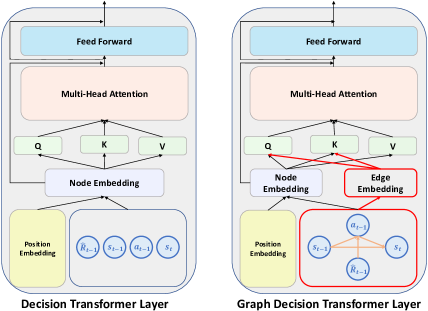
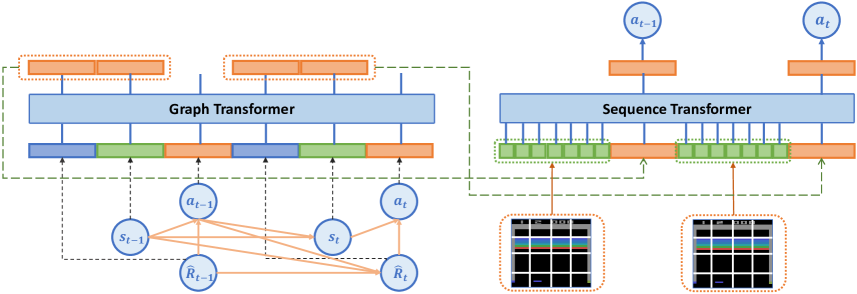
- 将状态-动作-奖励三元组的输入序列转换为因果图,其中节点代表标记,边编码时间与因果关系。
- 使用节点嵌入与边嵌入计算图注意力机制中的查询(Q)与键(K)矩阵,而仅使用节点嵌入计算值(V)矩阵。
- 应用图变压器处理图结构化输入,实现对长期依赖与因果先验的有效建模。
- 集成可选的序列变压器,将图像状态按补丁处理(类似ViT),提升视觉任务中的空间特征提取能力。
- 通过三种方式连接图变压器与序列变压器:替换、融合或堆叠,其中堆叠在高信息密度环境中表现最优。
- 将模型训练为监督序列建模任务,基于输入图与可选的视觉编码,预测动作序列。
实验结果
研究问题
- RQ1将离线强化学习输入建模为因果图,是否相比标准序列建模能更有效地提升长期依赖学习能力?
- RQ2在非马尔可夫环境中,显式编码状态、动作与奖励之间的因果关系,对性能有何影响?
- RQ3在离线强化学习基准中,使用关系增强注意力的图变压器是否优于标准Transformer?
- RQ4在视觉强化学习环境中,可选的序列变压器在多大程度上提升了动作预测性能?
- RQ5GDT在不同奖励设置下的表现如何,特别是在减少对返回目标依赖方面的表现?
主要发现
- GDT在基于图像的Atari和OpenAI Gym离线强化学习环境中,优于最先进方法,实现了新的最先进结果。
- 随着输入序列长度增加,GDT表现出显著性能提升,而标准决策变压器性能趋于饱和,表明其具备更优的长序列建模能力。
- 图结构输入降低了对返回目标奖励塑造的依赖,GDT在逐步奖励设置下仍保持强性能,而DT则表现欠佳。
- 在高信息密度的Atari环境中,GDT-Stack连接方法(在序列变压器末尾堆叠图特征)在特征精炼方面表现最佳。
- 在低信息密度的Gym环境中,GDT-Fusion方法(早期融合图与序列特征)通过有效结合不同抽象层次,实现了更优结果。
- 因果图表示有助于更好地解耦策略与世界动态,提升泛化能力,并减少价值估计中的过度乐观现象。
更好的研究,从现在开始
从阅读论文到最终审阅,大幅缩短您的研究时间。
无需绑定信用卡
本解读由 AI 生成,并经人工编辑审核。