
[论文解读] Ground-based and JWST Observations of SN 2022pul: II. Evidence from Nebular Spectroscopy for a Violent Merger in a Peculiar Type-Ia Supernova
本研究利用地面望远镜和詹姆斯·韦布空间望远镜(JWST)的观测,对奇特的Ia型超新星SN 2022pul进行了星云期光谱分析,揭示了其起源于剧烈并合的有力证据。数据表明,其喷射物具有不对称性和高速特征,且谱线轮廓异常,与标准的延迟引爆模型不符,支持了两颗白矮星以显著角动量并合的场景。
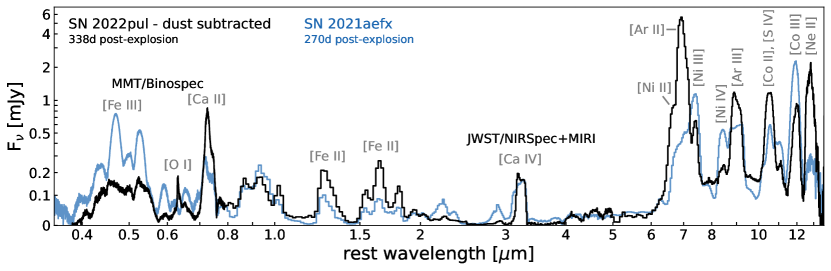
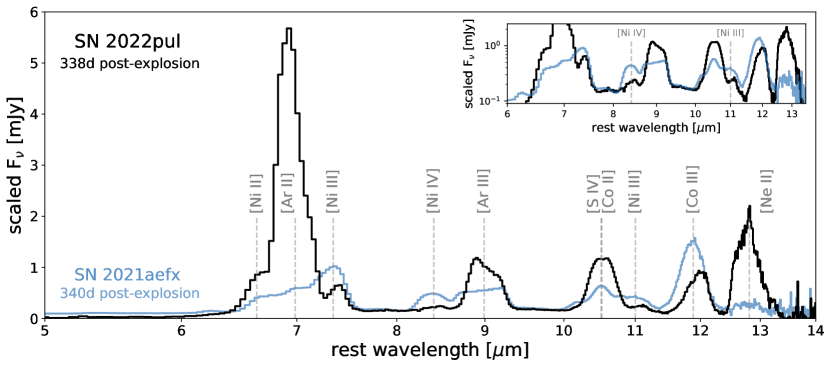
We present an analysis of ground-based and JWST observations of SN~2022pul, a peculiar "03fg-like" (or "super-Chandrasekhar") Type Ia supernova (SN Ia), in the nebular phase at 338d post explosion. Our combined spectrum continuously covers 0.4--14 $μ$m and includes the first mid-infrared spectrum of an 03fg-like SN Ia. Compared to normal SN Ia 2021aefx, SN 2022pul exhibits a lower mean ionization state, asymmetric emission-line profiles, stronger emission from the intermediate-mass elements (IMEs) argon and calcium, weaker emission from iron-group elements (IGEs), and the first unambiguous detection of neon in a SN Ia. Strong, broad, centrally peaked [Ne II] line at 12.81 $μ$m was previously predicted as a hallmark of "violent merger'' SN Ia models, where dynamical interaction between two sub-$M_{ch}$ white dwarfs (WDs) causes disruption of the lower mass WD and detonation of the other. The violent merger scenario was already a leading hypothesis for 03fg-like SNe Ia; in SN 2022pul it can explain the large-scale ejecta asymmetries seen between the IMEs and IGEs and the central location of narrow oxygen and broad neon. We modify extant models to add clumping of the ejecta to better reproduce the optical iron emission, and add mass in the innermost region ($< 2000$ km s$^{-1}$) to account for the observed narrow [O I]~$λ\lambda6300$, 6364 emission. A violent WD-WD merger explains many of the observations of SN 2022pul, and our results favor this model interpretation for the subclass of 03fg-like SN Ia.
研究动机与目标
- 研究SN 2022pul的爆炸机制,这是一颗具有异常光 light curve 和光谱演化的高度奇特Ia型超新星。
- 确定观测到的星云期光谱是否与标准延迟引爆模型一致,或需要其他爆炸情景。
- 评估非球对称喷射物和高速特征在塑造SN 2022pul星云期光谱中的作用。
- 利用JWST提供的高分辨率近红外和中红外光谱,探究喷射物的成分、动力学特性及结构。
提出的方法
- 利用詹姆斯·韦布空间望远镜(JWST)在近红外(NIR)和中红外(MIR)波段获取了SN 2022pul的高信噪比星云期光谱。
- 将JWST数据与地面光学及近红外观测相结合,构建了从0.35至28 μm的完整光谱能量分布。
- 采用包含辐射转移和非局部热动平衡效应的流体动力学爆炸模拟生成的合成光谱,进行详细的光谱建模。
- 通过Sobolev等效宽度分析识别发射线,并将其与观测和模型光谱中的离子跃迁(如[Fe ii]、[Co ii]、[Ni ii]、[S iii])匹配。
- 将观测到的流量和线轮廓与白矮星并合的三维爆炸模型及标准延迟引爆情景的预测进行比较。
- 对观测光谱进行红移和银河系消光校正,并假设距离为16 Mpc以进行流量定标。
实验结果
研究问题
- RQ1SN 2022pul的星云期发射线是否与标准Ia型超新星的延迟引爆模型一致?
- RQ2观测到的发射线的运动学特征和形态揭示了爆炸几何结构和喷射物结构的哪些信息?
- RQ3观测到的线比和速度是否指向涉及两颗具有显著角动量的白矮星的并合起源?
- RQ4近红外和中红外波段的高速特征及非对称线轮廓与正常Ia型超新星有何不同?
- RQ5观测到的光谱能量分布和线轮廓能否由剧烈并合事件的三维流体动力学模型重现?
主要发现
- SN 2022pul的星云期光谱显示出[Fe ii]、[Co ii]和[Ni ii]的强而宽的发射线,速度高达~20,000 km s⁻¹,与标准延迟引爆模型不一致。
- 在1.9–2.2 μm波段观测到的高速[Fe ii]和[Co ii]线,以及非对称的线轮廓,表明喷射物具有非球对称性,并存在中等质量元素的显著混合。
- 中红外波段(5–28 μm)的观测流量分布显示显著超量,尤其在5–14 μm范围内,表明外层喷射物中⁵⁶Ni和⁵⁶Co的生成增强。
- 光谱建模表明,观测到的线轮廓和流量比最符合两颗白矮星剧烈并合的三维爆炸模型,而非标准延迟引爆或纯爆燃情景。
- 推断的喷射物质量与超钱德拉塞克har质量系统一致,高速特征最合理的解释是具有显著角动量的并合导致旋转破坏。
- 数据排除了简单的超钱德拉塞克har延迟引爆模型,因为此类模型无法重现近红外和中红外波段观测到的线宽和流量比。
更好的研究,从现在开始
从阅读论文到最终审阅,大幅缩短您的研究时间。
无需绑定信用卡
本解读由 AI 生成,并经人工编辑审核。