
[论文解读] Growing Excesses of New Scalars at the Electroweak Scale
该论文结合 ATLAS 与 CMS 的搜索,在一个简化的 H→SS* 框架下发现两个新的 EW 尺度标量:S′ ~95 GeV 和 S ~152 GeV,全球显著性约为 5σ,并可能通过 H→SS′ 脱变来解释多重轻重粒子异常。
We combine searches for scalar resonances at the electroweak scale performed by the Large Hadron Collider experiments ATLAS and CMS where persisted excesses have been observed in recent years. Using both the side-bands of Standard Model Higgs analyses as well as dedicated beyond the Standard Model analyses, we find significant hints for new scalars at $\approx 95\,$GeV ($S^\prime$) and $\approx152\,$GeV ($S$). The presence of a $95\,$GeV scalar is preferred over the Standard Model hypothesis by $3.8σ$, while interpreting the $152\,$GeV excesses in a simplified model with resonant pair production of $S$ via a new heavier scalar $H(270)$, a global significance of $\approx5σ$ is obtained. While the production mechanism of the $S^\prime$ cannot yet be determined, data strongly favours the associated production of $S$, i.e. via the decay of a heavier boson $H$ ($pp o H o SS^*$). A possible alternative or complementary decay chain is $H ightarrow SS^{\prime}$, where $S o WW^*$ ($S^{\prime}$) would be the source of the leptons ($b$-quarks) necessary to explain the multi-lepton anomalies found in Large Hadron Collider data.
研究动机与目标
- Motivate the search for additional scalar bosons beyond the Standard Model at the electroweak scale.
- Investigate whether persistent excesses in various channels point to new scalar resonances.
- Quantify the combined significance of potential resonances within a simplified production framework.
提出的方法
- Combine Higgs-sideband and beyond-Standard-Model analyses from ATLAS and CMS across multiple channels to build a global picture.
- Use p-values and Fisher’s combined probability test to aggregate evidence across channels with multiple degrees of freedom.
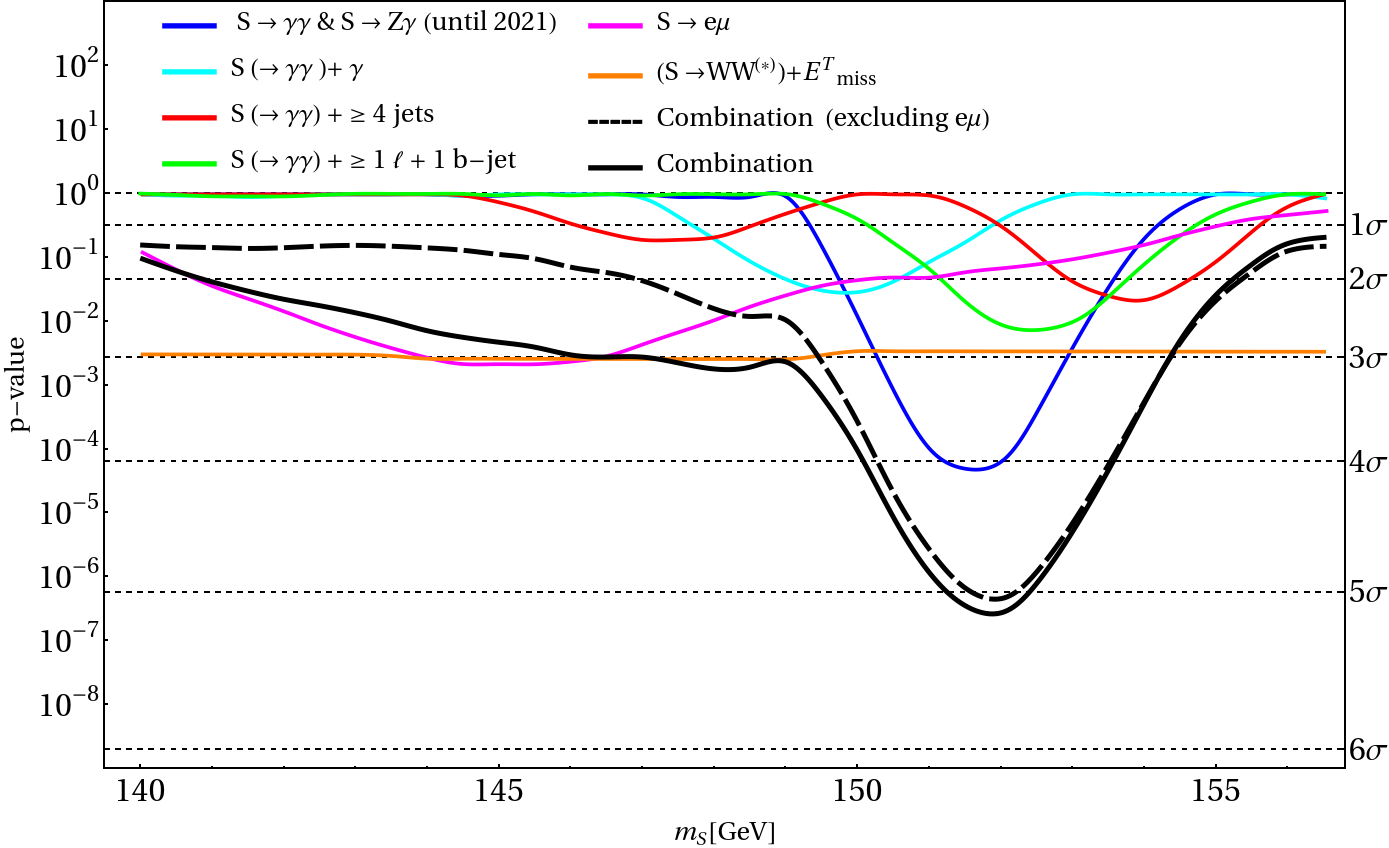
- Model the high-mass state S via a simplified H→SS* scenario with H ≈ 270 GeV and S with SM-like branching ratios, including possible invisible decays.
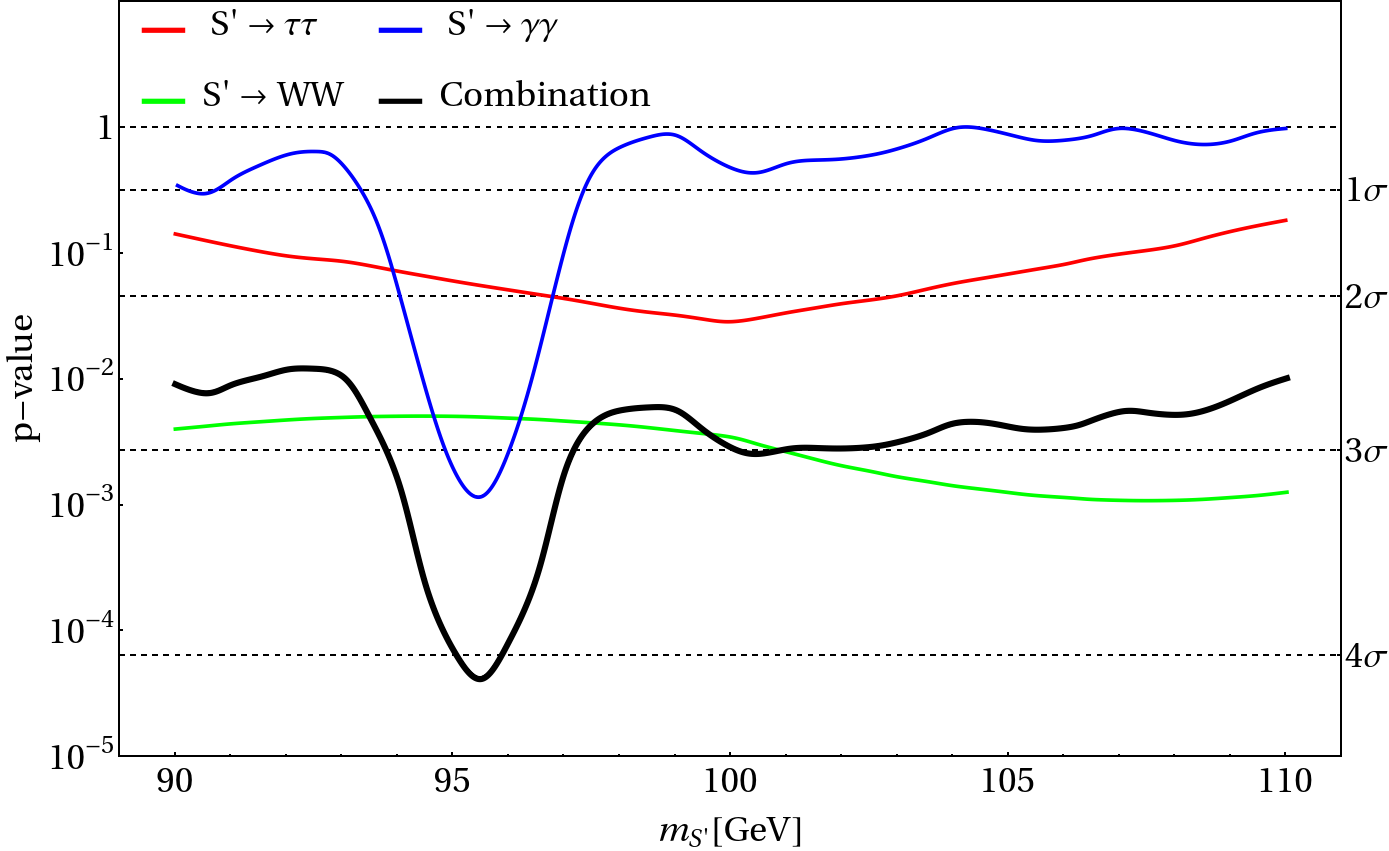
- Reconstruct S′ ~95 GeV by aggregating γγ, ττ, WW*, and related channels while accounting for look-elsewhere effects.
- Incorporate an exotic S→eμ channel in an alternative combination to test robustness of the 152 GeV signal.
实验结果
研究问题
- RQ1Do the low-mass (~95 GeV) and high-mass (~152 GeV) scalar hints persist when combining ATLAS and CMS data across multiple channels?
- RQ2Is a simplified H→SS* production mechanism capable of explaining the observed excesses without conflicting with SM Higgs measurements?
- RQ3What are the global significances of the proposed resonances after accounting for trial factors and channel-specific systematics?
- RQ4Could a decay chain H→SS′ (with S→WW* and S′→bb) explain multi-lepton anomalies observed at the LHC?
- RQ5Does including exotic channels like S→eμ materially alter the combined evidence for a 152 GeV state?
主要发现
- A low-mass scalar S′ around 95 GeV is preferred over the SM by about 3.8σ after accounting for look-elsewhere effects.
- A high-mass scalar S around 152 GeV yields a global significance of about 5σ in a simplified H→SS* model.
- The strongest 152 GeV signal arises when interpreting S as SM-like with additional H→SS* production, producing consistency with several channels.
- The data favor associated production of S, likely via decay of a heavier boson H (pp→H→SS*), with potential H→SS′ decays discussed as an explanation for multi-lepton anomalies.
- The absence of a clear S→ZZ*→4ℓ signal favors S being an SU(2) triplet neutral component in some models.
更好的研究,从现在开始
从阅读论文到最终审阅,大幅缩短您的研究时间。
无需绑定信用卡
本解读由 AI 生成,并经人工编辑审核。