
[论文解读] Hamiltonian Analysis of $f(Q)$ Gravity and the Failure of the Dirac-Bergmann Algorithm for Teleparallel Theories of Gravity
本文表明,由于算法基础假设(特别是动能矩阵的可逆性)的崩溃,Dirac-Bergmann约束分析在$f(\mathbb{Q})$引力及其相关规范理论中失效。通过基于对角化主动能矩阵的替代场重定义方法,作者证明$f(\mathbb{Q})$引力最多传播七个物理自由度,与先前声称的八个自由度相矛盾,揭示了标准哈密顿方法在非度规引力理论中的关键缺陷。
In recent years, $f(Q)$ gravity has enjoyed considerable attention in the literature and important results have been obtained. However, the question of how many physical degrees of freedom the theory propagates -- and how this number may depend on the form of the function $f$ -- has not been answered satisfactorily. In this article we show that a Hamiltonian analysis based on the Dirac-Bergmann algorithm -- one of the standard methods to address this type of question -- fails. We isolate the source of the failure, show that other commonly considered teleparallel theories of gravity are affected by the same problem, and we point out that the number of degrees of freedom obtained in Phys. Rev. D 106 no. 4, (2022) by K. Hu, T. Katsuragawa, and T. Qui (namely eight), based on the Dirac-Bergmann algorithm, is wrong. Using a different approach, we show that the upper bound on the degrees of freedom is seven. Finally, we propose a more promising strategy for settling this important question.
研究动机与目标
- 解决$f(\mathbb{Q})$引力中物理自由度数量长期存在的模糊性。
- 识别基于非度规性或扭转的规范理论中Dirac-Bergmann算法的失效。
- 纠正先前研究(Hu等,2022年)中关于$f(\mathbb{Q})$引力中存在八个物理自由度的错误主张。
- 为高阶导数、非度规引力理论中的自由度计数开发一种稳健的替代方法。
- 通过避免标准Dirac-Bergmann程序的陷阱,为规范引力中的哈密顿分析建立更可靠的框架。
提出的方法
- 作者使用广义形式的Dirac-Bergmann算法分析$f(\mathbb{Q})$引力的哈密顿结构,识别其假设在何处崩溃。
- 他们发现,失败的原因在于运动方程中的动能矩阵$\mathcal{K}$由于存在非平凡的空间导数混合矩阵$\mathcal{M}^{(i)}$而无法求逆。
- 提出一种新方法,涉及非线性场重定义,以对角化主动能矩阵,从而消除$\mathcal{M}^{(i)}$矩阵并恢复可逆性。
- 该方法依赖于从拉格朗日量的动能项和导数项构造一个对称主矩阵,该矩阵可对角化以实现场的解耦。
- 随后通过计数对角化后动能矩阵的非零特征值来确定物理自由度的数量。
- 该方法被推广至其他基于非度规性或扭转的规范理论,表明相同的失效机制具有普遍适用性。
实验结果
研究问题
- RQ1为何标准Dirac-Bergmann算法在$f(\mathbb{Q})$引力及其相关规范理论中失效?
- RQ2$f(\mathbb{Q})$引力中正确的物理自由度数量是多少,其与函数$f$的关系如何?
- RQ3能否在存在二阶时间导数与空间导数非平凡混合的理论中执行一致的哈密顿分析?
- RQ4Hu等(2022年)声称$f(\mathbb{Q})$引力中存在八个物理自由度是否成立?若不成立,正确的上限是多少?
- RQ5是否可以系统性地构建一种场重定义策略,以恢复Dirac-Bergmann算法在这些理论中的适用性?
主要发现
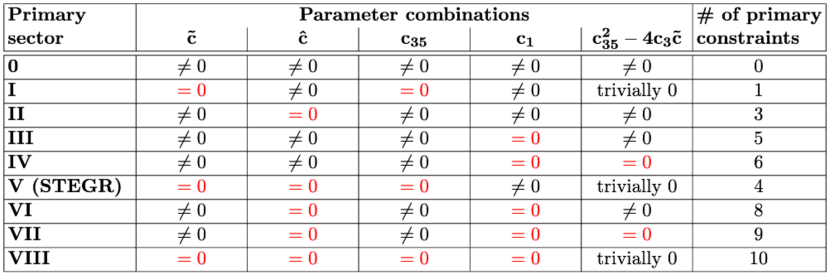
- Dirac-Bergmann算法在$f(\mathbb{Q})$引力中失效,原因在于动能矩阵$\mathcal{K}$由于存在非平凡的空间导数混合矩阵$\mathcal{M}^{(i)}$而不可逆。
- 先前研究(Hu等,2022年)声称$f(\mathbb{Q})$引力中存在八个物理自由度的主张是错误的,原因在于算法失效。
- 通过非线性场重定义,作者构建了一个可对角化的主动能矩阵,消除了有问题的$\mathcal{M}^{(i)}$项。
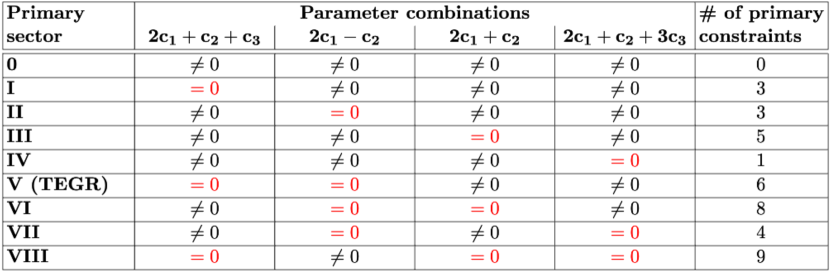
- 对角化后,通过计数非零特征值确定物理自由度数量,得出上限为七个。
- 该失效机制并非局限于$f(\mathbb{Q})$引力,而是影响所有具有类似导数结构的基于非度规性或扭转的规范理论。
- 所提出的该方法为在标准Dirac-Bergmann方法失效的高阶导数、非度规引力理论中执行更可靠的哈密顿分析提供了替代方案。
更好的研究,从现在开始
从阅读论文到最终审阅,大幅缩短您的研究时间。
无需绑定信用卡
本解读由 AI 生成,并经人工编辑审核。