
[论文解读] Hardware Trojan Detection using Graph Neural Networks
本文提出一种无需黄金参考的硬件后门(HT)检测方法,利用图神经网络(GNNs)分析RTL和门级网表的数据流图(DFGs)。通过从图表示中自动学习电路行为,该方法在RTL上实现97%的召回率,耗时21.1ms;在门级网表上实现84%的召回率,耗时13.42秒,能够实现快速、可扩展的检测,无需依赖参考设计,可识别已知和未知的HT。
The globalization of the Integrated Circuit (IC) supply chain has moved most of the design, fabrication, and testing process from a single trusted entity to various untrusted third-party entities around the world. The risk of using untrusted third-Party Intellectual Property (3PIP) is the possibility for adversaries to insert malicious modifications known as Hardware Trojans (HTs). These HTs can compromise the integrity, deteriorate the performance, and deny the functionality of the intended design. Various HT detection methods have been proposed in the literature; however, many fall short due to their reliance on a golden reference circuit, a limited detection scope, the need for manual code review, or the inability to scale with large modern designs. We propose a novel golden reference-free HT detection method for both Register Transfer Level (RTL) and gate-level netlists by leveraging Graph Neural Networks (GNNs) to learn the behavior of the circuit through a Data Flow Graph (DFG) representation of the hardware design. We evaluate our model on a custom dataset by expanding the Trusthub HT benchmarks \cite{trusthub1}. The results demonstrate that our approach detects unknown HTs with 97% recall (true positive rate) very fast in 21.1ms for RTL and 84% recall in 13.42s for Gate-Level Netlist.
研究动机与目标
- 为应对全球化IC供应链中,来自不可信第三方IP(3PIP)和EDA工具的硬件后门(HT)日益增长的风险。
- 克服现有HT检测方法依赖黄金参考、人工代码审查,或无法适应现代复杂设计的局限性。
- 开发一种可扩展、自动化且通用的HT检测框架,能够识别RTL和门级网表中的已知与未知HT。
- 通过利用基于图的表示和机器学习,实现在早期预硅阶段的硬件安全验证,实现高效且准确的HT检测。
提出的方法
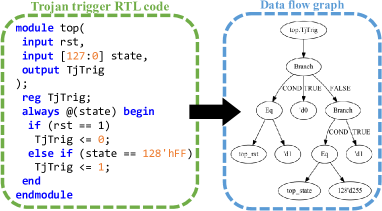
- 该方法从RTL和门级网表设计中构建数据流图(DFGs),以表示信号、寄存器和组合逻辑之间的数据与控制流。
- 在这些DFGs上训练图神经网络(GNNs),以学习内在电路行为,自动区分正常与恶意模式。
- GNN模型实现端到端的特征提取与分类,无需人工特征工程或黄金参考电路。
- 该方法使用基于Trusthub HT基准扩展的自定义数据集,对多样化HT变体进行模型训练与评估。
- 模型针对推理速度进行优化,在RTL上实现21.1ms的检测时间,在门级网表上实现13.42秒的检测时间。
- 通过学习行为模式而非匹配已知HT签名,该方法支持对未知HT的泛化能力。

实验结果
研究问题
- RQ1无黄金参考的HT检测方法是否能在RTL和门级网表上同时实现高召回率与快速推理?
- RQ2GNN是否能有效从DFG表示中学习并泛化,以检测未知HT,而无需事先了解恶意模式?
- RQ3与现有HT检测技术相比,该GNN方法在可扩展性、速度和准确性方面表现如何?
- RQ4该模型在面对结构或触发机制与已知示例不同的未见HT时,其泛化能力能达到何种程度?
- RQ5基于DFG的GNN方法是否能扩展至节点数量庞大、互连复杂的工业级大规模设计?
主要发现
- 所提出的基于GNN的方法在RTL网表中实现97%的召回率和94%的F1分数,平均检测时间为21.1ms。
- 在门级网表中,该方法实现84%的召回率和86%的F1分数,平均检测时间为13.42秒。
- 该模型在无需黄金参考电路的情况下成功检测出未知HT,证明其具备超越已知HT模式的泛化能力。
- 该方法优于依赖人工特征工程或子图匹配的传统方法,后者耗时且仅限于已知HT签名的检测。
- 使用DFG能够有效建模数据流与控制流,使GNN能够捕捉到恶意逻辑的异常行为特征。
- 该方法具备可扩展性和高效性,适用于工业设计环境中预硅阶段硬件验证流程的集成。
更好的研究,从现在开始
从阅读论文到最终审阅,大幅缩短您的研究时间。
无需绑定信用卡
本解读由 AI 生成,并经人工编辑审核。