
[论文解读] HE-DKSAP: Privacy-Preserving Stealth Address Protocol via Additively Homomorphic Encryption
该论文提出 HE-DKSAP,一种基于加法同态加密(特别是 Paillier)的隐私保护隐身地址协议,可增强交易不可链接性并抵抗量子攻击。通过将同态加密与双密钥隐身地址方案结合,HE-DKSAP 在保持高效计算和减少链上存储空间的同时,实现了强大的安全保证,相较于普通 DKSAP 具有更优性能。
Blockchain transactions have gained widespread adoption across various industries, largely attributable to their unparalleled transparency and robust security features. Nevertheless, this technique introduces various privacy concerns, including pseudonymity, Sybil attacks, and potential susceptibilities to quantum computing, to name a few. In response to these challenges, innovative privacy-enhancing solutions like zero-knowledge proofs, homomorphic encryption, and stealth addresses (SA) have been developed. Among the various schemes, SA stands out as it prevents the association of a blockchain transaction's output with the recipient's public address, thereby ensuring transactional anonymity. However, the basic SA schemes have exhibited vulnerabilities to key leakage and quantum computing attacks. To address these shortcomings, we present a pioneering solution - Homomorphic Encryption-based Dual-Key Stealth Address Protocol (HE-DKSAP), which can be further extended to Fully HE-DKSAP (FHE-DKSAP). By leveraging the power of homomorphic encryption, HE-DKSAP introduces a novel approach to safeguarding transaction privacy and preventing potential quantum computing attacks. This paper delves into the core principles of HE-DKSAP, highlighting its capacity to enhance privacy, scalability, and security in programmable blockchains. Through a comprehensive exploration of its design architecture, security analysis, and practical implementations, this work establishes a privacy-preserving, practical, and efficient stealth address protocol via additively homomorphic encryption.
研究动机与目标
- 解决传统区块链隐身地址协议中的隐私漏洞,包括密钥泄露和对量子计算攻击的脆弱性。
- 在不损害可扩展性的前提下,增强可编程区块链中的交易不可链接性和数据机密性。
- 设计一种新型协议,将同态加密与双密钥隐身地址机制结合,以实现更强的安全保障。
- 评估同态加密在隐身地址生成中的性能权衡,重点关注计算时间和链上存储开销。
- 为未来抗量子区块链应用扩展 HE-DKSAP 至全同态加密(FHE-DKSAP)奠定基础。
提出的方法
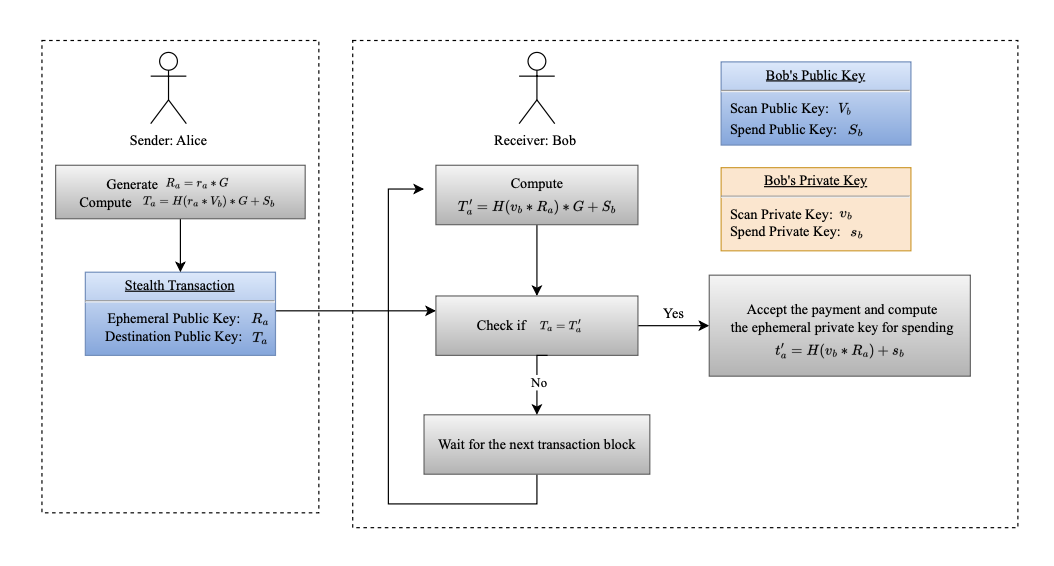
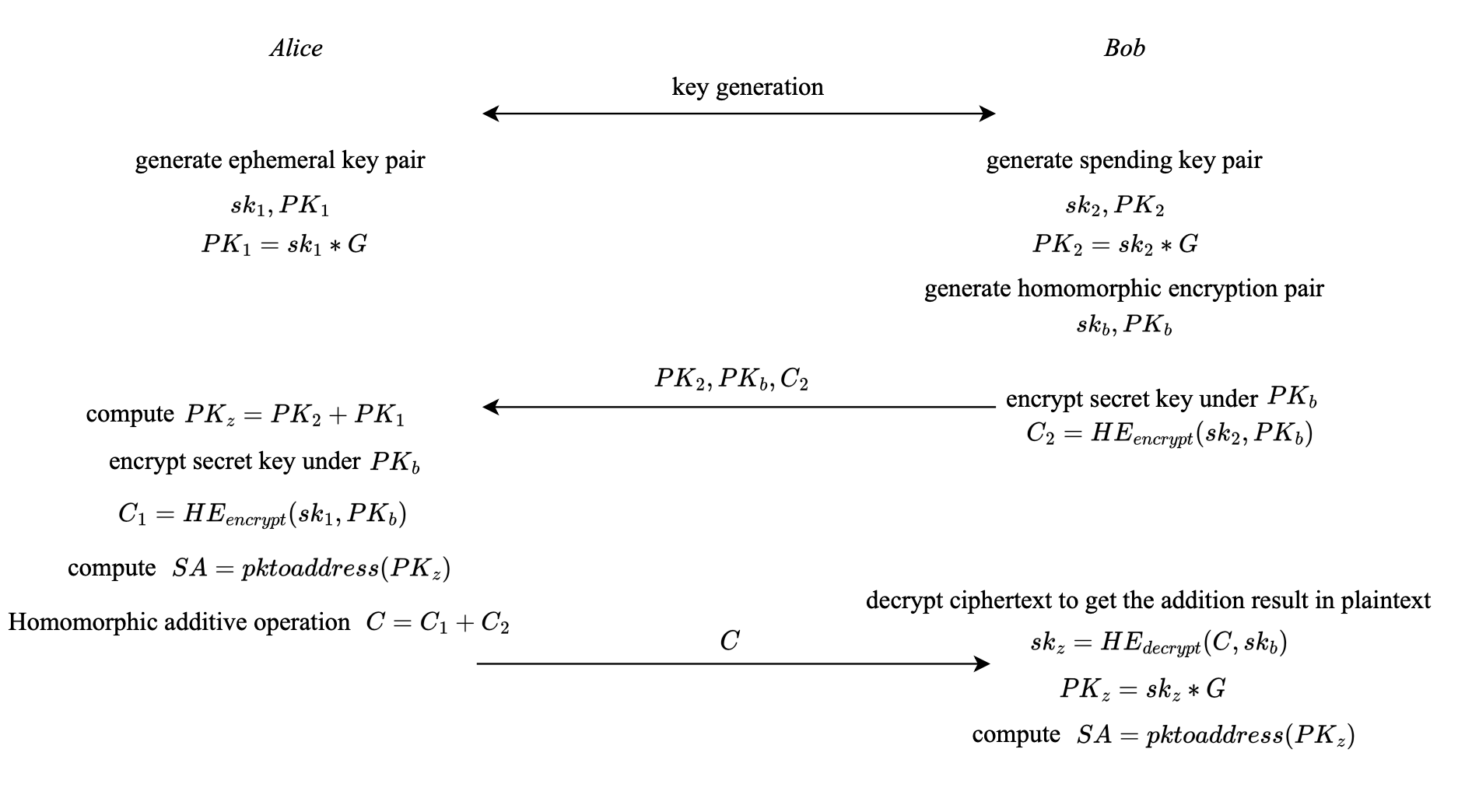
- 协议使用加法同态加密(Paillier)对收件人的公钥和随机值进行加密,支持在密文上执行同态运算而无需解密。
- 采用双密钥结构分离支出密钥与扫描密钥,防止密钥泄露导致完整私钥暴露。
- 隐身地址通过同态计算生成:$ C = \text{Enc}_{pk}(R \cdot P) + \text{Enc}_{pk}(r) \mod n^2 $,其中 $ R $ 为发送方的临时密钥,$ P $ 为收件人的公钥。
- 协议在判定性 Diffie-Hellman(DDH)假设和学习误差(LWE)假设下被形式化证明安全,适用于同态加密层。
- 通过 BFV 全同态加密方案扩展得到 FHE-DKSAP,支持在不解密的情况下对加密数据进行计算。
- 对 CPA( chosen-plaintext attack)安全性、不可链接性以及抗密文策略攻击能力进行了形式化安全分析。
实验结果
研究问题
- RQ1加法同态加密能否有效集成到双密钥隐身地址协议中,以增强隐私保护和抗量子能力?
- RQ2同态加密的计算开销如何影响现实区块链系统中隐身地址生成的效率?
- RQ3与标准 DKSAP 和 FHE-DKSAP 相比,HE-DKSAP 的链上存储开销如何?
- RQ4在选择明文攻击下,HE-DKSAP 在多大程度上保持了不可链接性和数据机密性?
- RQ5FHE-DKSAP(BFV)在计算和存储方面与 HE-DKSAP(Paillier)及普通 DKSAP 相比性能如何?
主要发现
- HE-DKSAP-Paillier 的计算速度约为普通 DKSAP 的 1/20,平均每次生成耗时 0.4456 秒。
- FHE-DKSAP-BFV 显著快于 HE-DKSAP-Paillier,平均计算时间仅为 0.0355 秒,仅略慢于普通 DKSAP。
- HE-DKSAP-Paillier 和 FHE-DKSAP-BFV 的链上存储开销均低于普通 DKSAP,其中 FHE-DKSAP-BFV 的密文组件仅需 256 位存储。
- 在 LWE 假设下,协议实现了 CPA 安全性,证实其对选择明文攻击具备抗性。
- 安全分析表明,HE-DKSAP 能够有效保持数据机密性、交易不可链接性以及抗量子攻击能力。
- FHE-DKSAP-BFV 实现中使用 RUST 语言显著提升了性能,凸显了底层语言优化的重要性。
更好的研究,从现在开始
从阅读论文到最终审阅,大幅缩短您的研究时间。
无需绑定信用卡
本解读由 AI 生成,并经人工编辑审核。