
[论文解读] HERA bound on x-ray luminosity when accounting for population III stars
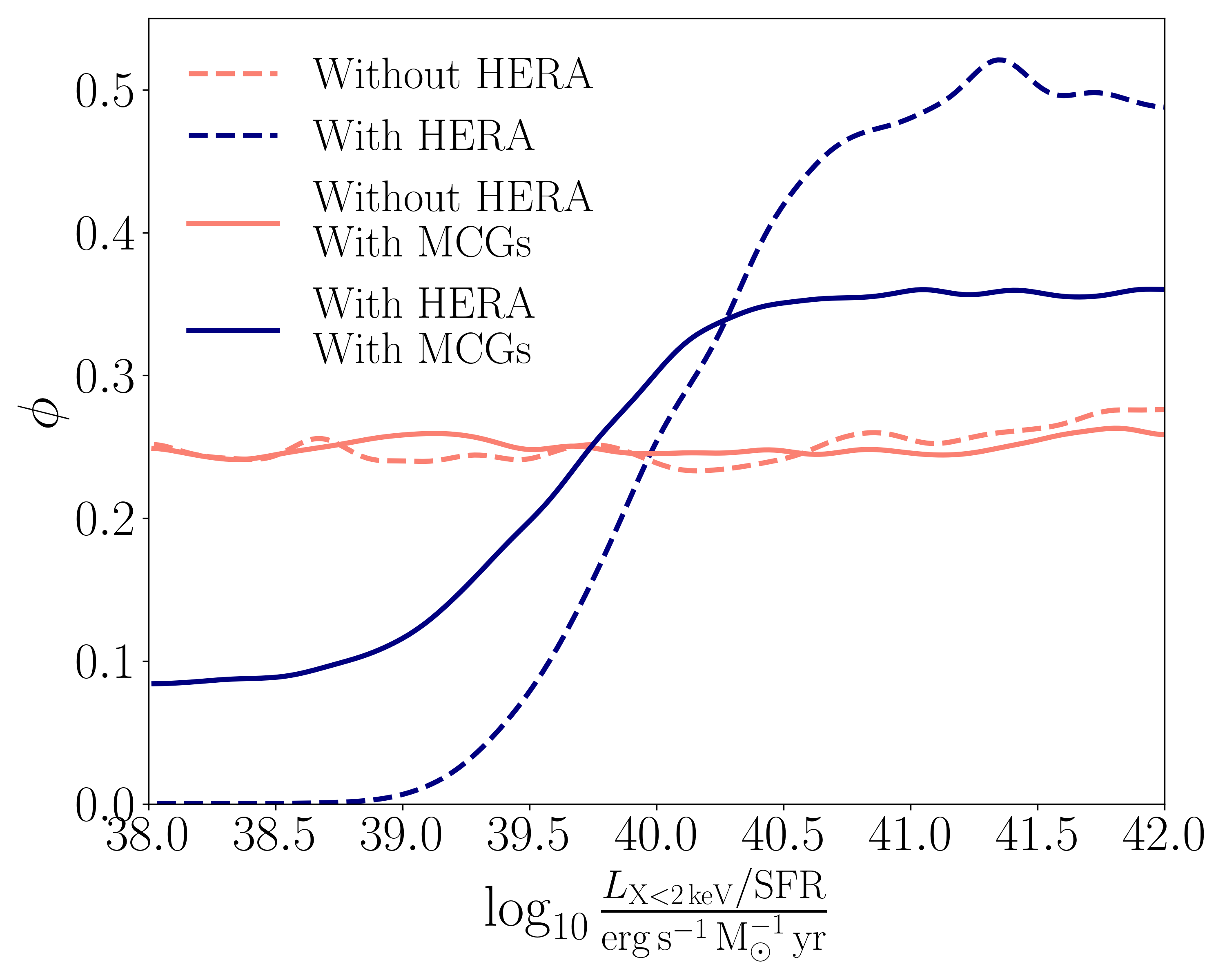
该论文通过在21-cm信号模拟中引入孕育第三星族恒星的分子冷却星系(MCGs),重新审视了HERA对软 band X射线光度每单位恒星形成率(L_X<2keV/SFR)的约束。利用机器学习代理模型和MCMC推断,研究发现引入MCGs可降低对高X射线光度的需求,从而削弱了此前对L_X<2keV/SFR ≲ 10^39.5 erg s⁻¹ M☉⁻¹ yr⁻¹的强烈排他性,使其与本地X射线源的观测值趋于一致。
Recent upper bounds from the Hydrogen Epoch of Reionization Array (HERA) on the cosmological 21-cm power spectrum at redshifts $z \approx 8, 10$, have been used to constrain $L_{ m X<2 \, keV}/{ m SFR}$, the soft-band X-ray luminosity measured per unit star formation rate (SFR), strongly disfavoring values lower than $\approx 10^{39.5} \, { m erg} \;{ m s}^{-1} \;{ m M}_{\odot}^{-1} \;{ m yr}$. This conclusion is derived from semi-numerical models of the 21-cm signal, specifically focusing on contributions from atomic cooling galaxies that host PopII stars. In this work, we first reproduce the bounds on $L_{ m X<2 \, keV}/{ m SFR}$ and other parameters using a pipeline that combines machine learning emulators for the power spectra and the intergalactic medium characteristics, together with a standard Markov chain Monte Carlo parameter fit. We then use this approach when including molecular cooling galaxies that host PopIII stars in the cosmic dawn 21-cm signal, and show that lower values of $L_{ m X<2 \, keV}/{ m SFR}$ are hence no longer strongly disfavored. The revised HERA bound does not require high-redshift X-ray sources to be significantly more luminous than high-mass X-ray binaries observed at low redshift.
研究动机与目标
- 重新评估z ≈ 8和10时HERA对21-cm功率谱的上限约束,该约束此前对低L_X<2keV/SFR值持强烈排斥态度。
- 探究包含孕育第三星族恒星的分子冷却星系(MCGs)是否会影响对单位SFR下X射线光度的推断约束。
- 开发并验证用于21-cm功率谱、光学深度(τ_e)和中性氢分数(x_HI)的机器学习代理模型,以加速贝叶斯参数推断。
- 证明此前对低L_X<2keV/SFR值的强烈排斥主要源于忽略了MCG的贡献,而MCG可在宇宙黎明期间显著改变21-cm信号。
提出的方法
- 开发基于神经网络的机器学习流程,用于将21-cm功率谱、τ_e和x_HI作为宇宙学与天体物理参数的函数进行代理建模。
- 使用拉丁超立方采样法从约20,000次模拟中采样参数,并将输入归一化至[-1, 1]区间以提升稳定性。
- 采用具有ReLU激活函数、批量归一化、10%丢弃率(dropout)和Sigmoid输出的信号分类器,以区分z ≈ 8和10时的高功率与低功率21-cm信号。
- 将代理模型与标准马尔可夫链蒙特卡洛(MCMC)采样器集成,对L_X<2keV/SFR参数执行贝叶斯推断。
- 通过对比包含与不包含MCGs的模拟结果,直接评估MCG贡献对HERA约束的影响。
- 使用Adam优化器最小化损失函数,结合早停法与衰减学习率策略,最终保留性能最佳的模型权重。
实验结果
研究问题
- RQ1在21-cm信号模型中引入孕育第三星族恒星的分子冷却星系(MCGs)是否会影响HERA对L_X<2keV/SFR的约束?
- RQ2机器学习代理模型能否以足够精度再现21-cm功率谱及相关全局量(τ_e、x_HI),以支持宇宙学推断?
- RQ3当MCGs被纳入21-cm信号模型时,与仅包含原子冷却星系(ACGs)的模型相比,L_X<2keV/SFR的边际后验分布如何变化?
- RQ4MCGs在多大程度上降低了为匹配HERA对21-cm功率谱上限而对单位SFR所需X射线光度的需求?
- RQ5当MCG贡献被正确考虑时,此前对L_X<2keV/SFR ≲ 10^39.5 erg s⁻¹ M☉⁻¹ yr⁻¹的强烈排斥是否依然稳健?
主要发现
- 引入孕育第三星族恒星的分子冷却星系(MCGs)显著削弱了对低L_X<2keV/SFR值的排斥,这些值此前曾以高显著性被排除。
- 修正后的HERA约束允许L_X<2keV/SFR ≲ 10^39.5 erg s⁻¹ M☉⁻¹ yr⁻¹,而无需假设X射线源的光度超过本地大质量X射线双星的水平。
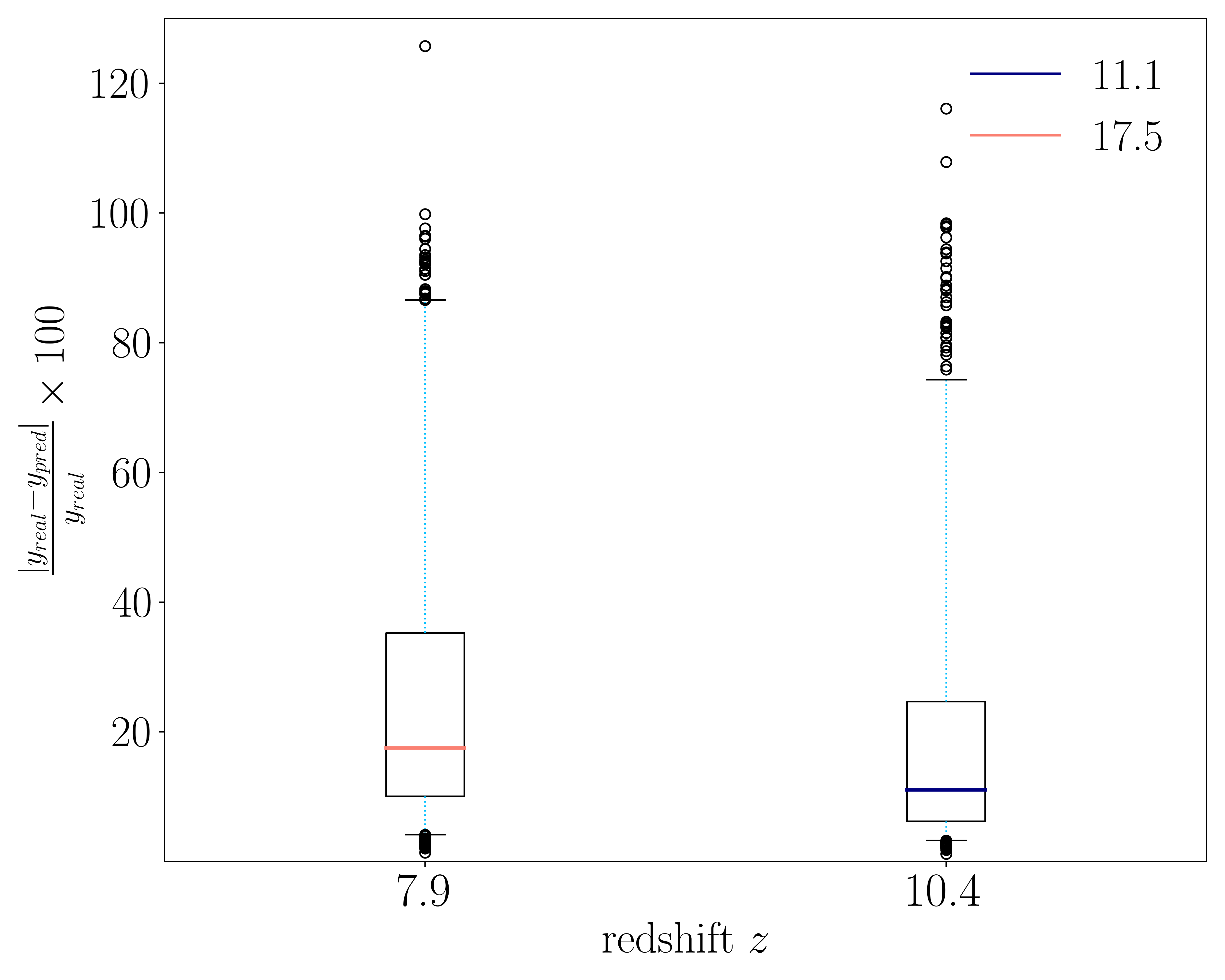
- 用于21-cm功率谱、τ_e和x_HI的机器学习代理模型表现出高精度,中位损失值低于1%,且16th–84th百分位区间表明性能稳健。
- MCMC流程中使用的信号分类器准确率超过97%,确保了对高功率与低功率21-cm信号区别的可靠性。
- 当MCGs被纳入时,L_X<2keV/SFR的后验分布向更低值移动,表明MCGs可通过足够加热与电离作用解释观测数据,而无需极端X射线光度。
- 本研究证明,忽略MCGs会导致对原子冷却星系所需X射线效率的高估,凸显了在21-cm建模中纳入早期恒星形成的重要性。
更好的研究,从现在开始
从阅读论文到最终审阅,大幅缩短您的研究时间。
无需绑定信用卡
本解读由 AI 生成,并经人工编辑审核。