
[论文解读] Heterogeneous network approach to predict individuals' mental health
本研究提出了一种异质信息网络(HIN)框架,整合智能手机、可穿戴设备(Fitbit)和调查数据,利用推荐系统(RS)和节点分类(NC)方法预测抑郁和焦虑。表现最佳的方法——深度矩阵分解(DMF)——优于传统的逻辑回归和随机基线模型,表明在HIN上使用推荐系统比节点分类更适用于心理健康预测。
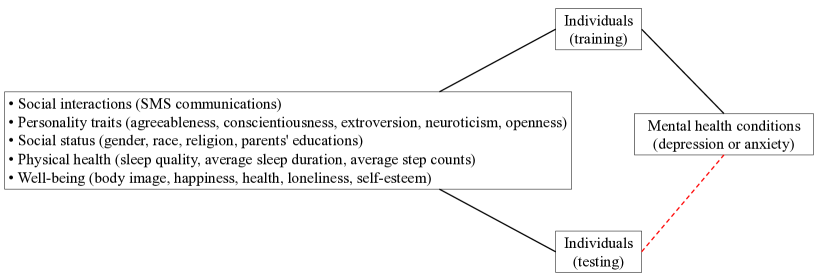
Depression and anxiety are critical public health issues affecting millions of people around the world. To identify individuals who are vulnerable to depression and anxiety, predictive models have been built that typically utilize data from one source. Unlike these traditional models, in this study, we leverage a rich heterogeneous data set from the University of Notre Dame's NetHealth study that collected individuals' (student participants') social interaction data via smartphones, health-related behavioral data via wearables (Fitbit), and trait data from surveys. To integrate the different types of information, we model the NetHealth data as a heterogeneous information network (HIN). Then, we redefine the problem of predicting individuals' mental health conditions (depression or anxiety) in a novel manner, as applying to our HIN a popular paradigm of a recommender system (RS), which is typically used to predict the preference that a person would give to an item (e.g., a movie or book). In our case, the items are the individuals' different mental health states. We evaluate four state-of-the-art RS approaches. Also, we model the prediction of individuals' mental health as another problem type - that of node classification (NC) in our HIN, evaluating in the process four node features under logistic regression as a proof-of-concept classifier. We find that our RS and NC network methods produce more accurate predictions than a logistic regression model using the same NetHealth data in the traditional non-network fashion as well as a random-approach. Also, we find that the best of the considered RS approaches outperforms all considered NC approaches. This is the first study to integrate smartphone, wearable sensor, and survey data in an HIN manner and use RS or NC on the HIN to predict individuals' mental health conditions.
研究动机与目标
- 为解决单一数据类型心理健康预测模型的局限性,通过整合多种数据源。
- 开发一种新颖方法,将心理健康预测建模为异质信息网络(HIN)上的推荐系统(RS)问题。
- 评估RS和节点分类(NC)方法在HIN上相对于传统非网络模型和随机基线的性能。
- 探索不同数据模态(如体力活动、幸福感、人格特质)在预测心理健康结果中的相对重要性。
- 建立一个通用框架,利用HIN结构中的多源数据预测个体特征。
提出的方法
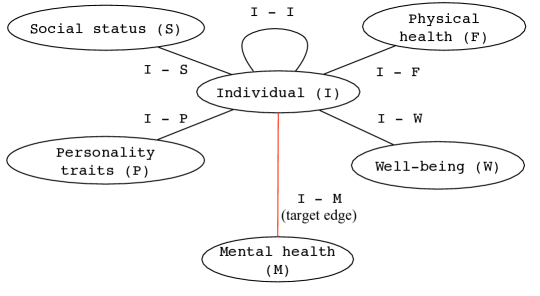
- 将NetHealth研究数据——包括智能手机交互日志、Fitbit可穿戴传感器数据和基于调查的人格特质数据——建模为具有不同节点类型和边类型的异质信息网络(HIN)。
- 将心理健康预测任务重新定义为推荐系统(RS)问题,其中个体为“用户”,心理健康状态(抑郁/焦虑)为待预测的“项目”。
- 评估了四种最先进的RS方法(包括深度矩阵分解)在基于HIN结构预测心理健康状况方面的能力。
- 同时评估了四种节点分类(NC)方法,使用基于HIN节点特征的逻辑回归,作为概念验证性对比。
- HIN构建了多种边类型:个体到社交互动(S)、体力活动(F)、幸福感(W)和人格特质(P),以实现多模态数据整合。
- 使用标准指标(AUC、F1、准确率)评估性能,并通过p值评估统计显著性。
实验结果
研究问题
- RQ1异质信息网络(HIN)能否有效整合多源数据(智能手机、可穿戴设备、调查)以提升心理健康预测效果?
- RQ2在HIN上使用推荐系统(RS)范式是否比传统节点分类(NC)或非网络模型更有效地预测抑郁和焦虑?
- RQ3哪些数据模态组合(如F+W、P+W)能为抑郁和焦虑预测提供最高的准确率?
- RQ4在使用HIN进行心理健康预测的背景下,不同RS和NC方法的预测性能如何比较?
- RQ5从数据集中抑郁和焦虑个体之间的重叠中,可以得出关于两种预测模式相似性与差异性的哪些见解?
主要发现
- 深度矩阵分解(DMF)推荐系统方法在所有评估指标上均表现最佳,优于所有其他RS和NC方法,以及非网络逻辑回归基线模型。
- FW组合(Fitbit和幸福感数据)在预测抑郁方面最为准确,而PW组合(人格特质和幸福感)在焦虑预测方面表现最佳。
- DMF方法显著优于非网络逻辑回归模型,表明基于网络的建模能增强预测能力。
- 抑郁和焦虑个体之间存在统计显著的重叠(51人),p < 0.05,这可能解释了两种病症预测模式的相似性。
- FW组合在焦虑预测中位列第二,表明身体健康和幸福感是两种病症的强预测因子。
- DMF与非网络模型预测结果之间无显著重叠,表明存在通过集成学习进一步提升性能的潜力。
更好的研究,从现在开始
从阅读论文到最终审阅,大幅缩短您的研究时间。
无需绑定信用卡
本解读由 AI 生成,并经人工编辑审核。