
[论文解读] HIC-YOLOv5: Improved YOLOv5 For Small Object Detection
HIC-YOLOv5 通过引入专门用于高分辨率特征图的小目标检测头(SODH)、用于增强主干网络与颈部之间通道信息的卷积块(involution block),以及在主干网络末端的轻量化CBAM注意力模块,提出了一种改进的YOLOv5模型以提升小目标检测性能。该方法在VisDrone-2019-DET数据集上实现了mAP@[.5:.95] 6.42%的绝对提升和mAP@0.5 9.38%的提升,同时相比先前基于注意力机制的方法计算成本更低。
Small object detection has been a challenging problem in the field of object detection. There has been some works that proposes improvements for this task, such as adding several attention blocks or changing the whole structure of feature fusion networks. However, the computation cost of these models is large, which makes deploying a real-time object detection system unfeasible, while leaving room for improvement. To this end, an improved YOLOv5 model: HIC-YOLOv5 is proposed to address the aforementioned problems. Firstly, an additional prediction head specific to small objects is added to provide a higher-resolution feature map for better prediction. Secondly, an involution block is adopted between the backbone and neck to increase channel information of the feature map. Moreover, an attention mechanism named CBAM is applied at the end of the backbone, thus not only decreasing the computation cost compared with previous works but also emphasizing the important information in both channel and spatial domain. Our result shows that HIC-YOLOv5 has improved mAP@[.5:.95] by 6.42% and mAP@0.5 by 9.38% on VisDrone-2019-DET dataset.
研究动机与目标
- 解决基于无人机成像中因高空拍摄导致目标尺寸极小所带来的小目标检测挑战。
- 克服YOLOv5在检测小目标和极小目标时因特征图分辨率低和通道表征不足而产生的局限性。
- 在提升检测精度的同时,相比现有基于注意力机制或结构改进的方法,降低计算成本。
- 通过最小化网络架构复杂度和参数增长,保持实时推理能力。
提出的方法
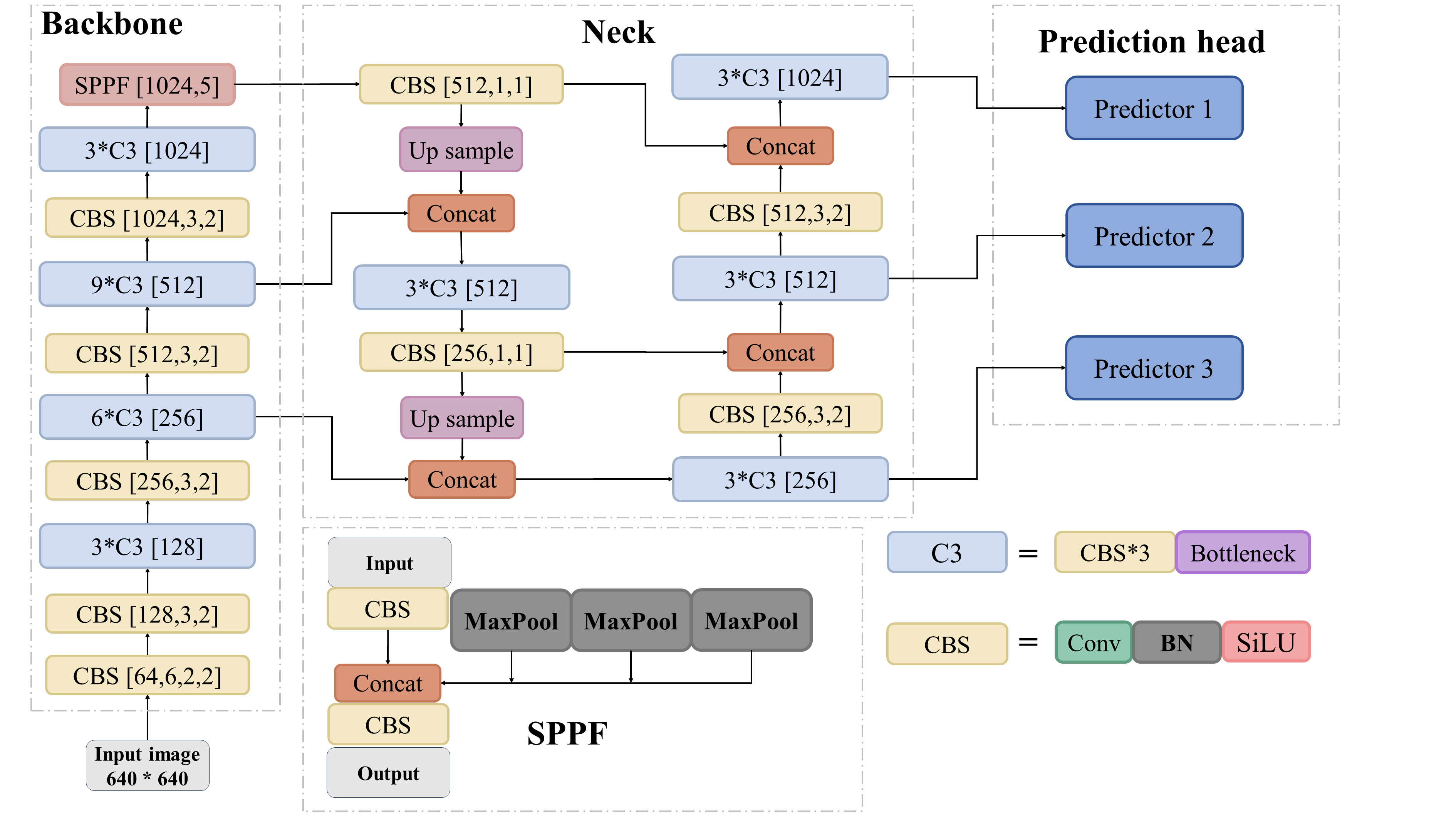
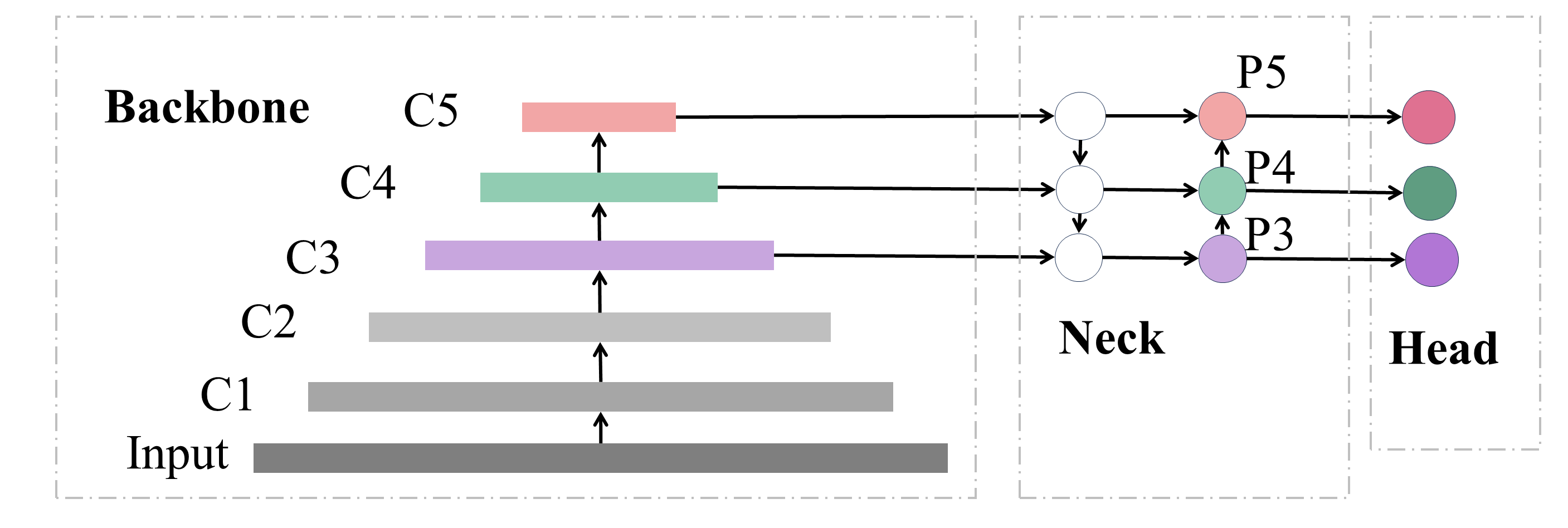
- 引入一个专用的小目标检测头(SODH),用于处理高分辨率特征图,以提升对极小目标和小目标的定位与分类性能。
- 在主干网络与颈部之间插入卷积块(involution block),以增强通道间特征交互,丰富通道维度的表征,同时显著减少参数增长。
- 在主干网络末端应用轻量化CBAM注意力模块,选择性地增强重要空间与通道特征,减少冗余计算。
- 采用数据增强技术(如中心裁剪)以提升小目标检测任务中的鲁棒性与泛化能力。
- 将SODH、卷积块(involution)和CBAM三个组件整合至YOLOv5-6.0架构中,构建HIC-YOLOv5模型,同时保持实时推理能力。
实验结果
研究问题
- RQ1专用的高分辨率预测头是否能提升YOLOv5在小目标检测中的性能?
- RQ2在主干网络与颈部之间引入卷积块(involution block)是否能在不增加计算成本的前提下增强小目标检测的特征表征能力?
- RQ3轻量化CBAM注意力模块是否能在降低推理开销的同时,优于如Transformer等更重的注意力机制,从而在小目标检测中表现更优?
- RQ4SODH、卷积块(involution)和CBAM等各组件在VisDrone-2019-DET数据集上的mAP提升中分别贡献了多少?
主要发现
- 与YOLOv5s相比,HIC-YOLOv5在VisDrone-2019-DET测试集上实现了mAP@[.5:.95] 6.42%的绝对提升和mAP@0.5 9.38%的提升。
- 仅添加SODH便使mAP@.5提升8.31%,mAP@[.5:.95]提升5.51%,表明其在性能提升中起主导作用。
- 在SODH基础上引入卷积块(involution block)后,mAP@.5额外提升0.66%,mAP@[.5:.95]额外提升0.57%,证明其对特征表征的增强作用。
- CBAM模块分别带来0.41%和0.34%的mAP@.5和mAP@[.5:.95]提升,显示出其在低开销下对特征精炼的有效性。
- 消融实验表明,单独使用CBAM或卷积块(involution)均不足以实现显著性能提升,强调了多尺度特征利用的必要性。
- HIC-YOLOv5相比先前基于注意力机制的模型(如Wang et al. [11])减少了模型参数和梯度数量,分别为8.39M和14.58M,证实了其更低的计算成本。
更好的研究,从现在开始
从阅读论文到最终审阅,大幅缩短您的研究时间。
无需绑定信用卡
本解读由 AI 生成,并经人工编辑审核。