
[论文解读] Hidden Markov modeling of single particle diffusion with stochastic tethering
该论文提出一种基于隐马尔可夫模型(HMM)并结合交替最大化算法的方法,用于从二维单粒子轨迹中推断瞬态束缚状态及物理参数(如扩散系数、束缚速率和受限区域大小)。该方法采用鞍点近似以识别最可能的隐藏状态序列,并在多种参数范围内实现可靠参数估计,对初始值不敏感,且通过合成数据验证了其有效性。
The statistics of the diffusive motion of particles often serve as an experimental proxy for their interaction with the environment. However, inferring the physical properties from the observed trajectories is challenging. Inspired by a recent experiment, here we analyze the problem of particles undergoing two-dimensional Brownian motion with transient tethering to the surface. We model the problem as a Hidden Markov Model where the physical position is observed, and the tethering state is hidden. We develop an alternating maximization algorithm to infer the hidden state of the particle and estimate the physical parameters of the system. The crux of our method is a saddle-point-like approximation, which involves finding the most likely sequence of hidden states and estimating the physical parameters from it. Extensive numerical tests demonstrate that our algorithm reliably finds the model parameters, and is insensitive to the initial guess. We discuss the different regimes of physical parameters and the algorithm's performance in these regimes. We also provide a ready-to-use open source implementation of our algorithm.
研究动机与目标
- 解决在束缚状态不可直接观测的情况下,从实验测得的二维粒子轨迹中推断隐藏束缚状态及物理参数的挑战。
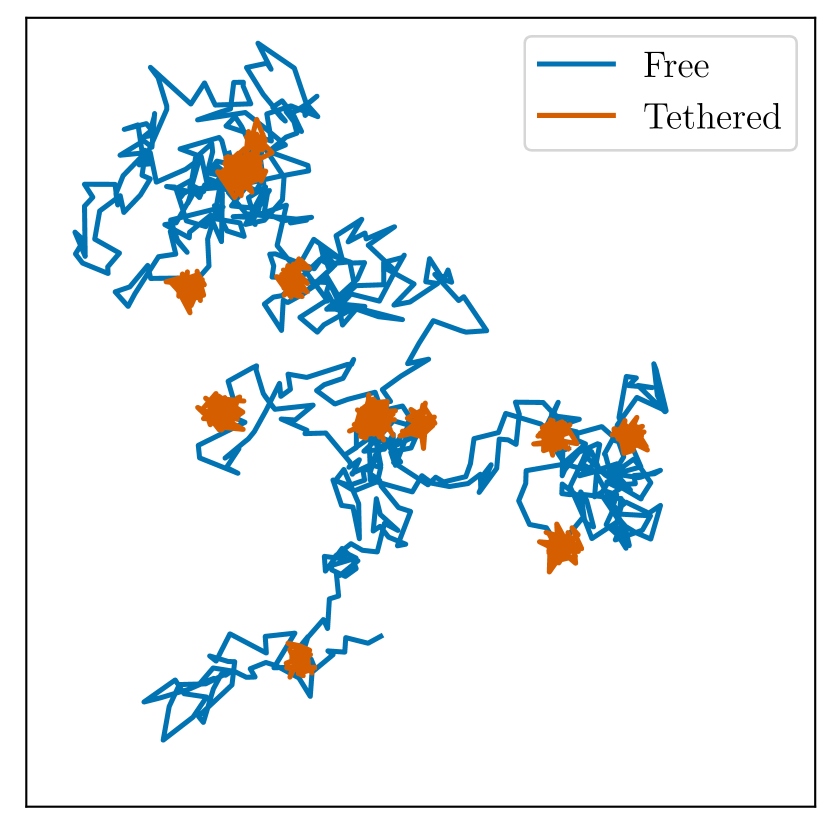
- 将瞬态束缚建模为一个两状态连续时间马尔可夫过程,其中自由状态为正常扩散,束缚状态为奥恩斯坦-乌伦贝克动力学。
- 开发一种计算高效的算法,从稀疏、噪声较大的轨迹数据中估计扩散系数、束缚/解束缚速率以及有效受限区域大小。
- 确保对初始值不敏感,并在不同物理参数范围内(包括短时与长时束缚)具有适用性。
- 提供免费开源实现,便于在实验数据分析中实际应用。
提出的方法
- 将系统建模为隐马尔可夫模型,其中观测位置为可观测变量,束缚状态(自由/束缚)为隐藏变量。
- 采用连续时间马尔可夫链,束缚事件($\tau_0$)和解束缚事件($\tau_1$)的等待时间为指数分布。
- 通过奥恩斯坦-乌伦贝克过程描述束缚状态的动力学,其受状态相关谐振势控制,由比值 $k/\gamma$ 决定。
- 应用交替最大化算法,通过维特比式搜索迭代估计最可能的隐藏路径,并利用最大似然估计更新模型参数。
- 通过将所有隐藏路径的求和替换为最可能路径的似然值,实现鞍点近似,从而降低计算复杂度。
- 可推广至其他扩散类型及非泊松过程束缚,只需调整转移概率与动力学模型,可选地扩展至前K条最可能路径以提升精度。
![Figure 1: A snapshot of an experimental microscopy video of peptide-coated microparticles, in a system similar to that of Chakraborty et. al. [ 9 ] . The colored curve represents the top-right particle’s recorded trajectory in the 320 seconds preceding the snapshot. The trajectory is colored based o](https://ar5iv.labs.arxiv.org/html/2308.01100/assets/x1.png)
实验结果
研究问题
- RQ1当束缚状态不可直接观测时,隐马尔可夫模型能否有效从二维单粒子轨迹中推断出瞬态束缚状态?
- RQ2在不同参数范围内,该算法对关键物理参数(扩散系数、束缚/解束缚速率、受限区域大小)的估计精度如何?
- RQ3该算法对初始值是否具有鲁棒性?在轨迹数据存在噪声或采样率变化时,其性能是否敏感?
- RQ4采用最可能路径的鞍点近似是否能提供与完整路径积分相当的可靠参数估计?
- RQ5该方法能否在极少修改下推广至非泊松过程束缚或异常扩散?
主要发现
- 该算法在多种物理参数范围内均能高精度恢复所有模型参数(扩散系数、束缚/解束缚速率、受限区域大小)。
- 该方法对初始值不敏感,无论初始参数猜测如何,性能均保持一致。
- 即使时间步长 $\Delta t$ 与束缚状态的弛豫时间相当或更长,算法仍保持高精度,且下采样处理不降低估计准确性。
- 前K条路径扩展(最多K=100)未带来显著性能提升,因为最可能的路径在定性上相似,仅在束缚/解束缚时刻存在微小扰动。
- 在某些情况下,算法能正确识别出不存在短暂束缚或自由阶段的情况,与底层统计模型及轨迹特征一致。
更好的研究,从现在开始
从阅读论文到最终审阅,大幅缩短您的研究时间。
无需绑定信用卡
本解读由 AI 生成,并经人工编辑审核。