
[论文解读] Hierarchical Semantic Tree Concept Whitening for Interpretable Image Classification
本文提出分层语义树概念白化(HaST-CW),一种通过新颖的语义约束(SC)损失将潜在表征与分层语义概念树对齐,以增强深度图像分类可解释性的方法。该方法保持了概念之间的层次关系,提升了表征解缠程度,同时维持了分类准确率,已在基于ResNet主干网络的Agri-ImageNet数据集上得到验证。
With the popularity of deep neural networks (DNNs), model interpretability is becoming a critical concern. Many approaches have been developed to tackle the problem through post-hoc analysis, such as explaining how predictions are made or understanding the meaning of neurons in middle layers. Nevertheless, these methods can only discover the patterns or rules that naturally exist in models. In this work, rather than relying on post-hoc schemes, we proactively instill knowledge to alter the representation of human-understandable concepts in hidden layers. Specifically, we use a hierarchical tree of semantic concepts to store the knowledge, which is leveraged to regularize the representations of image data instances while training deep models. The axes of the latent space are aligned with the semantic concepts, where the hierarchical relations between concepts are also preserved. Experiments on real-world image datasets show that our method improves model interpretability, showing better disentanglement of semantic concepts, without negatively affecting model classification performance.
研究动机与目标
- 通过主动将人类可理解的语义概念嵌入潜在表征,解决深度神经网络可解释性不足的问题,而非依赖事后分析。
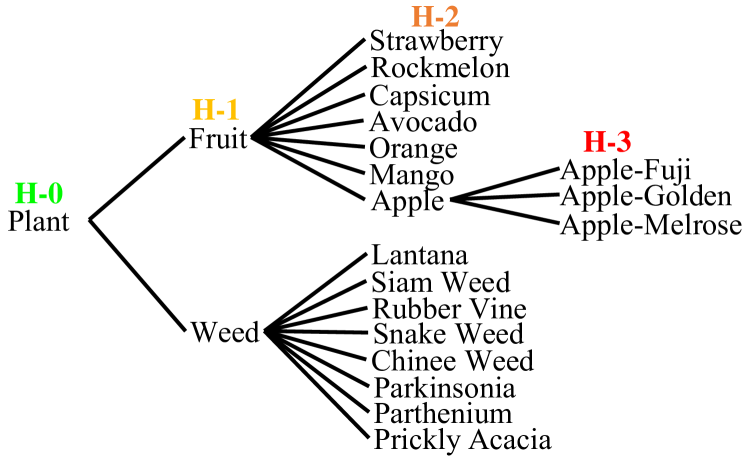
- 在深度学习模型的潜在空间中建模概念之间的层次关系,如疾病阶段或农业对象类别。
- 在保持分类性能的同时,提升潜在表征中语义概念的解缠程度。
- 提供模型如何在各层编码并关联概念的全局、结构化理解。
- 通过结构化的语义约束,将模型表征与领域知识对齐,实现更清晰、更可信的AI。
提出的方法
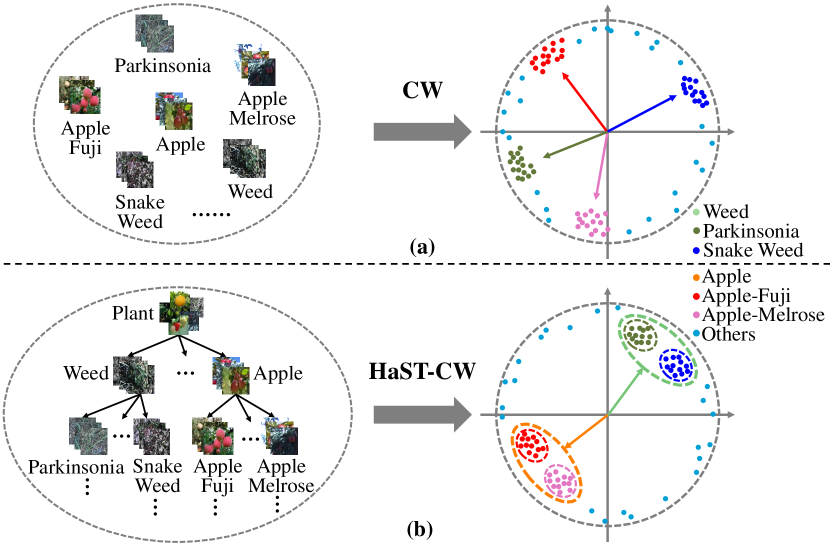
- 该方法构建一个语义概念的分层树,其中每个节点代表一个概念(如“Weed”、“Snake Weed”),父子关系反映语义粒度。
- 提出一种新颖的语义约束(SC)损失函数,以正则化潜在表征,使语义上相似的概念在潜在空间中更接近。
- 分层概念白化(HCW)消除潜在维度之间的激活相关性,使每个概念与一个或多个特定维度对齐,同时保持层次结构。
- SC损失强制将相关概念(如“Weed”和“Snake Weed”)的数据实例映射到潜在空间中相邻区域。
- 该方法通过交叉熵损失与SC损失联合训练,实现分类与可解释性的端到端联合优化。
- 采用ResNet18和ResNet50主干网络在Agri-ImageNet数据集上评估该方法,并通过分层激活树可视化评估概念对齐效果。
实验结果
研究问题
- RQ1我们能否通过主动将分层语义概念嵌入潜在空间,来提升深度图像分类器的可解释性?
- RQ2在潜在空间中保持概念之间的层次关系,如何影响解缠程度与表征质量?
- RQ3所提出的SC损失函数是否能有效对齐潜在空间中语义相似的概念,同时保持分类准确率?
- RQ4HaST-CW在多大程度上能通过分层激活树可视化揭示网络各层中概念的渐进式学习过程?
- RQ5该方法能否泛化至农业和医疗等现实世界领域,其中概念层次具有语义意义?
主要发现
- 使用ResNet50的HaST-CW模型在Agri-ImageNet数据集上达到69.49% ± 3.20的测试准确率,略高于基线CW方法(69.30% ± 3.75)和标准交叉熵基线(69.25% ± 3.93)。
- 分层激活树的可视化结果表明,图像在语义层次上被正确激活,例如“Snake Weed”图像在父概念“Weed”和子概念“Snake Weed”上均表现出最高激活。
- SC损失有效将相关概念(如“Weed”和“Apple”)的图像聚类为潜在空间中连贯的区块,而标准概念白化则呈现散乱分布。
- 该方法在表征中保持了层次结构,子概念如“Snake Weed”和“Apple-Melrose”形成了与父概念对齐的独立聚类。
- 结果表明,HaST-CW在不降低分类性能的前提下,提升了表征的解缠程度与可解释性,表现为更清晰、更结构化的潜在空间组织。
- 该方法实现了对模型行为的全局、概念级理解,支持人类与AI在医疗、农业等关键领域中的协作与信任。
更好的研究,从现在开始
从阅读论文到最终审阅,大幅缩短您的研究时间。
无需绑定信用卡
本解读由 AI 生成,并经人工编辑审核。