
[论文解读] High angular momentum coupling for enhanced Rydberg-atom sensing in the VHF band
本文提出高角动量匹配激发拉曼(HAMMER)方法,以提升铷蒸气室中VHF频段里里德堡原子传感的性能,实现100 μV/m/√Hz的灵敏度。通过利用高角动量耦合放大斯塔克位移,HAMMER方法可实现对低频信号(如AIS波形)的优越检测,相比传统交流斯塔克效应方法,在灵敏度和海事射频传感应用中的作用距离预测方面表现更优。
Recent advances in Rydberg atom electrometry detail promising applications in radio frequency (RF) communications. Presently, most applications use carrier frequencies greater than 1~GHz where resonant Autler-Townes splitting provides the highest sensitivity. This letter documents a series of experiments with Rydberg atomic sensors to collect and process waveforms from the automated identification system (AIS) used in maritime navigation in the Very High Frequency (VHF) band. Detection in this band is difficult with conventional resonant Autler-Townes based Rydberg sensing and requires a new approach. We show the results from a new method called High Angular Momentum Matching Excited Raman (HAMMER), which enhances low frequency detection and exhibits superior sensitivity compared to the traditional AC Stark effect. From measurements of electromagnetically induced transparency (EIT) in rubidium and cesium vapor cells, we show the relationship between incident electric field strength and observed signal-to-noise ratio and find that the sensitivity of the HAMMER scheme in rubidium achieved an equivalent single VHF tone sensitivity of $\mathrm{100~μV/m/\sqrt{Hz}}$. With these results, we estimate the usable range of the atomic vapor cell antenna for AIS waveforms given current technology and detection techniques.
研究动机与目标
- 为解决传统里里德堡原子传感器依赖高主量子数而易受退相干影响,在VHF频段(50–300 MHz)信号检测中灵敏度低的问题。
- 开发一种新型传感机制,可在不依赖高-n里里德堡态的情况下提升VHF频段的灵敏度。
- 证明里里德堡原子可作为可追溯、低SWaP的天线,用于实际射频通信信号(如AIS)的检测。
- 从信噪比和可检测电场强度角度,比较HAMMER方法与传统交流斯塔克效应传感的性能。
- 在当前技术约束下,估算基于原子蒸气室天线对AIS波形的有效工作距离。
提出的方法
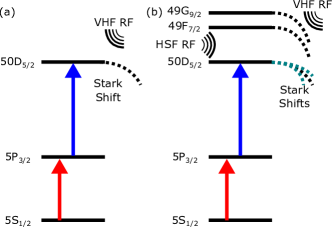
- HAMMER方法利用调制射频场,通过共振SHF跃迁将一个里里德堡态耦合至附近更高角动量的里里德堡态(例如50D → 49F或49G)。
- 施加强VHF本振(LO),使F和G态发生斯塔克位移,从而使F→G跃迁与入射VHF信号场共振。
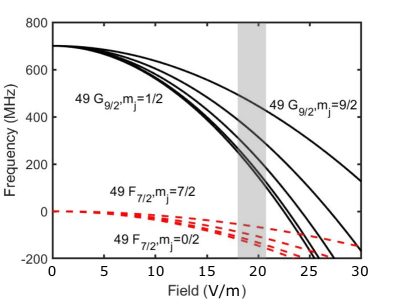
- 高-j态(如铷中49G态,极化率为5.5 MHz/(V/m)²)的增强极化率提高了对弱电场的敏感度。
- 采用电磁感应透明(EIT)探测系统,信噪比(SNR)作为入射电场强度的函数进行测量。
- 通过铷和铯蒸气室的实验验证该方法,电场校准采用由软件定义无线电(SDR)驱动的平行铜板。
- 基于Friis和VTRPE传播模型推导作用距离预测,假设为12.5 W功率、5 m天线高度的A类AIS发射机。
实验结果
研究问题
- RQ1里里德堡态中的高角动量耦合是否能显著增强VHF频段射频检测的灵敏度?
- RQ2与传统交流斯塔克效应传感相比,HAMMER方法在信噪比(SNR)和可检测电场强度方面表现如何?
- RQ3在开阔海域条件下,基于里里德堡原子的天线对AIS信号的有效工作距离是多少?
- RQ4原子种类(Rb与Cs)的选择在多大程度上影响HAMMER方法的灵敏度和性能?
- RQ5量子化噪声和接收链特性在真实SDR实现中如何影响观测到的信噪比?
主要发现
- 在铷蒸气室中,HAMMER方法实现了100 μV/m/√Hz的等效单音灵敏度,显著优于传统交流斯塔克效应方法。
- 在10%分组检测成功率下,HAMMER系统的信噪比(SNR)达到11 dB,与基于误比特率建模的理论预期一致。
- 对于17 mV/m的入射电场,基于VTRPE传播模型预测的原子蒸气室天线有效作用距离接近1 km,具体取决于环境条件。
- 尽管极化率和实验复杂度差异显著,Rb和Cs系统的校准结果在两倍以内一致。
- 观测到ADC噪声底限与频谱分析仪噪声底限之间存在2.4 dB的偏差,归因于SDR中的量化噪声,从而解释了高于预期的SNR。
- HAMMER方法可在不依赖高主量子数的情况下实现VHF频段的高灵敏度检测,避免了有害的退相干效应。
更好的研究,从现在开始
从阅读论文到最终审阅,大幅缩短您的研究时间。
无需绑定信用卡
本解读由 AI 生成,并经人工编辑审核。