
QUICK REVIEW
[论文解读] High-coherence hybrid-integrated 780 nm source by self-injection-locked second-harmonic generation in a high-Q silicon-nitride resonator
Bohan Li, Zhiquan Yuan|arXiv (Cornell University)|Jun 19, 2023
Advanced Fiber Laser Technologies被引用 5
一句话总结
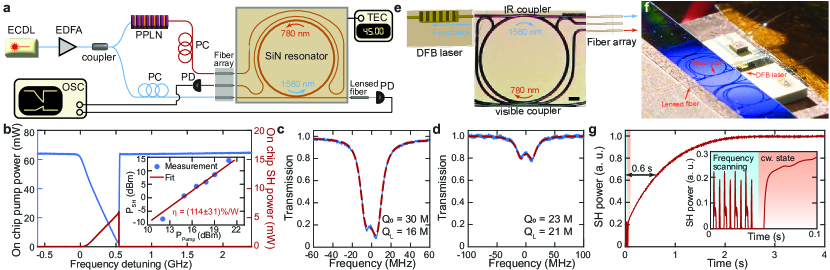
本论文展示了一种紧凑、高相干性的780 nm可见光激光源,利用高品质因子硅氮化物微腔中的自注入锁定二次谐波产生。通过将1560 nm分布反馈激光器锁定至微腔,系统实现了创纪录的4 Hz²/Hz频率噪声底限,实现了光学钟和LiDAR应用所需的超稳定可见光输出。
ABSTRACT
By self-injection-locking a 1560 nm distributed feedback semiconductor laser to a high-$Q$ silicon nitride resonator, a high-coherence 780 nm second harmonic signal is generated via the photogalvanic-induced second-order nonlinearity. A record-low frequency noise floor of 4 Hz$^2$/Hz is achieved for the 780 nm emission. The approach can be generalized for signal generation over a wide range of visible and near-visible bands.
研究动机与目标
- 开发一种紧凑、芯片集成的高相干可见光光源,适用于实验室以外的应用场景。
- 克服当前光学原子钟、LiDAR和传感中使用的笨重、高成本台式可见激光器的局限性。
- 通过自注入锁定与共振增强,实现在可见光芯片激光器中的超低频噪声。
- 利用单一平台实现可见光及近可见光谱段的可扩展、可调谐可见光生成。
提出的方法
- 使用具有5 µm波导宽度和850 µm半径的高品质因子硅氮化物微腔,实现对1560 nm和780 nm光的限制。
- 采用双模耦合器:2.3 µm宽的近红外耦合器和1.6 µm宽的可见光耦合器,以最小化串扰。
- 利用Si3N4中的光电致变效应诱导光学畴极化,实现准相位匹配的二次谐波产生。
- 通过端面耦合将1560 nm DFB激光器接入微腔,利用后向散射光实现激光频率的自注入锁定。
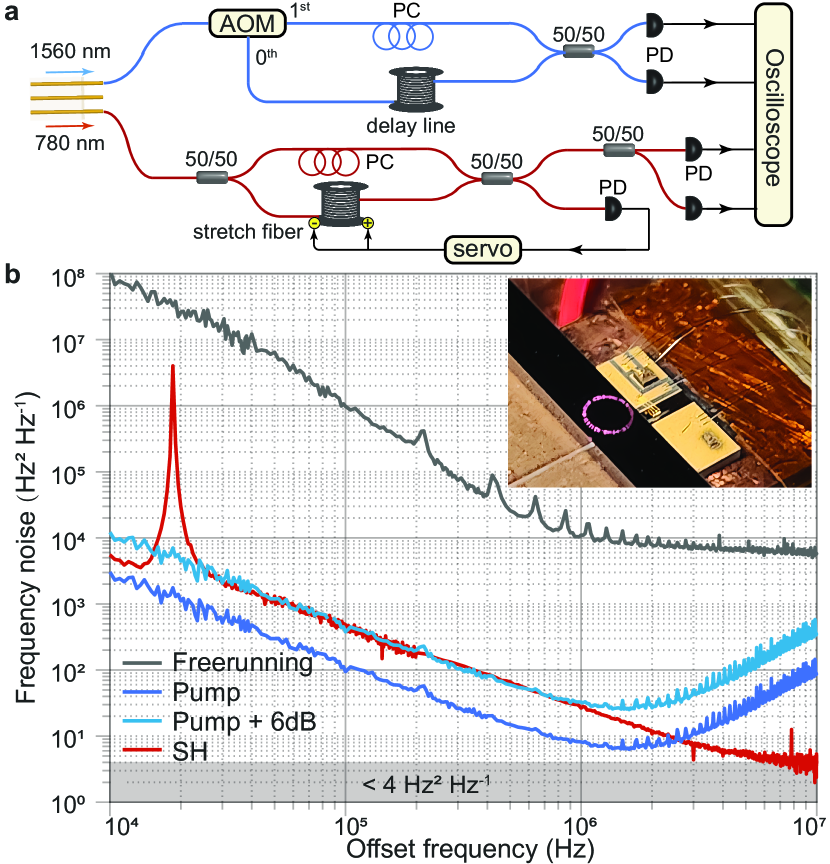
- 采用自本振混频技术结合平衡互相关方法表征频率噪声,以抑制光电探测器噪声。
- 通过调节激光器电流和反馈相位,控制光谱梳的形成,以维持单模运转并最大化二次谐波输出功率。
实验结果
研究问题
- RQ1在高品质因子Si3N4微腔中实现自注入锁定,能否将1560 nm DFB激光器的频率噪声降低至实现高相干可见光输出?
- RQ2Si3N4中的光电致变效应在多大程度上可实现780 nm处高效、准相位匹配的二次谐波产生?
- RQ3系统性能如何随微腔品质因子变化而变化?其噪声抑制的理论极限是什么?
- RQ4该平台能否推广至在可见光及近可见光谱段生成相干光,且仅需极少重新配置?
- RQ5在反馈系统中,单频振荡与克尔光谱梳形成之间存在何种权衡?如何实现有效控制?
主要发现
- 混合集成780 nm光源在100 kHz偏置频率下实现了创纪录的4 Hz²/Hz频率噪声底限。
- 自注入锁定的1560 nm泵浦激光器在100 kHz处实现40 dB噪声抑制,在1 MHz处实现32 dB噪声抑制,相比其自由振荡状态。
- 二次谐波转换效率达到114 ± 31% W⁻¹,实测芯片上二次谐波输出功率最高达24 mW。
- 系统在宽调谐范围内保持单频运转,通过电流和相位控制避免了有害的克尔频率梳形成。
- 实测780 nm光源的瞬时线宽为25 Hz,为目前报道的芯片级可见激光中最窄。
- 该平台具有可扩展性,通过重新配置波导耦合器,可适配其他可见光及近可见光波长。
更好的研究,从现在开始
从阅读论文到最终审阅,大幅缩短您的研究时间。
无需绑定信用卡
本解读由 AI 生成,并经人工编辑审核。