
[论文解读] High Tide or Riptide on the Cosmic Shoreline? A Water-Rich Atmosphere or Stellar Contamination for the Warm Super-Earth GJ~486b from JWST Observations
本研究分析了詹姆斯·韦布空间望远镜(JWST)NIRSpec/G395H对温热超级地球GJ 486b的透射光谱,发现其在2.2–3.3σ显著性水平下偏离平坦光谱。数据可由水汽丰富的大气(2σ水平下H₂O > 10%)或未掩星的太阳黑子引起的恒星污染共同拟合,凸显出一种退化现象,需借助短波长观测才能解决。
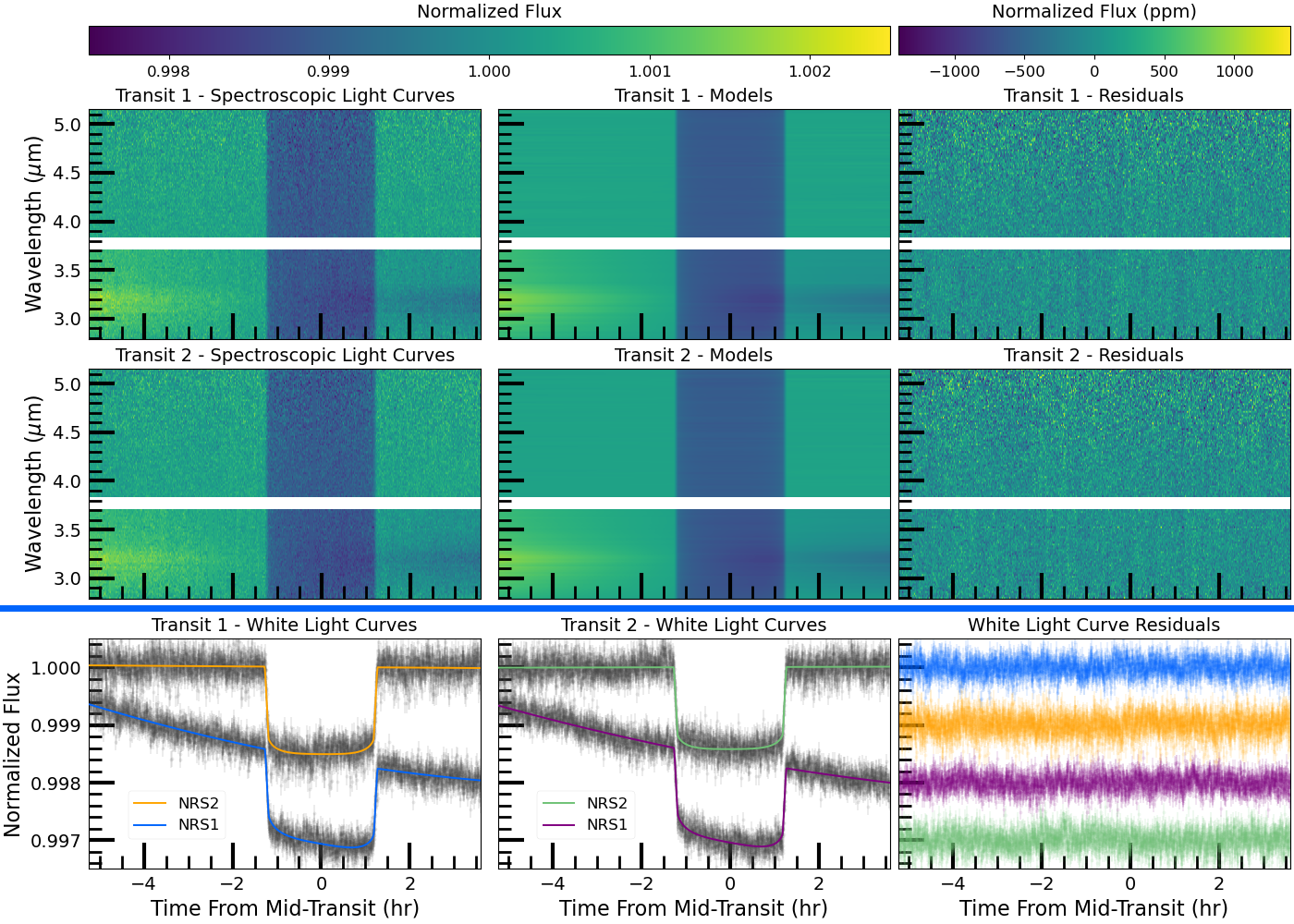
Planets orbiting M-dwarf stars are prime targets in the search for rocky exoplanet atmospheres. The small size of M dwarfs renders their planets exceptional targets for transmission spectroscopy, facilitating atmospheric characterization. However, it remains unknown whether their host stars' highly variable extreme-UV radiation environments allow atmospheres to persist. With JWST, we have begun to determine whether or not the most favorable rocky worlds orbiting M dwarfs have detectable atmospheres. Here, we present a 2.8-5.2 micron JWST NIRSpec/G395H transmission spectrum of the warm (700 K, 40.3x Earth's insolation) super-Earth GJ 486b (1.3 R$_{\oplus}$ and 3.0 M$_{\oplus}$). The measured spectrum from our two transits of GJ 486b deviates from a flat line at 2.2 - 3.3 $σ$, based on three independent reductions. Through a combination of forward and retrieval models, we determine that GJ 486b either has a water-rich atmosphere (with the most stringent constraint on the retrieved water abundance of H2O > 10% to 2$σ$) or the transmission spectrum is contaminated by water present in cool unocculted starspots. We also find that the measured stellar spectrum is best fit by a stellar model with cool starspots and hot faculae. While both retrieval scenarios provide equal quality fits ($χ^2_ν$ = 1.0) to our NIRSpec/G395H observations, shorter wavelength observations can break this degeneracy and reveal if GJ 486b sustains a water-rich atmosphere.
研究动机与目标
- 确定尽管其主星具有高磁活动性,温热超级地球GJ 486b是否拥有可探测的、富含水汽的大气层。
- 评估恒星不均匀性(特别是未掩星的太阳黑子和亮斑)是否能在透射光谱中产生类似大气吸收特征的假信号。
- 通过多还原、多仪器的一致性检验,解决真实大气信号与恒星污染之间的退化问题。
- 利用JWST数据,为围绕活跃M型矮星运行的岩石系外行星提供大气成分的稳健约束。
提出的方法
- 利用JWST/NIRSpec/G395H在两次凌日观测期间获取了GJ 486b在2.8–5.2 μm波段的透射光谱。
- 采用Eureka!、FIREFly和Tiberius三个独立的数据还原流程,以确保一致性并减少系统性偏差。
- 在FIREFly中应用超级偏置去趋势处理,在Eureka!和Tiberius中手动校正偏移量,以修正NRS1与NRS2探测器之间的探测器级不一致性。
- 使用CHIMERA和PICASO进行正向建模,测试端元大气成分(如H₂O、CO₂、CH₄、类地行星成分)与实测光谱的匹配度。
- 采用POSEIDON反演框架,对比两种竞争性情景:富含水汽的大气层与未掩星的太阳黑子。
- 通过减少的卡方(χ²ν)和显著性水平(σ)在不同还原流程和模型间的评估,评价拟合优度。
实验结果
研究问题
- RQ1GJ 486b透射光谱中观测到的光谱偏离是源于富含水汽的大气层,还是恒星污染?
- RQ2M型矮星主星上的未掩星太阳黑子是否能产生模仿可探测大气信号的虚假吸收特征?
- RQ3在多个独立的数据还原流程和探测器通道中,光谱结果的稳健性如何?
- RQ4光谱偏离平坦谱线的统计显著性是多少?该显著性在不同还原流程中如何变化?
- RQ5未来更短波长的观测能否打破大气起源与恒星起源假说之间的退化现象?
主要发现
- 在三个独立的数据还原流程中,观测到的透射光谱在2.2–3.3σ显著性水平下偏离平坦谱线。
- 水汽丰富的大气层与未掩星太阳黑子两种情景对数据的拟合效果相当,χ²ν均为1.0。
- 反演模型给出的最严格约束表明,若信号源自大气层,则H₂O丰度在2σ置信水平下大于10%。
- 恒星建模显示,最佳拟合的恒星光谱包含较冷的太阳黑子和较热的亮斑,支持污染假说。
- 在应用超级偏置去趋势和手动偏移校正后,NRS1与NRS2探测器的掩星深度才表现出一致性,成功解决了仪器差异问题。
- 当前数据尚无法解决大气起源与恒星起源之间的退化现象,但预计未来短波长观测将打破该退化。

更好的研究,从现在开始
从阅读论文到最终审阅,大幅缩短您的研究时间。
无需绑定信用卡
本解读由 AI 生成,并经人工编辑审核。