
[论文解读] Hot Pixels: Frequency, Power, and Temperature Attacks on GPUs and ARM SoCs
本文展示了,由于在热或功耗限制下的DVFS机制,现代GPU和ARM SoC通过软件可访问的频率、功耗和温度传感器泄露敏感信息。作者利用基于JavaScript的攻击——像素窃取、历史记录探测和网站指纹识别——在启用所有防护措施的情况下,实现了76%的网站分类Top-5准确率。
The drive to create thinner, lighter, and more energy efficient devices has resulted in modern SoCs being forced to balance a delicate tradeoff between power consumption, heat dissipation, and execution speed (i.e., frequency). While beneficial, these DVFS mechanisms have also resulted in software-visible hybrid side-channels, which use software to probe analog properties of computing devices. Such hybrid attacks are an emerging threat that can bypass countermeasures for traditional microarchitectural side-channel attacks. Given the rise in popularity of both Arm SoCs and GPUs, in this paper we investigate the susceptibility of these devices to information leakage via power, temperature and frequency, as measured via internal sensors. We demonstrate that the sensor data observed correlates with both instructions executed and data processed, allowing us to mount software-visible hybrid side-channel attacks on these devices. To demonstrate the real-world impact of this issue, we present JavaScript-based pixel stealing and history sniffing attacks on Chrome and Safari, with all side channel countermeasures enabled. Finally, we also show website fingerprinting attacks, without any elevated privileges.
研究动机与目标
- 探究现代GPU和ARM SoC是否由于DVFS机制,通过软件可访问的频率、功耗和温度传感器泄露信息。
- 评估仅使用内部传感器数据而无需外部测量设备,是否可行实施侧信道攻击。
- 在启用所有防护措施的情况下,演示针对Chrome和Safari等浏览器的真实世界隐私攻击——包括像素窃取、历史记录探测和网站指纹识别。
- 分析不同设备类型(被动散热与主动散热)下,指令/数据模式与可观察传感器行为之间的相关性。
提出的方法
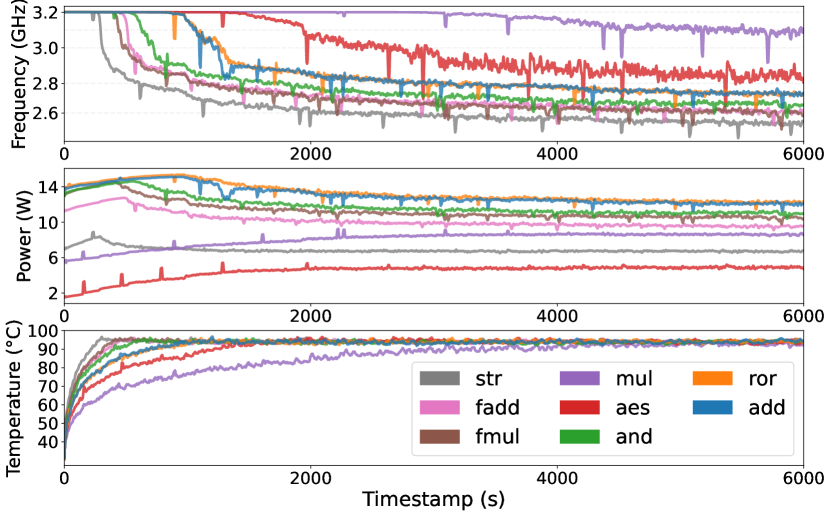
- 使用ARM SoC和GPU上的内部传感器,测量指令和数据依赖引起的频率、功耗和温度变化。
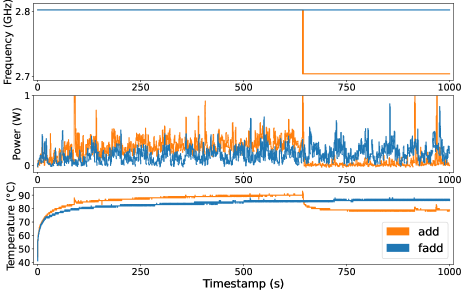
- 采用汉明距离(HD)模型对CPU泄漏进行建模,以关联操作数差异与功耗、频率和温度变化。
- 基于不同网站的传感器轨迹训练网站指纹识别分类器,并以Top-1、Top-2和Top-5准确率作为评估指标。
- 通过JavaScript实现浏览器端的像素窃取和历史记录探测攻击,利用数据依赖的频率调制作为时序信道。
- 利用JavaScript中的时序测量,基于可观测的频率变化推断像素值或浏览历史。
- 在不同设备(Mac Mini、MacBook Air)和散热条件下评估攻击性能,以评估其鲁棒性和泛化能力。
实验结果
研究问题
- RQ1是否可以仅利用内部传感器读数(频率、功耗、温度)在GPU和ARM SoC上实施纯软件侧信道攻击?
- RQ2指令和数据模式在多大程度上影响DVFS控制设备中可观测的频率、功耗和热力学行为?
- RQ3这些基于传感器的侧信道是否可用于在浏览器环境中执行网站指纹识别、像素窃取或历史记录探测?
- RQ4散热方式(被动散热与主动散热)如何影响这些侧信道的可检测性和泄露速率?
- RQ5此类攻击在真实系统中的实际限制和潜在缓解措施是什么?
主要发现
- 在主动散热的Mac Mini上,分类器在验证数据上的Top-5准确率达到0.76,证明了其强大的网站指纹识别能力。
- 在被动散热的MacBook Air上,Top-5准确率下降至0.49,这是由于热力学动态和内容变化所致,但仍远高于基线(0.01),高出一个数量级。
- 在热约束设备上,泄露速率受限于约0.1比特每秒,原因在于热平衡过程缓慢以及频率/功耗变化微小。
- 通过JavaScript时序信道可观察到数据依赖的频率调制,即使在启用所有侧信道防护措施的情况下,仍可实现像素窃取和历史记录探测攻击。
- 在Mac Mini等设备中,主动散热可防止数据依赖的频率变化,表明散热策略显著影响攻击可行性。
- 汉明距离模型在CPU和GPU上均显示出操作数差异与可观测功耗、频率和温度变化之间的显著关联。
更好的研究,从现在开始
从阅读论文到最终审阅,大幅缩短您的研究时间。
无需绑定信用卡
本解读由 AI 生成,并经人工编辑审核。