
[论文解读] How baryons appear in low-energy QCD: Domain-wall Skyrmion phase in strong magnetic fields
本文提出了一种在强磁场下低能QCD中无模型依赖的解析相变:当重子化学势 μ_B ≥ μ_c ≈ 1.03 GeV 时,手征子晶体(CSL)相转变为域壁Skyrmion相。在孤子表面出现二维Skyrmion,表现为具有量子化内部结构和由带电π介子凝聚引发的持续超导电流的三维重子,为重离子碰撞中可实现的新重子相提供了新视角。
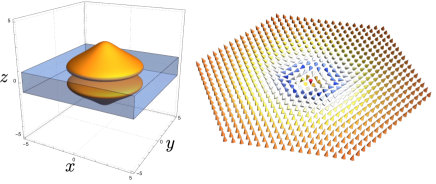
Low-energy dynamics of QCD can be described by pion degrees of freedom in terms of the chiral perturbation theory(ChPT). A chiral soliton lattice(CSL), an array of solitons, is the ground state due to the chiral anomaly in the presence of a magnetic field larger than a certain critical value at finite density. Here, we show in a model-independent and fully analytic manner (at the leading order of ChPT) that the CSL phase transits to a {\it domain-wall Skyrmion phase} when the chemical potential is larger than the critical value $μ_{ m c} = 16πf_π^2/3m_π \sim 1.03 \;\; { m GeV}$ with the pion's decay constant $f_π$ and mass $m_π$, which can be regarded as the nuclear saturation density. There spontaneously appear stable two-dimensional Skyrmions or lumps on a soliton surface, which can be viewed as three-dimensional Skyrmions carrying even baryon numbers from the bulk despite no Skyrme term. They behave as superconducting rings with persistent currents due to a charged pion condensation, and areas of the rings' interiors are quantized. This phase is in scope of future heavy-ion collider experiments.
研究动机与目标
- 为了理解在不依赖Skyrme项的前提下,重子如何在低能QCD中产生。
- 为了在强磁场和有限重子密度条件下,识别一种新的重子相。
- 为了在高化学势下建立从手征子晶体(CSL)到域壁Skyrmion相的无模型依赖、解析的相变。
- 为了阐明手征异常和带电π介子凝聚在稳定孤子表面二维Skyrmion中的作用。
提出的方法
- 在有效拉格朗日量中基于手征微扰理论(ChPT)的一阶展开进行解析推导,该拉格朗日量描述了与电磁场和手征异常耦合的π介子。
- 通过中性π介子对磁场的异常耦合,将系统映射到sine-Gordon模型,从而获得域壁解。
- 将三维重子数密度分解为sine-Gordon孤子数和二维块状拓扑电荷密度的贡献。
- 使用亚纯函数描述k-块构型,并通过计算Wess-Zumino-Witten(WZW)项来评估磁通和旋量结构的能量贡献。
- 应用Goldstone-Wilczek电流,将手征异常与有效作用量中的磁场耦合联系起来。
- 评估能量泛函,表明重子数密度在两个不同位置出现峰值,表明形成了稳定的Skyrmion样结构。
实验结果
研究问题
- RQ1在强磁场和有限重子密度下,不依赖Skyrme项时,重子如何在低能QCD中产生?
- RQ2在高化学势下,手征子晶体(CSL)向新重子相的相变本质是什么?
- RQ3二维Skyrmion如何在孤子表面形成,其拓扑与物理特性如何?
- RQ4带电π介子凝聚在稳定这些结构并实现持续电流中起什么作用?
- RQ5在此新相中,重子数密度如何分布,Skyrmion核心的量子化由什么决定?
主要发现
- 当重子化学势超过 μ_c = 16πf_π²/(3m_π) ≈ 1.03 GeV 时,CSL相转变为域壁Skyrmion相,对应于核饱和密度。
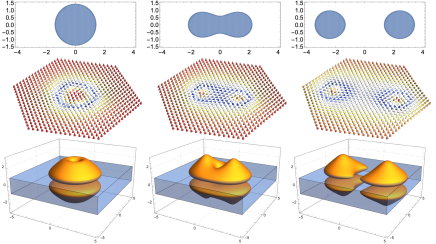
- 稳定的二维Skyrmion(块状结构)在孤子表面自发形成,具有拓扑稳定性并携带量子化重子数。
- 尽管缺少Skyrme项,这些域壁Skyrmion从体相视角表现如同三维Skyrmion。
- 由于带电π介子凝聚,Skyrmion内部存在持续超电流,导致其内部磁通量子化。
- 重子数密度在z方向(垂直于孤子平面)呈现双峰结构,总积分为2q(x,y),证实了Skyrmion电荷的二维特性。
- 能量泛函偏好 b_{k-1} = 0 的构型,表明最低能量Skyrmion态是亚纯函数描述中非均匀性最小的那些态。
更好的研究,从现在开始
从阅读论文到最终审阅,大幅缩短您的研究时间。
无需绑定信用卡
本解读由 AI 生成,并经人工编辑审核。