
[论文解读] How to Train Data-Efficient LLMs
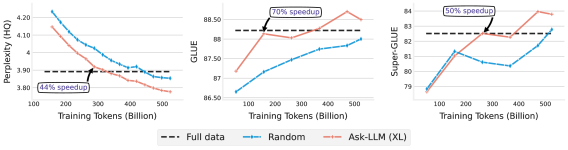
本文提出 Ask-LLM 和密度采样(Density sampling),通过分别优先考虑数据质量和覆盖度,提升大语言模型(LLM)预训练的数据效率。Ask-LLM 使用一个小型指令微调的 LLM 来评估训练样本的质量,使模型即使在去除 90% 数据的情况下,仍能超越全量数据训练的性能,且收敛速度最快可提升 70%。
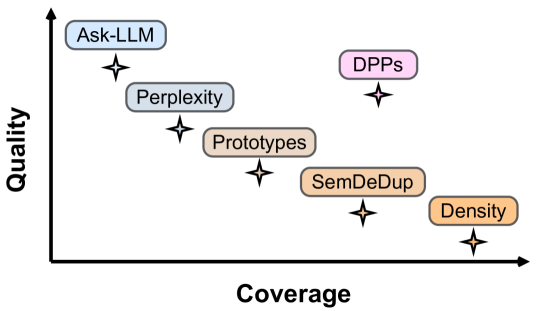
The training of large language models (LLMs) is expensive. In this paper, we study data-efficient approaches for pre-training LLMs, i.e., techniques that aim to optimize the Pareto frontier of model quality and training resource/data consumption. We seek to understand the tradeoffs associated with data selection routines based on (i) expensive-to-compute data-quality estimates, and (ii) maximization of coverage and diversity-based measures in the feature space. Our first technique, Ask-LLM, leverages the zero-shot reasoning capabilities of instruction-tuned LLMs to directly assess the quality of a training example. To target coverage, we propose Density sampling, which models the data distribution to select a diverse sample. In our comparison of 19 samplers, involving hundreds of evaluation tasks and pre-training runs, we find that Ask-LLM and Density are the best methods in their respective categories. Coverage sampling can recover the performance of the full data, while models trained on Ask-LLM data consistently outperform full-data training -- even when we reject 90% of the original dataset, while converging up to 70% faster.
研究动机与目标
- 解决大语言模型(LLM)预训练过程中计算与数据成本高昂的问题,该问题因幂律缩放而面临收益递减。
- 探究在 LLM 预训练中,基于数据质量的估计与基于覆盖度的优化,哪种方法能带来更高的数据效率。
- 在真实 LLM 训练场景中,评估基于质量的采样与基于覆盖度的采样之间的权衡。
- 确定数据筛选是否能够提升模型质量与数据/资源消耗之间的帕累托前沿。
- 提供一个涵盖多种模型尺寸与评估任务的 19 种采样策略的大规模实证基准。
提出的方法
- 提出 Ask-LLM:一种数据筛选方法,利用具备零样本推理能力的小型指令微调 LLM(如 Flan-T5-XL)基于样本的信息量与质量进行评分。
- 实现密度采样:一种以覆盖度为导向的方法,通过建模数据的潜在特征分布,选择多样化且具代表性的样本。
- 在 Ask-LLM 中使用困惑度作为数据质量的代理指标,其中较低的困惑度表示更高的质量。
- 使用 19 种不同的采样策略,在筛选后的数据子集上训练 T5-Large(800M)和 T5-Small(60M)模型。
- 在微调后,于 111 项下游 NLP 任务上评估所有模型,实现性能与收敛速度的全面比较。
- 分析收敛速率、采样器相关性以及采样成本对下游性能的影响,以识别数据效率的关键驱动因素。
实验结果
研究问题
- RQ1通过 LLM 实现基于质量的数据筛选,是否能在模型性能与训练速度上超越全量数据训练?
- RQ2基于覆盖度的采样(如密度采样)能否恢复全量数据预训练的性能?
- RQ3在不同模型尺寸与采样率下,数据质量与覆盖度之间的权衡如何影响模型性能?
- RQ4与更简单的覆盖度启发式方法相比,质量估计带来的计算成本是否值得?
- RQ5数据筛选技术是否能够推动 LLM 预训练中模型质量与数据/资源消耗之间的帕累托前沿?
主要发现
- Ask-LLM 在所有情况下均优于全量数据训练,在去除 90% 训练数据后仍能实现更优的下游性能。
- 使用 Ask-LLM 训练的模型收敛速度比全量数据训练快最多 70%,尽管使用的数据量显著减少。
- 密度采样通过最大化数据分布中潜在主题的覆盖度,成功恢复了全量数据预训练的性能。
- Ask-LLM 中使用的微型代理模型(60M 参数)在性能上优于大多数已有的数据筛选基线方法。
- Ask-LLM 的性能超越了全量数据训练,表明数据质量过滤可超越单纯依赖数据量的优势。
- 本研究证明,数据筛选能够推动模型质量与数据/资源消耗之间的帕累托前沿,使更高质量的模型在更少数据与计算资源下实现。
更好的研究,从现在开始
从阅读论文到最终审阅,大幅缩短您的研究时间。
无需绑定信用卡
本解读由 AI 生成,并经人工编辑审核。