
[论文解读] Hybrid Oscillator-Qubit Quantum Processors: Instruction Set Architectures, Abstract Machine Models, and Applications
本文提出混合连续变量(CV)与离散变量(DV)量子处理器的抽象机器模型和指令集体系结构,详细描述表示、门、编译方法,以及在量子仿真与纠错中的应用。
Quantum computing with discrete variable (DV, qubit) hardware is approaching the large scales necessary for computations beyond the reach of classical computers. However, important use cases such as quantum simulations of physical models containing bosonic modes, and quantum error correction are challenging for DV-only systems. Separately, hardware containing native continuous-variable (CV, oscillator) systems has received attention as an alternative approach, yet the universal control of such systems is non-trivial. In this work, we show that hybrid CV-DV hardware offers a great advantage in meeting these challenges, offering a powerful computational paradigm that inherits the strengths of both DV and CV processors. We provide a pedagogical introduction to CV-DV systems and the multiple abstraction layers needed to produce a full software stack connecting applications to hardware. We present a variety of new hybrid CV-DV compilation techniques, algorithms, and applications, including the extension of quantum signal processing concepts to CV-DV systems and strategies to simulate systems of interacting spins, fermions, and bosons. To facilitate the development of hybrid CV-DV processor systems, we introduce formal Abstract Machine Models and Instruction Set Architectures -- essential abstractions that enable developers to formulate applications, compile algorithms, and explore the potential of current and future hardware for realizing fault-tolerant circuits, modules, and processors. Hybrid CV-DV quantum computations are beginning to be performed in superconducting, trapped ion, and neutral atom platforms, and large-scale experiments are set to be demonstrated in the near future. We present a timely and comprehensive guide to this relatively unexplored yet promising approach to quantum computation and providing an architectural backbone to guide future development.
研究动机与目标
- 激发并形式化混合振荡子-量子比特硬件的需求,以结合CV和DV量子资源的优势。
- 定义混合CV-DV处理器的抽象机器模型(AMMs)和通用指令集体系结构(ISAs)。
- 开发并分析将算法映射到混合ISAs的编译与转译技术。
- 探索在量子仿真、态和过程层析,以及玻色子量子纠错中的应用。
- 为软件/硬件协同设计提供路线图,以推动容错量子计算的发展。
提出的方法
- 介绍玻色态及混合表示(振荡子与量子比特)的教学基础。
- 给出从高斯(类似Clifford)到非高斯以及混合门的分层门集。
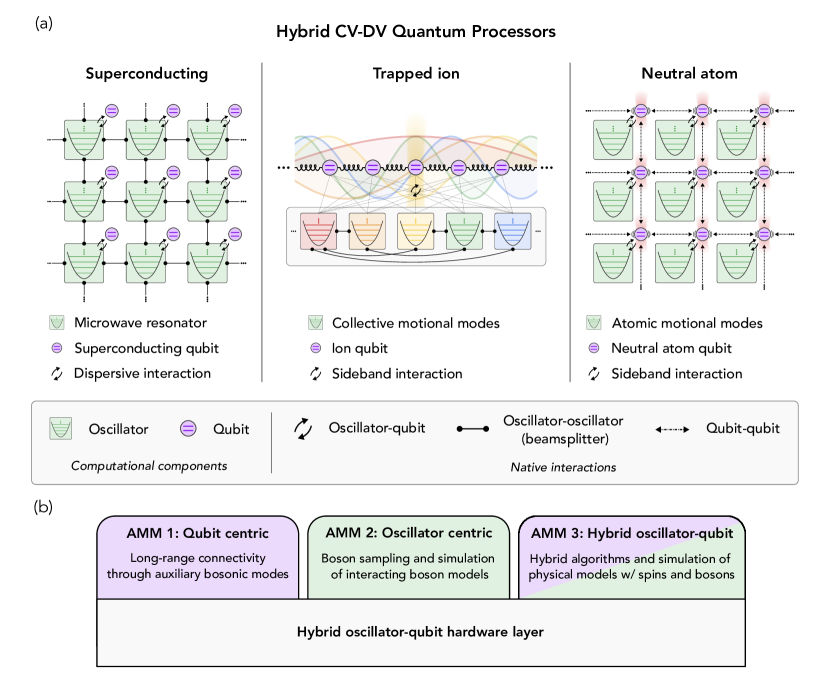
- 提出多种ISA(Gaussian、Cubic、Phase-Space、Fock-Space、Sideband)和三种AMMs,以揭示不同硬件特征。
- 描述抽象机器模型及其对资源估计与编程的影响。
- 概述面向混合系统的精确与近似编译策略,包括量子信号处理扩展。
- 讨论玻色子量子纠错及其与编译和控制的整合。
实验结果
研究问题
- RQ1如何为混合CV-DV量子处理器定义抽象机器模型,以实现对计算和容错的形式化推理?
- RQ2哪些通用指令集能够为振荡子-量子比特系统提供实用且可扩展的控制?
- RQ3如何将电路和子程序高效编译到混合ISAs上,包括玻色子纠错协议?
- RQ4在量子仿真及相关任务中,混合CV-DV硬件最具前景的应用有哪些?
- RQ5不同的AMMs如何影响资源估计与混合量子计算机的软件栈设计?
主要发现
- 混合CV-DV硬件在玻色子系统的量子仿真以及玻色子量子纠错方面提供了优势。
- 三种抽象机器模型将混合硬件的不同方面暴露给软件栈,为多样化的编译路径提供可能。
- 多种ISA(Gaussian、Cubic、Phase-Space、Fock-Space、Sideband)在硬件高效映射下实现通用控制。
- 将量子信号处理扩展到混合CV-DV系统,为纠缠门和玻色子QEC提供精确与近似的编译路径。
- 玻色模式提供硬件高效的表示,在模拟玻色或晶格规范理论时可以降低量子比特开销。
- 该工作为硬件、编译器与应用在容错量子计算与仿真中的协同设计提供了正式的基础框架与工具。
更好的研究,从现在开始
从论文设计到论文写作,大幅缩短您的研究时间。
无需绑定信用卡
本解读由 AI 生成,并经人工编辑审核。