
[论文解读] Hydrodynamical Evolution of Black-Hole Binaries Embedded in AGN Discs: III. The Effects of Viscosity
本研究通过2D局部剪切盒模拟,探究了活跃星系核(AGN)盘中等质量黑洞双星的流体动力学演化,重点关注粘性效应的影响。粘性使流动结构更加平滑,提升吸积率,并通过增强正向力矩促进双星硬化,尤其在顺行配置下更为显著;同时,当存在粘性或类等温方程态时,可降低对吸积体尺寸的依赖性。
Stellar-mass binary black holes (BBHs) embedded in active galactic nucleus (AGN) discs offer a distinct dynamical channel to produce black hole mergers detected in gravitational waves by LIGO/Virgo. To understand their orbital evolution through interactions with the disc gas, we perform a suite of 2D high-resolution, local shearing box, viscous hydrodynamical simulations of equal-mass binaries. We find that viscosity not only smooths the flow structure around prograde circular binaries, but also greatly raises their accretion rates. The torque associated with accretion may be overwhelmingly positive and dominate over the gravitational torque at a high accretion rate. However, the accreted angular momentum per unit mass decreases with increasing viscosity, making it easier to shrink the binary orbit. In addition, retrograde binaries still experience rapid orbital decay, and prograde eccentric binaries still experience eccentricity damping. Our numerical experiments further show that prograde binaries are more likely to be hardened if the physical sizes of the accretors are sufficiently small such that the accretion rate is reduced. The dependency of the binary accretion rate on the accretor size can be weaken through boosted accretion either due to a high viscosity or a more isothermal-like equation of state (EOS). Our results widen the explored parameter space for the hydrodynamics of embedded BBHs and demonstrate that their orbital evolution in AGN discs is a complex, multifaceted problem.
研究动机与目标
- 理解粘性如何影响嵌入AGN盘中的黑洞双星的流体动力学与轨道演化。
- 检验粘性是否能降低吸积率对吸积体(汇点半径)物理尺寸的依赖性。
- 研究粘性在改变力矩平衡(特别是引力力矩与吸积驱动力矩之间)中的作用。
- 在局部剪切盒框架中引入粘性应力,扩展先前无粘性模拟,以更真实地模拟AGN盘条件。
- 评估粘性对逆行及偏心双星的影响,并与先前无粘性结果进行对比。
提出的方法
- 对黏性AGN盘中的等质量黑洞双星执行2D高分辨率局部剪切盒流体动力学模拟。
- 采用标准的$α$-粘性模型来模拟盘气体中的湍流粘性。
- 使用可变半径($r_{\rm s} = 0.02a_{\rm b}, 0.04a_{\rm b}, 0.08a_{\rm b}$)的吸收汇点粒子来模拟双星组分的吸积。
- 将流动结构解析至小于$\lesssim 1\%$双星希尔半径,最细网格单元小于$\lesssim 0.1\%$希尔半径。
- 通过绝热指数$\gamma$调节方程态(EOS),包括近似等温($\gamma \approx 1$)与非等温($\gamma > 1$)情形。
- 测量时间平均的双星迁移率$\langle \dot{a}_{\rm b} \rangle / a_{\rm b}$、吸积率与力矩,以量化轨道演化。
实验结果
研究问题
- RQ1粘性如何改变AGN盘中顺行、逆行及偏心黑洞双星周围的流动形态与吸积结构?
- RQ2粘性是否能降低吸积率对汇点半径$r_{\rm s}$(即黑洞吸积体尺寸)的依赖性?
- RQ3粘性对双星轨道演化产生何种净效应——是促进硬化还是扩张?
- RQ4在黏性盘中,吸积驱动力矩与引力力矩相比如何?这种关系随粘性与方程态如何变化?
- RQ5粘性在多大程度上影响双星组分的自旋力矩,特别是在存在或不存在围绕单个黑洞的盘状结构时?
主要发现
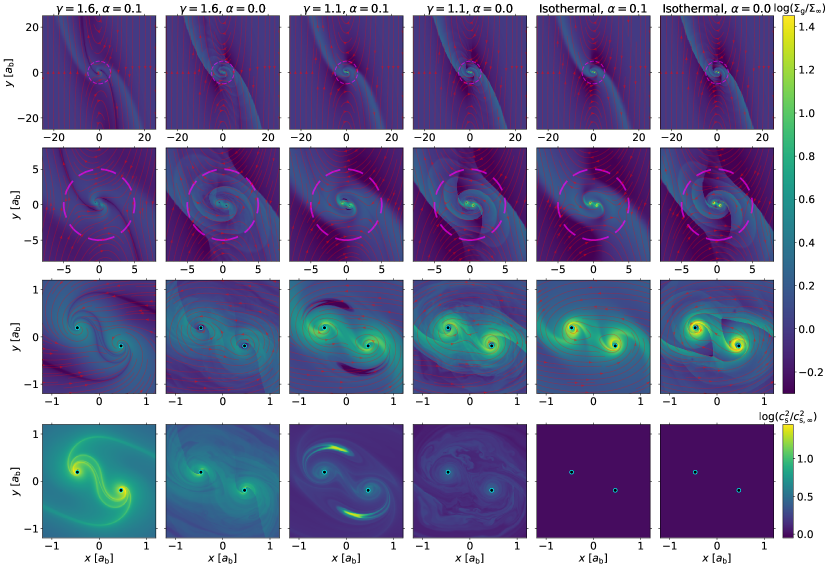
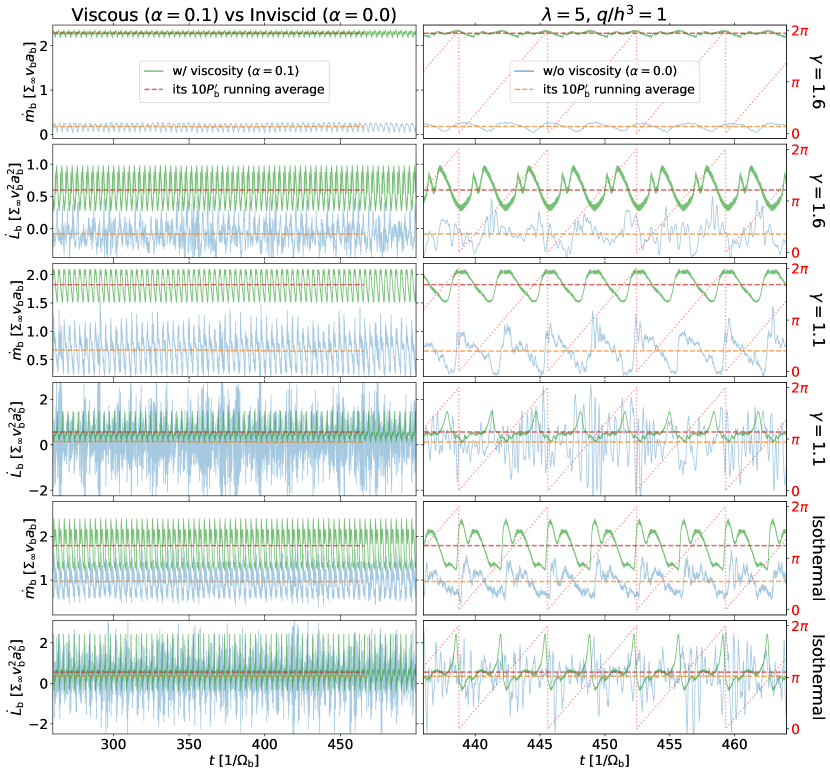
- 粘性使激波结构更加平滑,并减少围绕单个黑洞的盘状结构(CSDs)的质量,从而提升吸积率并增强双星所受的总力矩。
- 具有非等温方程态(如$\gamma > 1$)的顺行双星,其轨道衰减速率可达质量倍增率的数倍,且随着$\gamma$增大而减小。
- 在黏性盘中,当吸积率较高时,吸积驱动力矩超过引力力矩,导致顺行双星净硬化。
- 当粘性较高或方程态接近等温时,吸积率对汇点半径$r_{\rm s}$的依赖性显著减弱,粘性驱动的吸积几乎与$r_{\rm s}$无关。
- 尽管缺乏CSDs且自旋力矩可忽略,逆行双星仍因强吸积而经历快速轨道衰减。
- 偏心顺行双星经历强烈的偏心率阻尼与增强的吸积,导致正向力矩与轨道扩张,尽管粘性降低了吸积率对$r_{\rm s}$的依赖性。
更好的研究,从现在开始
从阅读论文到最终审阅,大幅缩短您的研究时间。
无需绑定信用卡
本解读由 AI 生成,并经人工编辑审核。