
[论文解读] Hyperdimensional Computing for ADHD Classification using EEG Signals
该论文使用带有时空编码器的高维计算对静息态 EEG 的 ADHD 进行分类,准确率达到 88.9%,远超 DNN 基准,且训练数据显著更少。
Following the recent interest in applying the Hyperdimensional Computing paradigm in medical context to power up the performance of general machine learning applied to biomedical data, this study represents the first attempt at employing such techniques to solve the problem of classification of Attention Deficit Hyperactivity Disorder using electroencephalogram signals. Making use of a spatio-temporal encoder, and leveraging the properties of HDC, the proposed model achieves an accuracy of 88.9%, outperforming traditional Deep Neural Networks benchmark models. The core of this research is not only to enhance the classification accuracy of the model but also to explore its efficiency in terms of the required training data: a critical finding of the study is the identification of the minimum number of patients needed in the training set to achieve a sufficient level of accuracy. To this end, the accuracy of our model trained with only $7$ of the $79$ patients is comparable to the one from benchmarks trained on the full dataset. This finding underscores the model's efficiency and its potential for quick and precise ADHD diagnosis in medical settings where large datasets are typically unattainable.
研究动机与目标
- 使用 Hyperdimensional Computing (HDC) 对 EEG 的 ADHD 分类进行研究。
- 开发一个通用的时空 HDC 编码器,能够在多名患者之间工作且无需患者特异性训练。
- 通过确定实现具竞争力准确率所需的最少患者数量来评估训练数据效率。
- 将 HDC 的性能与标准深度学习基线(SVM、CNN、LSTM)进行比较。
- 推广适用于临床环境的轻量级、高效诊断方法。
提出的方法
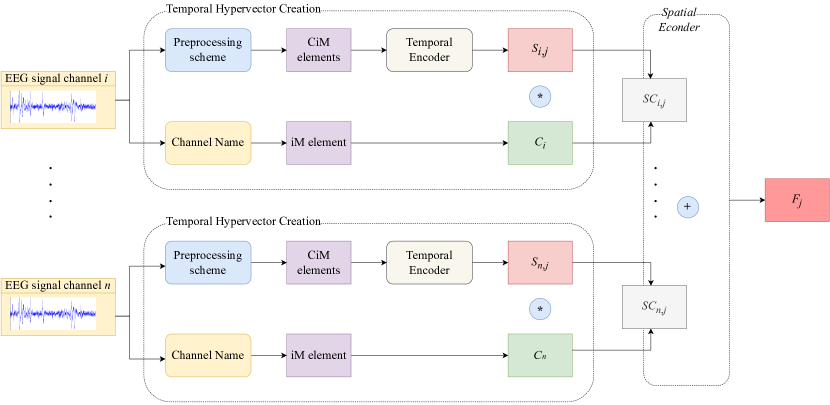
- 使用两部分时空编码器将 EEG 信号编码到高维空间(跨通道的空间 HV 绑定与时序 n-gram HV 置换)。
- 采用正交的通道特定项记忆(iM)和连续项记忆(CiM)对信号水平进行量化。
- 在联想记忆中创建类别原型,并通过与原型的余弦相似度进行分类(原型的一次学习)。
- 将数据在所有患者之间划分为训练 / 测试集,以提升泛化能力,而非患者特定训练。
- 将 EEG 采样率从 256 Hz 降至 32 Hz,并分段为 1 秒的 n-gram(每个 n-gram 为 32 维 HV),以捕捉时间结构。
- 在 59 名患者上训练,在 20 名患者上测试,评估逐 n-gram 的分类并汇总为每患者的决策。

实验结果
研究问题
- RQ1HDC 是否可用通用的时空编码器从静息态 EEG 实现 ADHD 与对照的分类?
- RQ2与传统 DNN 相比,HDC 是否需要更少的训练样本就能达到具竞争力的准确率?
- RQ3所提出的编码器如何处理时空信息以提升鲁棒性和效率?
- RQ4在同一数据集上,HDC 的性能与 SVM、CNN、LSTM 的基线相比如何?
- RQ5哪些预处理和数据降维步骤足以保留 ADHD 分类的诊断信息?
主要发现
| Model | Accuracy (%) | F1-Score | Precision | Recall |
|---|---|---|---|---|
| SVM-ADHD | 70.7±0.05 | 0.712±0.003 | 0.708±0.004 | 0.716±0.002 |
| CNN-ADHD | 71.4±0.01 | 0.720±0.002 | 0.715±0.003 | 0.727±0.001 |
| LSTM-ADHD | 72.2±0.01 | 0.731±0.003 | 0.729±0.002 | 0.733±0.003 |
| ADHDC | 88.9±0.02 | 0.875±0.004 | 0.850±0.005 | 0.904±0.003 |
- 基于 HDC 的 ADHDC 模型在测试集上达到 88.9% 的准确率,优于全部三个 DNN 基线。
- ADHDC 在 ADHD 与对照任务上达到 0.875 的 F1 分数、0.850 的精确率和 0.904 的召回率。
- 与 SVM(70.7%)、CNN(71.4%)和 LSTM(72.2%)相比,ADHDC 提供显著更高的性能。
- 该模型在 59 名患者上训练、在 20 名患者上测试,显示出强数据效率。
- 该方法在最少的预处理下实现快速训练和较低的计算需求。
更好的研究,从现在开始
从论文设计到论文写作,大幅缩短您的研究时间。
无需绑定信用卡
本解读由 AI 生成,并经人工编辑审核。