
[论文解读] Identifying and Characterizing Silently-Evolved Methods in the Android API
本文提出 AndroSea 工具,用于识别和表征 Android API 中的无声演化方法(SEMs)——即行为在版本间发生变化但未相应更新文档的方法。研究在十个 Android API 版本中识别出 4,769 个 SEMs,发现 562 个手动分析的 SEMs 中有 363 个涉及语义变化,且在 1,000 个真实应用中,有 957 个使用了至少一个 SEM,揭示了因未检测到的行为变化而带来的严重兼容性风险。
With over 500,000 commits and more than 700 contributors, the Android platform is undoubtedly one of the largest industrial-scale software projects. This project provides the Android API, and developers heavily rely on this API to develop their Android apps. Unfortunately, because the Android platform and its API evolve at an extremely rapid pace, app developers need to continually monitor API changes to avoid compatibility issues in their apps (\ie issues that prevent apps from working as expected when running on newer versions of the API). Despite a large number of studies on compatibility issues in the Android API, the research community has not yet investigated issues related to silently-evolved methods (SEMs). These methods are functions whose behavior might have changed but the corresponding documentation did not change accordingly. Because app developers rely on the provided documentation to evolve their apps, changes to methods that are not suitably documented may lead to unexpected failures in the apps using these methods. To shed light on this type of issue, we conducted a large-scale empirical study in which we identified and characterized SEMs across ten versions of the Android API. In the study, we identified SEMs, characterized the nature of the changes, and analyzed the impact of SEMs on a set of 1,000 real-world Android apps. Our experimental results show that SEMs do exist in the Android API, and that 957 of the apps we considered use at least one SEM. Based on these results, we argue that the Android platform developers should take actions to avoid introducing SEMs, especially those involving semantic changes. This situation highlights the need for automated techniques and tools to help Android practitioners in this task.
研究动机与目标
- 调查 Android API 方法的行为变化是否以及如何在无对应文档更新的情况下发生。
- 在多个 Android API 版本中识别并表征无声演化方法(SEMs)。
- 评估 SEMs 对现有 Android 应用程序的现实世界影响。
- 突出显示由于广泛使用 API 中未记录的语义变化而导致的兼容性故障风险。
- 倡导在 Android 框架开发中改进文档实践并采用自动化检测工具。
提出的方法
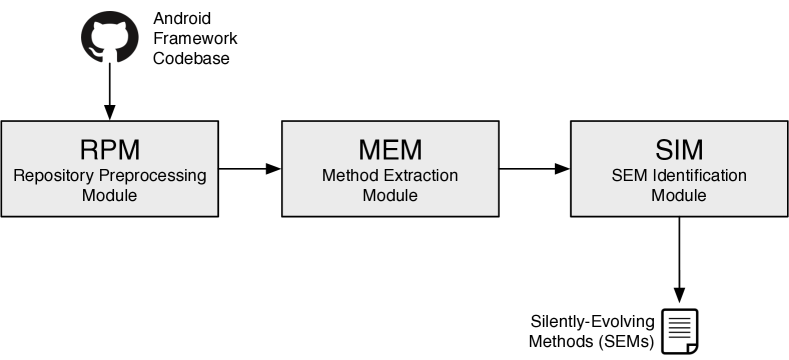
- 构建 AndroSea 原型工具,通过比较连续 API 版本中的方法实现,分析 Android 框架源代码以检测 SEMs。
- 通过检测方法实现中的行为差异(同时保持相同的 Javadoc 注释)来自动识别 SEMs。
- 对 562 个具有统计显著性的 SEMs 进行手动分析,以分类变化的性质(如语法变化与语义变化)。
- 收集并分析 1,000 个真实世界 Android 应用程序中 SEMs 的使用情况,以评估其现实世界影响。
- 利用应用代码中的版本检查作为信号,推断开发人员是否正在缓解 SEM 相关的兼容性问题。
- 在十个 Android API 发布版本(从 1.5 到 10.0)中应用实证分析,以确保对演化模式的广泛覆盖。
实验结果
研究问题
- RQ1在多个版本中,无声演化方法(SEMs)在 Android API 中普遍存在到何种程度?
- RQ2SEMs 中最常见的变化类型(语法或语义)是什么,它们如何影响 API 兼容性?
- RQ3SEMs 在真实世界 Android 应用中的使用频率如何,开发人员是否能检测或缓解这些问题?
- RQ4SEMs 的引入是否存在特定模式,例如仅被引入一次或出现在特定 API 类别中?
- RQ5现有应用实践(如 API 版本检查)在多大程度上表明开发人员意识到了 SEM 引发的兼容性风险?
主要发现
- 在十个 Android API 版本中总共识别出 4,769 个 SEMs,其中 2,271 个为公开可访问的方法。
- 在手动分析的 562 个 SEMs 中,有 363 个(64.6%)涉及语义变化,表明存在较高的运行时故障风险。
- 在研究的 1,000 个真实世界 Android 应用中,有 957 个使用了至少一个公开可访问的 SEM。
- 大多数 SEMs(尤其是 PASEMs)仅被引入一次,表明框架维护者可能并未完全意识到此类变化。
- 许多使用 SEMs 的应用并未采用 API 版本检查,表明尽管存在潜在的兼容性风险,但缺乏缓解措施。
- 部分应用中存在版本检查,证实开发人员意识到了 API 演化问题,但并非所有开发人员都在主动应对 SEM 特定风险。

更好的研究,从现在开始
从阅读论文到最终审阅,大幅缩短您的研究时间。
无需绑定信用卡
本解读由 AI 生成,并经人工编辑审核。