
[论文解读] Identifying and Explaining the Resilience of Ecological Networks
本研究将生物化学调控网络中的工具应用于三营养级生态网络,在广义Lotka-Volterra框架下识别并解释了鲁棒完美适应——即物种丰度在扰动后精确恢复至原始水平的韧性——的机制。在超过20,000种可能的网络结构中,发现了23种表现出该韧性的网络,揭示了以序列单向相互作用和种内竞争为特征的结构基序是关键机制。
Resilient ecological systems will be better able to maintain their structure and function in the emerging Anthropocene. Estimating the resilience of different systems will therefore provide valuable insight for conservation decision-makers, and is a priority goal of resilience theory. Current estimation methods rely on the accurate parameterisation of ecosystem models, or the identification of important motifs in the structure of the ecological system network. However, both of these methods face significant empirical and theoretical challenges. In this paper, we adapt tools developed for the analysis of biochemical regulatory networks to prove that a form of resilience - robust perfect adaptation - is a property of particular ecological networks, and to explain the specific process by which the ecosystem maintains its resilience. We undertake an exhaustive search for robust perfect adaptation across all possible three-species ecological networks, under a generalised Lotka-Volterra framework. From over 20,000 possible network structures, we identify 23 network structures that are capable of robust perfect adaptation. The resilient properties of these networks provide important insights into the potential mechanisms that could promote resilience in ecosystems, and suggest new avenues for measuring and understanding the property of ecological resilience in larger, more realistic socioecological networks.
研究动机与目标
- 识别在广义Lotka-Volterra模型下能够实现鲁棒完美适应的生态网络结构,即物种丰度在扰动后精确恢复至扰动前水平的韧性形式。
- 通过聚焦于结构特性而非动态参数,克服生态模型中参数估计的挑战。
- 通过借鉴生物化学反应网络理论的方法,解释生态网络中韧性的机制基础。
- 探讨具有完美韧性的网络基序是否可为社会生态系统中的保护管理与生态系统设计提供启示。
- 为在更大、更真实的生态网络中识别此类韧性结构奠定基础。
提出的方法
- 在广义Lotka-Volterra框架下,对所有可能的三物种生态网络拓扑结构进行了全面搜索。
- 应用代数技术,包括Gröbner基计算,以解析方式确定鲁棒完美适应的条件。
- 采用基于刺激的扰动模型模拟扰动,评估系统恢复至原始状态的行为。
- 识别出目标物种丰度在所有参数取值下均能精确恢复至扰动前水平的网络基序。
- 分析了韧性网络的结构特征,如单向相互作用序列以及种内竞争项的引入。
- 通过数值模拟验证结果,确认完美适应的动力学特性并评估振荡行为。
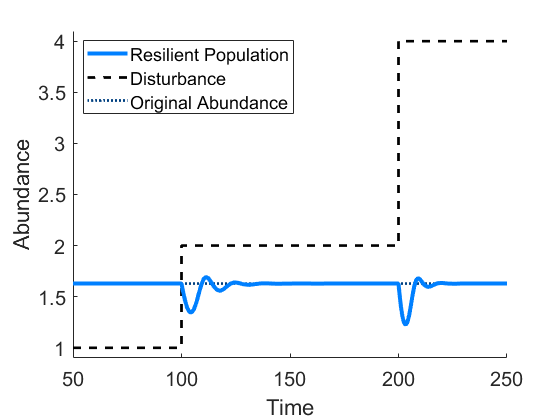
实验结果
研究问题
- RQ1在广义Lotka-Volterra模型下,哪些三物种生态网络结构表现出鲁棒完美适应?
- RQ2在生态系统中,哪些结构特征或网络基序与鲁棒完美适应一致相关?
- RQ3单向相互作用和种内竞争如何共同构成完美韧性的机制?
- RQ4是否所有种群同时受到扰动的情况也能支持鲁棒完美适应?原因是什么?
- RQ5在生物化学网络中使用的分析框架在多大程度上可被适配以识别生态网络中的韧性?
主要发现
- 在超过20,000种可能的三物种网络结构中,识别出23种具备鲁棒完美适应能力的网络。
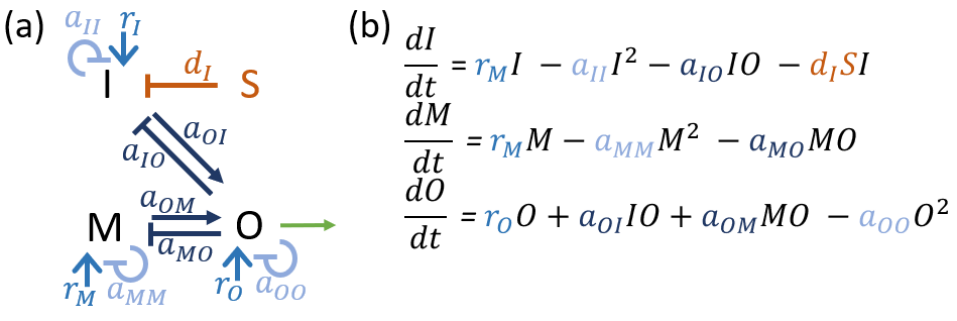
- 所有韧性网络均包含单向相互作用序列,即一个物种影响另一个物种但不被其反向影响。
- 所有韧性网络中均包含种内竞争项,其在稳定振荡动力学中发挥了关键作用。
- 所有种群直接受扰动的网络无法实现完美韧性,表明其在缓冲全局冲击方面存在局限性。
- 所识别的基序表现出高度振荡行为,使其对后续随机扰动更加脆弱。
- 基于Gröbner基计算的分析框架成功识别出韧性,而无需精确的参数值,从而克服了生态建模中的主要实证挑战。
更好的研究,从现在开始
从阅读论文到最终审阅,大幅缩短您的研究时间。
无需绑定信用卡
本解读由 AI 生成,并经人工编辑审核。