
[论文解读] Implications of the electron-phonon coupling in CuPb$_9$(PO$_4$)$_6$O for superconductivity: an extit{ab initio} study
本从头算研究调查了CuPb9(PO4)6O中的电子-声子耦合,以评估其具有高温超导性的潜力。尽管在费米能级附近存在平坦的Cu 3d–O 2p能带以及软的低能声子,但电子-声子耦合强度过弱(λ ≈ 0.4),无法克服库仑排斥作用,预测超导转变温度低于2 K,因此排除了通过Migdal-Eliashberg机制实现常规高温超导的可能性。
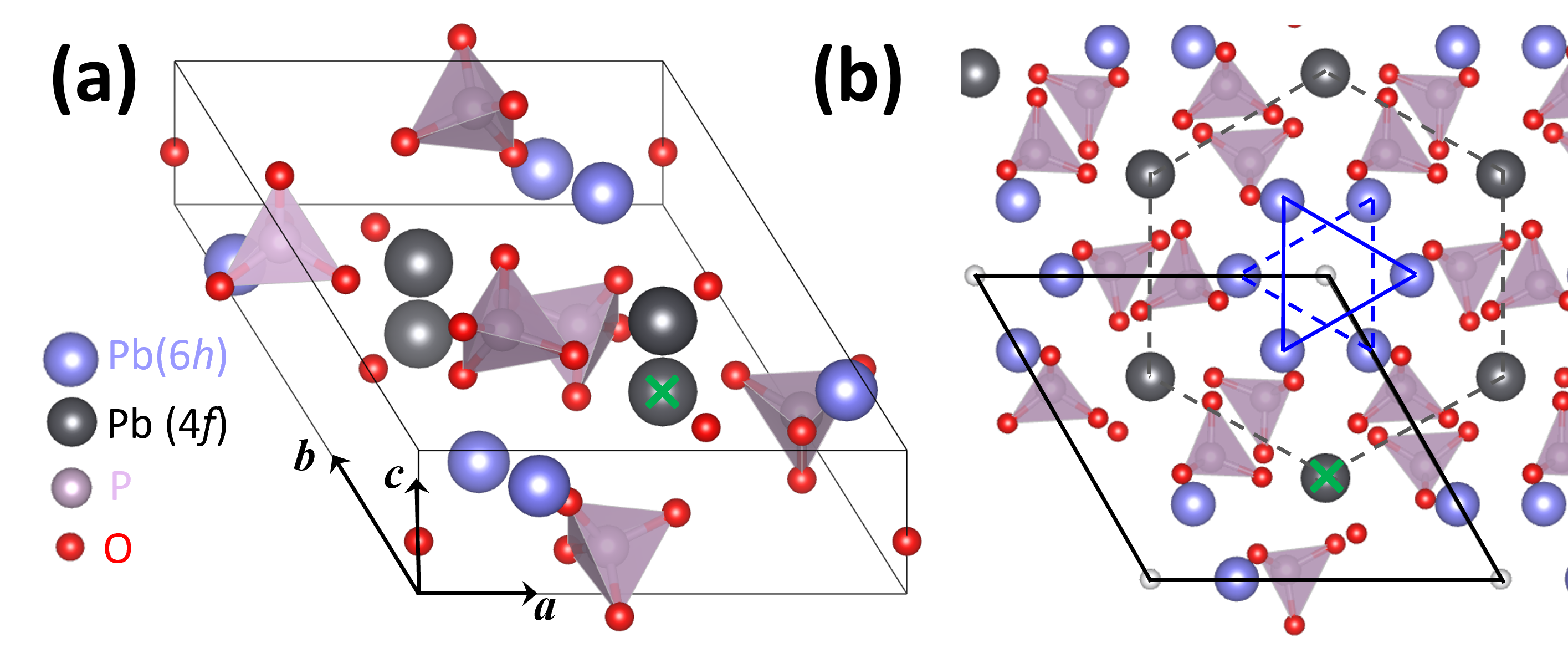
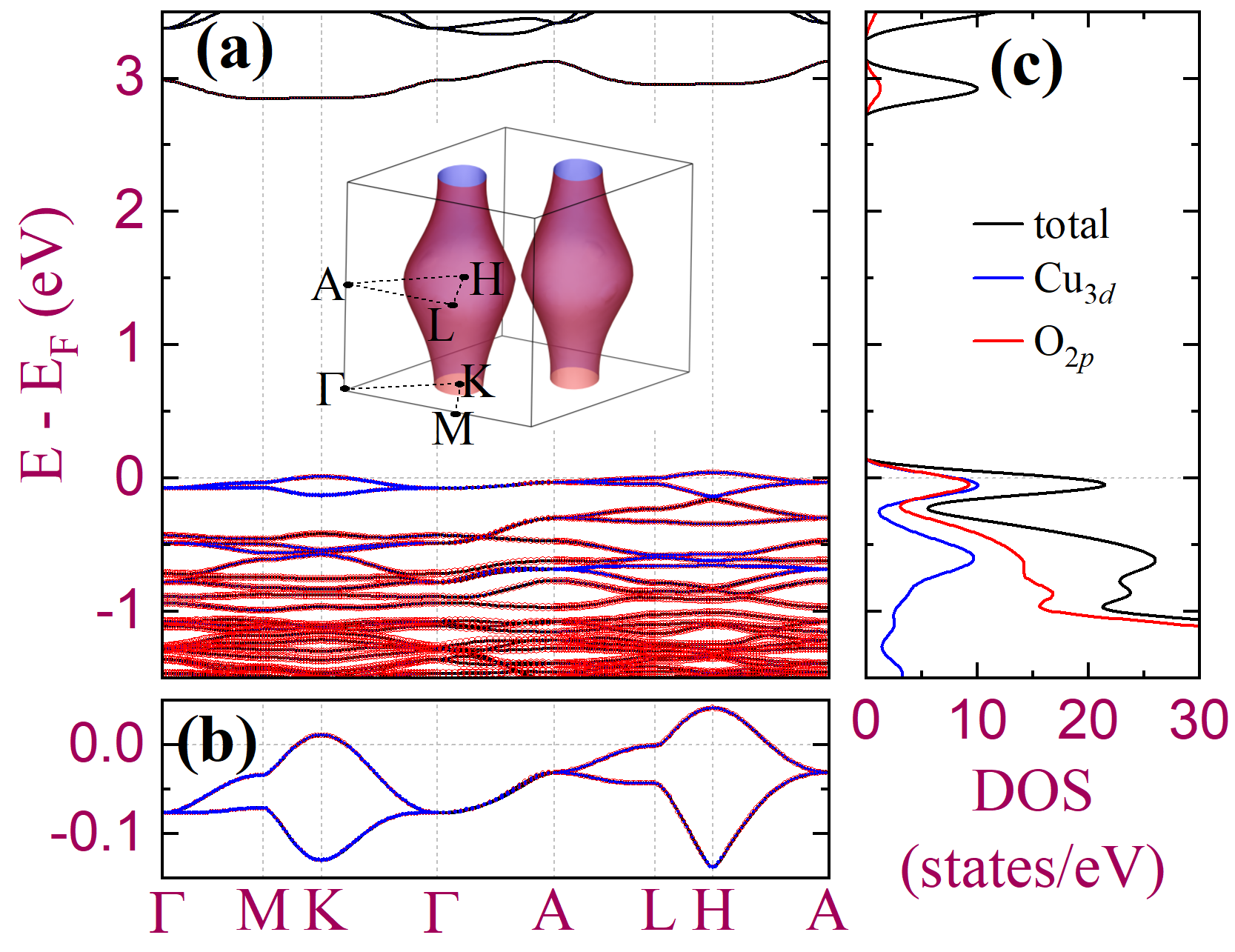
We report $ab~initio$ calculations of the electronic and vibrational properties in CuPb$_9$(PO$_4$)$_6$O, including the electron-phonon coupling strength via strong-coupling Migdal-Eliashberg theory. We verify the presence of appealing flat electronic bands near the Fermi level, a strong hybridization between the Cu $3d$ and O $2p$ states, and soft low-energy phonons, which can suggest high-temperature superconducting behavior. However, the electron-phonon coupling strength appears insufficient to overcome the Coulomb repulsion between an electron pair and thus does does not support high-temperature superconductivity in CuPb$_9$(PO$_4$)$_6$O via the conventional electron-phonon Migdal-Eliashberg mechanism. Even neglecting Coulomb repulsion of the electron pair we find this electron-phonon coupling suggests a superconducting transition temperature less than 2~K.
研究动机与目标
- 评估CuPb9(PO4)6O中的电子-声子耦合是否可通过强耦合Migdal-Eliashberg机制支持高温超导。
- 评估费米能级附近平坦电子能带、强Cu 3d–O 2p杂化以及低能声子在促进超导性中的作用。
- 确定电子-声子耦合强度是否足以克服该体系中电子-电子库仑排斥。
- 通过含Hubbard U的自旋极化计算,研究电子关联效应对超导潜力的影响。
- 基于从头算电子-声子耦合与Eliashberg理论,提供超导转变温度(Tc)的定量估计。
提出的方法
- 使用Quantum ESPRESSO进行从头算计算,采用非局域赝势和PBE-GGA交换关联泛函。
- 通过密集的k点网格(16×16×16和32×32×32)进行电子结构和费米面计算,以精确获得态密度和能带色散。
- 利用密度泛函微扰理论在4×4×4 q点网格上计算晶格动力学和电子-声子耦合。
- 应用Migdal-Eliashberg理论求解温度依赖的非线性Eliashberg方程,引入有效库仑排斥(μ*)以估算Tc。
- 采用Ueff = 3.0 eV的自旋极化计算,评估磁不稳定性及其对超导性的影响。
- 对费米能级偏移(−50至+20 meV)进行电子-声子耦合的敏感性分析,以检验结果的鲁棒性。
实验结果
研究问题
- RQ1CuPb9(PO4)6O中的电子-声子耦合是否可通过强耦合Migdal-Eliashberg机制支持高温超导?
- RQ2费米能级附近存在平坦能带和强Cu 3d–O 2p杂化,是否足以增强电子-声子耦合并诱导超导?
- RQ3该体系中电子-声子耦合强度是否足以克服库仑排斥作用?
- RQ4超导转变温度如何依赖于有效库仑排斥参数μ*?
- RQ5电子关联和磁有序在抑制或促进CuPb9(PO4)6O中超导性方面起什么作用?
主要发现
- 计算得到的电子-声子耦合强度(λ)较弱,平均约为0.4,不足以克服电子-电子库仑排斥。
- 即使不考虑库仑排斥,预测的超导转变温度也低于2 K,表明不存在高温超导潜力。
- 对于μ*的合理取值(0.1、0.15和0.2),估算的Tc分别为250 mK、26 mK和约0 mK。
- 该体系具有动力学稳定性,存在大量低于5 meV的低频声子模,主要涉及Pb原子。
- 费米能级附近的态密度因平坦能带和强Cu 3d–O 2p杂化而增强,但并未导致强电子-声子耦合。
- 自旋极化计算显示存在微弱磁矩(约1 μB/f.u.),但电子关联效应并未显著改变超导潜力。
更好的研究,从现在开始
从阅读论文到最终审阅,大幅缩短您的研究时间。
无需绑定信用卡
本解读由 AI 生成,并经人工编辑审核。