
[论文解读] Import options for chemical energy carriers from renewable sources to Germany
本研究利用基于地理信息系统(GIS)的可再生能源潜力分析与小时级气象数据,评估了向德国进口可再生化学能载体——氢气、甲烷、氨、甲醇及费托合成燃料——的成本竞争力。研究发现,对于每种载体,至少存在一条国际出口路线的成本低于德国国内生产,其中来自丹麦、西班牙和北非的氢气管道运输成本最低,为36–42欧元/兆瓦时LHV(低热值),而通过氨或甲醇等间接路线则因资本投入和能量损失而效率较低。
Import and export of fossil energy carriers are cornerstones of energy systems world-wide. If energy systems are to become climate neutral and sustainable, fossil carriers need to be substituted with carbon neutral alternatives or electrified if possible. We investigate synthetic chemical energy carriers, H2, CH4, MeOH, NH3 and Fischer-Tropsch fuels (FTF), produced using electricity from RES as fossil substitutes. [...] We model the sourcing of feedstock chemicals, synthesis and transport along nine different Energy Supply Chains to Germany (DE) and compare import options for seven locations around the world against each other and with domestically sourced alternatives on the basis of their respective cost per unit of H2 and energy delivered. We find that for each type of chemical energy carrier, there is an import option with lower costs compared to domestic production in DE. No single exporting country or energy carrier has a unique cost advantage, since for each energy carrier and country there are cost-competitive alternatives. This allows exporter and infrastructure decisions to be made based on other criteria than energy and cost. The lowest cost means for importing of energy and H2 are by H2 pipeline from Denmark, Spain and Western Asia and Northern Africa starting at 36 EUR/MWhLHV to 42 EUR/MWh-LHV or 1.0 EUR/kg-H2 to 1.3 EUR/kg-H2 (in 2050, assuming 5 % p.a. capital cost). For complex energy carriers derived from H2 like CH4, NH3, MeOH or FTF, imports from Argentina by ship to DE are lower cost than closer exporters in the European Union or Western Asia and Northern Africa. For meeting H2 demand, direct H2 imports are more attractive than indirect routes using CH4, MeOH or NH3 imports and subsequent decomposition to H2 because of high capital investment costs and energetic losses. We make our model and data available under open licenses for adaptation and reuse.
研究动机与目标
- 评估向德国进口可再生化学能载体作为化石燃料气候中性替代品的经济可行性。
- 将氢气、甲烷、氨、甲醇及费托合成燃料的国际进口选项与德国国内生产进行比较。
- 评估运输基础设施(管道、船舶及合成路径)对整体系统成本的影响。
- 基于可再生电力供应能力和物流条件,识别成本竞争力强的出口地区与能源载体。
- 通过建立全面的成本比较框架,支持政策与基础设施决策,综合考虑成本与非成本因素。
提出的方法
- 利用再分析气象数据,基于地理信息系统(GIS)分析全球可再生能源潜力(太阳能与风能),推导出电力发电的小时级时间序列。
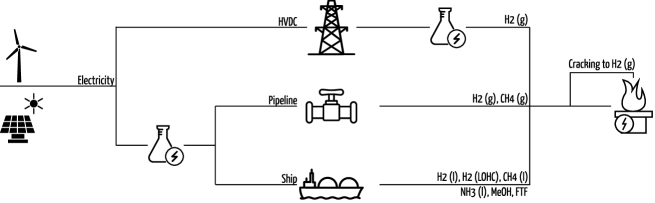
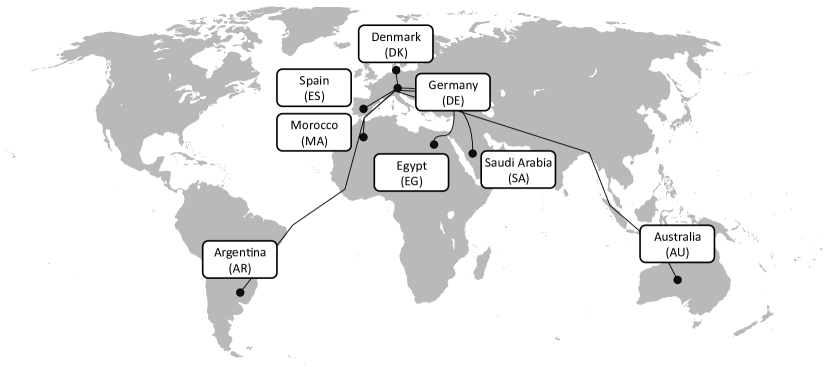
- 针对从七个全球地点向德国进口化学能载体,建立九种不同的能源供应链示例(ESC配置)。
- 应用技术经济模型,计算每单位氢气和所输送能量的平准化能源成本(LCOE),涵盖合成、运输及基础设施成本。
- 对管道(氢气)和船舶(液态载体)运输进行详细建模,考虑能量损失、蒸发损耗、装卸时间及往返效率。
- 为合成工厂实施强制运行约束,确保所有时间点均维持最低运行容量,以反映工业过程的技术要求。
- 采用模块化框架,比较通过管道直接进口氢气与经由氨、甲醇或甲烷等间接路径进口的方案,包括转换损失与资本成本。
实验结果
研究问题
- RQ1哪些国际出口地区能为德国提供最低成本的可再生氢气、甲烷、氨、甲醇及费托合成燃料进口?
- RQ2通过管道直接进口氢气的成本与使用氨、甲醇或甲烷作为氢载体的间接路线相比如何?
- RQ3运输距离、基础设施类型(管道与船舶)以及能量损失对进口合成燃料总成本有何影响?
- RQ4对于复杂能源载体而言,遥远的出口国(如北非、南美洲)是否相比更近的欧洲或北美供应商具有成本优势?
- RQ5在转换过程中产生的资本成本与能量损失在多大程度上影响了间接氢供应链的整体成本效益?
主要发现
- 对于每种化学能载体,至少存在一条国际进口路线的成本低于德国国内生产的氢气,且无单一国家或载体在成本上占据绝对主导地位。
- 最低成本的氢气进口方式是通过管道从丹麦、西班牙或北非进口,2050年在每千瓦5,000欧元资本成本假设下,成本为36–42欧元/兆瓦时LHV(或1.0–1.3欧元/公斤H₂)。
- 对于氨、甲醇及费托合成燃料等复杂载体,来自北非的进口成本低于来自更近的欧洲或北美供应商,主要因可再生电力成本更低。
- 与经由氨、甲醇或甲烷的间接路径相比,通过管道直接进口氢气更具成本效益,主要由于资本投入更低,且避免了多次转换步骤带来的能量损失。
- 液态氢和氨的海运效率显著受蒸发损耗和往返物流影响,调整后的出港时间已计入空载期,以维持年度往返频率。
- 本研究的模型与数据以开放许可证发布,支持未来能源系统规划与政策分析中的再利用与改编。
更好的研究,从现在开始
从阅读论文到最终审阅,大幅缩短您的研究时间。
无需绑定信用卡
本解读由 AI 生成,并经人工编辑审核。