
[论文解读] Improved motif-scaffolding with SE(3) flow matching
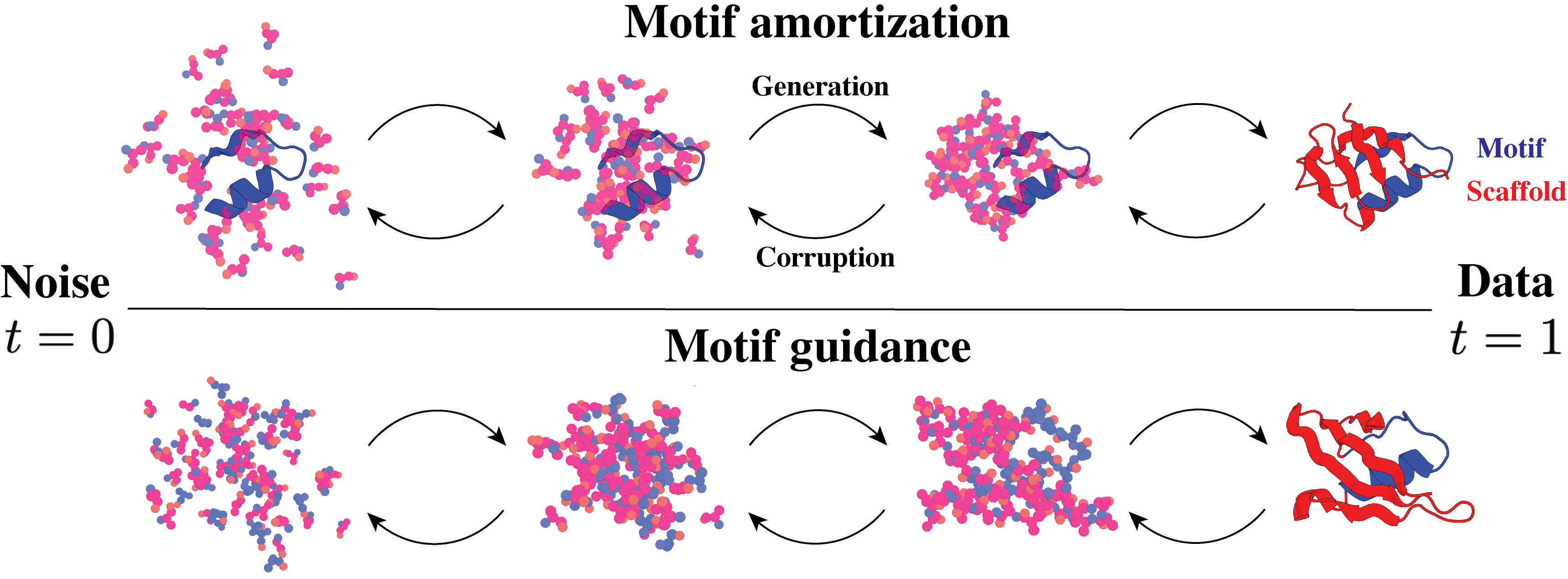
本论文在 FrameFlow 中引入基于 motif 条件的摊销与 motif 指导,以执行 motif-scaffolding,在保持对 RFdiffusion 的强设计性同时实现更高的支架多样性。
Protein design often begins with the knowledge of a desired function from a motif which motif-scaffolding aims to construct a functional protein around. Recently, generative models have achieved breakthrough success in designing scaffolds for a range of motifs. However, generated scaffolds tend to lack structural diversity, which can hinder success in wet-lab validation. In this work, we extend FrameFlow, an SE(3) flow matching model for protein backbone generation, to perform motif-scaffolding with two complementary approaches. The first is motif amortization, in which FrameFlow is trained with the motif as input using a data augmentation strategy. The second is motif guidance, which performs scaffolding using an estimate of the conditional score from FrameFlow without additional training. On a benchmark of 24 biologically meaningful motifs, we show our method achieves 2.5 times more designable and unique motif-scaffolds compared to state-of-the-art. Code: https://github.com/microsoft/protein-frame-flow.
研究动机与目标
- 通过将 SE(3) 流匹配扩展为两种策略:motif 摊销和 motif 指导,以改进 motif-scaffolding。
- 在基于 PDB 的 motif-scaffolding 基准上比较有条件(摊销)和无条件(指导)方法。
- 证明 FrameFlow 变体在设计性等同或更好且支架多样性更大的情况下优于 RFdiffusion。
- 证明轻量级 FrameFlow 模型所需参数和训练资源少于当前最先进方法。
提出的方法
- 通过对给定 motif 引入条件来扩展 FrameFlow,以在其周围生成支架(motif 摊销)。
- 通过使用无条件 FrameFlow 模型(无需额外训练)将采样轨迹按 motif 条件来引导,开发 motif 指导。
- 通过黎曼流匹配对 SE(3) 主干表示建模,使用对平移和 SO(3) 旋转分解的向量场。
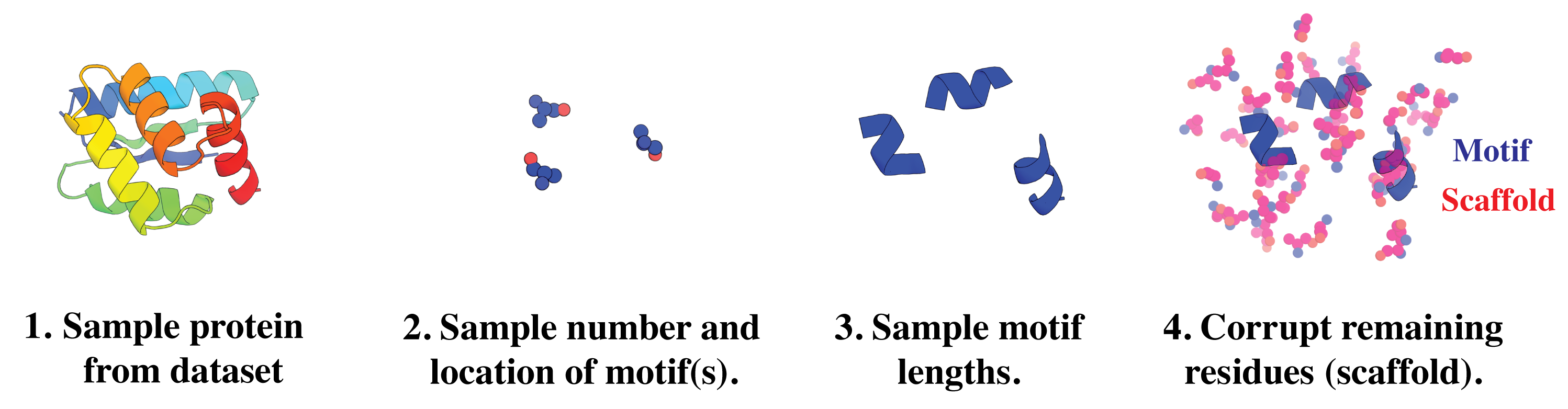
- 用 motif 数据增强来训练 motif 摊销 FrameFlow,以模拟来自未标记 PDB 的 motif 分布。
- 使用 500 步的 Euler-Maruyama 采样进行生成,并使用设计性和多样性指标进行评估。
- 在 motif-scaffolding 基准上与 RFdiffusion 和 TDS 进行比较。
实验结果
研究问题
- RQ1 motif 摊销 或 motif 指导 是否 能 在 SE(3) 流匹配 下 提升 motif-scaffolding 相对于先前的最先进 方法(RFdiffusion)的性能?
- RQ2有条件(摊销)与无条件(指导)方法在设计性和支架多样性方面有差异吗?
- RQ3FrameFlow 是否在保持轻量且可训练的前提下,为每个 motif 提供更多独特且具设计性的支架?
- RQ4无条件骨架结果如何支持 FrameFlow 指导下 motif-scaffolding 的可靠性?
主要发现
- FrameFlow 具备 motif 摊销 在基准上解决 21 个 motif,RFdiffusion 为 20。
- FrameFlow-指导 解决 20 个 motif,达到 RFdiffusion 的性能。
- 在所有 motif 上,FrameFlow 方法比 RFdiffusion 提供了约 2.5 倍的独特且可设计的支架。
- 无条件 FrameFlow 在设计性上与 RFdiffusion 相当,同时实现更高的多样性和新颖性。
- FrameFlow 条件化方法使用的网络规模比 RFdiffusion 小 3 倍(16.8M vs 59.8M 参数)且无需预训练。
- 与 RFdiffusion 和 TDS 相比,FrameFlow 的 motif-scaffolding 在总体上实现了更大规模的支架多样性。
更好的研究,从现在开始
从阅读论文到最终审阅,大幅缩短您的研究时间。
无需绑定信用卡
本解读由 AI 生成,并经人工编辑审核。